
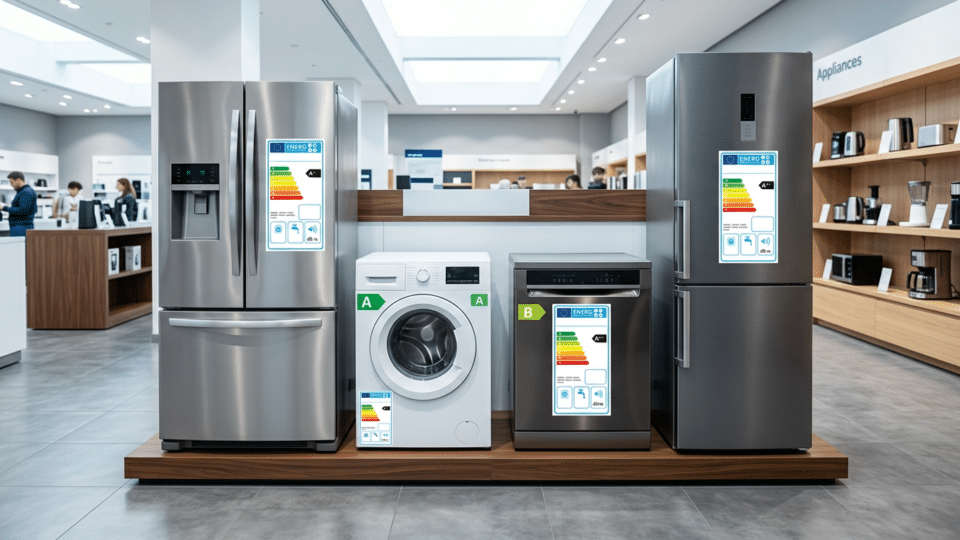
On 1 October 2026, the European Commission sent Romania a supplementary letter of formal notice over the insufficient enforcement of EU rules on ecodesign and energy labelling. For shoppers, the issue is not an immediate ban on refrigerators, televisions or air conditioners, but how effectively the information they see before paying is checked. In this context, oversight of energy labels is central to consumer protection.
According to the decision published by the European Commission, Romania has not fully met its market-surveillance obligations under Regulation (EU) 2019/1020. The Commission also said that the announced legislation to designate market-surveillance authorities in this area had not been adopted.
For more information on the European Commission, see also Road safety in Romania: real progress and a wide gap with the EU average, which provides complementary details on this subject.
In brief: the Commission’s document does not find that all appliances sold in Romania carry false labels, nor does it say their sale has been suspended. This is an administrative stage in an infringement procedure. Romania has two months to respond and take action; if its response is not considered satisfactory, the Commission may move to the next stage, a reasoned opinion.
What the Commission alleges — and what the notice does not say
An energy label is standardised information that allows products in the same category to be compared, including by energy consumption, capacity, noise level or other relevant parameters. Its value depends on several links in the chain. The supplier must declare the data accurately, the retailer must display it, and national authorities must be able to check whether these obligations are being met.
The European procedure concerns this last link: market surveillance. The European regulation on product surveillance requires Member States to designate authorities with appropriate powers and resources, and to carry out checks proportionate to the risk. These may begin with documents and information from online sales, but can also include physical inspections and laboratory tests. The legal framework is set out in Regulation (EU) 2019/1020.
The accurate description, therefore, is that Brussels is asking Romania to demonstrate effective market surveillance. It does not automatically follow that an appliance currently carrying an energy label in a shop is non-compliant, nor that a household’s electricity bill can be directly inferred from this procedure.
Energy-label checks: what Romania has adopted
Order No. 1,235/2026 of the Minister of Energy, signed a day earlier, was published on 16 October 2026. It approves a national monitoring and verification plan, as well as an action plan for market surveillance in the field of energy labelling.
The plan describes scrutiny broader than a conventional shop inspection. Products and economic operators are to be selected on a risk basis, including through complaints, compliance history and information from European databases, among them EPREL, ICSMS and Safety Gate. It provides for documentary and visual checks, inspections at points of sale, verification of online offers and preservation of digital evidence.
Where technical verification is warranted, the plan provides for products to be tested by accredited laboratories or other competent technical bodies, subject to available funding. This is the important distinction between noting that a label is missing or displayed incorrectly, and establishing through testing that a product’s declared performance does not meet the applicable requirements.
A plan is not yet a record of inspections
The plan includes internal deadlines: 60 days to approve and implement the operational procedure, 90 days to make cooperation with the National Authority for Consumer Protection operational, and 180 days to establish a functioning testing mechanism. These deadlines do not mean checks cannot take place before they expire, but they indicate that the inspection infrastructure was still being organised.
As of the reporting date, 7 November 2026, no public data had been identified showing how many inspections had been carried out under the new plan, how many products had undergone testing, what non-compliance had been found, or what corrective measures had been imposed. The plan also refers to testing subject to available funding, without specifying a concrete budget for it in the text consulted.
That is the difference between the existence of an administrative mechanism and evidence that it works: public reports, numbers of checks and products tested, withdrawals or corrections of information, and, where the law permits, sanctions imposed.
Who is responsible for the information on a label
European rules do not place all responsibility on the state. Under Regulation (EU) 2017/1369, suppliers must ensure the accuracy of labels and product information sheets, and retain the technical documentation needed to assess compliance.
Retailers have obligations of their own. They must display the energy label visibly and make the product information sheet available, including in distance sales. An incomplete product page or a missing in-store label can therefore be a separate issue from a situation in which a laboratory verifies an appliance’s technical performance.
The state must be able to follow the entire chain. An inspection may compare the model on display with data supplied by the manufacturer, the online offer and the European product database. Where signs of non-compliance emerge, technical documentation and, when necessary, physical or laboratory verification become relevant.
What buyers can check before buying
An energy label remains a useful tool, even though Romania needs to strengthen market controls. It allows similar products to be compared under standardised testing conditions. It is not, however, an exact promise of consumption in every home: use, ambient temperature, load, the programme selected and running time can all alter actual consumption.
For a basic check, buyers can take a few simple steps:
- note the brand and exact model code, rather than only the trade name;
- compare the energy class and parameters on the label with the product information sheet supplied by the retailer;
- look up the model in EPREL, the European energy-labelling registry, where public data are available for products covered by the system;
- keep a screenshot of the sales page and commercial documents if information is missing, contradictory or changes;
- compare appliances in the same category and of similar size or capacity, rather than only the letter on the label.
EPREL helps users check that a model exists and compare declared data. However, the database is not an independent laboratory separately confirming the performance of every appliance sold. That requires effective market surveillance and, where there is justified suspicion, technical testing.
Why online sales also matter
A significant part of appliance purchasing decisions is made before the product is seen in person. This is why the Romanian plan includes checks on online offers and the preservation of digital evidence. For an inspection, the product page, advertisement, photograph of the label, stated model, technical sheet and the time at which the information was published may all be relevant.
Such checks are particularly important where information on a website is incomplete or differs from what is shown in a shop. For consumers, a page without the required label or product information sheet does not by itself prove that an appliance uses more energy than declared, but it is a sign that the information needed for a comparative choice is not being presented properly.
What to watch after Romania responds to the Commission
The two-month deadline announced on 1 October points broadly to the beginning of December 2026, although the precise procedural calculation rests with official communication between the Commission and the Romanian state. Until a new public decision is issued, it cannot be said that the case has been closed or that Romania has fully remedied the issues identified.
The relevant indicators will not be limited to the adoption of new documents. More useful to the public will be clear answers to specific questions: which authorities have defined powers, how many checks they have carried out, what types of products were inspected, how many were tested, what shortcomings were found, and what action followed.
Until then, the energy label should be viewed as an official benchmark for comparison, rather than the sole purchasing criterion. The exact model, the product information sheet and a check in EPREL give consumers a better basis than a quick comparison of a single letter on the label.
Frequently asked questions
Does the EU notice mean appliances in Romania are banned?
No. The supplementary letter of formal notice concerns how Romania monitors the market and enforces European rules. It does not impose a general ban on the sale of appliances.
Does an energy label show exact consumption in my home?
No. The label compares products under standardised conditions. Actual consumption also depends on use, settings, load, temperature and running time.
What can I check in EPREL?
The European EPREL database provides public information, including the product information sheet, on models covered by energy-labelling rules. The data help with comparisons but do not replace independent testing of every appliance.
Who must display the energy label in online sales?
EU rules require retailers to display the label visibly and provide the product information sheet, including in distance sales, for products covered by these requirements.
Sources consulted
- European Commission — October infringements package: key decisions on energy, 1 October 2026
- Regulation (EU) 2019/1020 on market surveillance and product compliance
- Regulation (EU) 2017/1369 establishing a framework for energy labelling
- European Commission — EPREL, the European Product Registry for Energy Labelling
- Official Gazette No. 868 of 16 October 2026 — Order No. 1,235/2026 of the Minister of Energy, consulted PDF copy
Read also: Romania needs to strengthen its rules for offshore operations






Discuția cititorilor
Ai o opinie sau o întrebare despre acest articol? Spune-ne ce crezi.
Fii primul care deschide discuția.
Te rugăm să păstrezi un limbaj civilizat și să discuți la subiect. Comentariile spam sunt filtrate automat.