
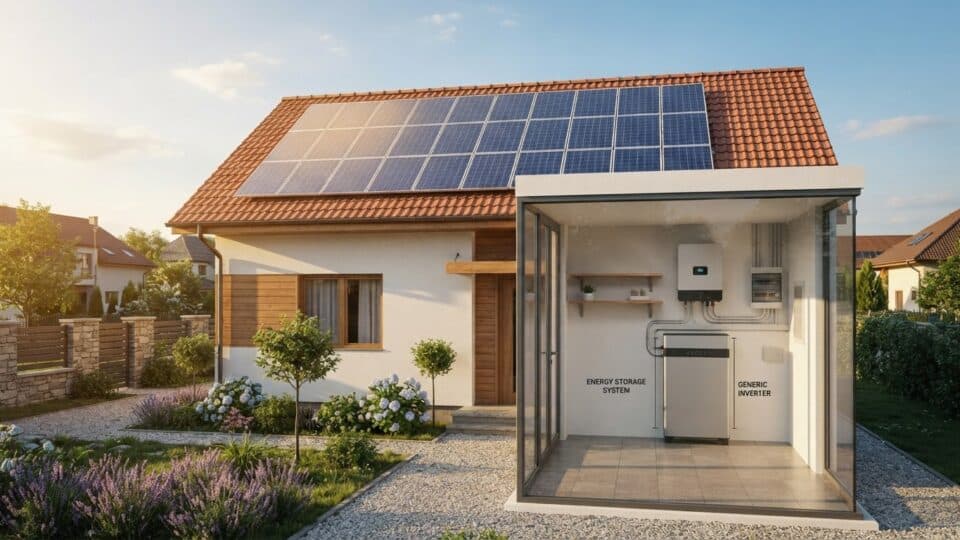
Solar panels with batteries or without in 2027? The question can no longer be answered properly simply by comparing annual generation with the electricity bill. What matters is when each kilowatt-hour is consumed, what surplus electricity fed into the grid is worth, what storage costs to install, and what happens after net metering ends at the close of 2030.
Interest is also borne out by the Environmental Fund Administration (AFM) figures of 26 November 2026: 56,944 applications for storage systems, totalling more than 803.5 million lei, against a budget of 400 million lei. At the same time, ANRE Order No. 67/2026 changed the rules governing prosumers’ billing and the monetisation of electricity. InfoBuz compares four solar-system capacities, three battery capacities and the financial results over 10 and 15 years, using a transparent model adapted to a household in Dobruja. It does not assume that every kWh generated is worth as much as a kWh bought from the grid.
Solar panels in 2027: what 3, 5, 8 and 10 kWp systems cost
The panels’ nominal power, expressed in kWp, describes their output under standard test conditions. Inverter power, in kW, denotes a conversion limit, while battery capacity, in kWh, indicates the energy that can be stored. An 8 kWp system with a 6 kW inverter and a 10 kWh battery does not contain three components serving the same function. Sizing must be checked against voltage, current, approved power and equipment compatibility.
A November commercial overview of quotes by Instalatori Fotovoltaice shows wide variation in prices for 5 kW installations, depending on the inverter, installation work and battery. Another inventory, published by Economisi.ro using prices collected on 29 October, provides benchmarks for 3, 8 and 10 kW systems as well. The SolarSud price list also illustrates differences between equipment brands and configurations. These are listed prices, not bespoke quotations for the same home.
| Panel capacity | Modelled annual generation | Hypothetical upfront investment, without battery | 500 W panels |
|---|---|---|---|
| 3 kWp | 3,900 kWh | 13,500 lei | 6 |
| 5 kWp | 6,500 kWh | 20,000 lei | 10 |
| 8 kWp | 10,400 kWh | 29,000 lei | 16 |
| 10 kWp | 13,000 kWh | 35,000 lei | 20 |
A full quotation should specify the panels and their combined capacity, inverter, mounting structure, electrical protection, cabling, labour, grid-connection documentation, commissioning and warranties. Roof-strengthening work, alterations to the electrical panel, a power-capacity increase or conversion to three-phase supply can substantially change the cost. VAT and equipment availability should be confirmed in the written offer. No subsidy for the new system is assumed.
How much panels generate in Dobruja: the crucial difference between summer and winter
The European Commission Joint Research Centre’s PVGIS platform can estimate generation according to location, orientation, tilt, technology and system losses. Its output is a climate estimate, not an exact forecast for a particular year. For Constanța, a public overview based on PVGIS 5.3 indicates 1,318 kWh/kWp per year for a south-facing system at a 35-degree tilt and with 14% losses.
| Period | 5 kWp – estimated generation | Approximate daily average |
|---|---|---|
| January | 310 kWh | 10.0 kWh |
| February | 355 kWh | 12.7 kWh (28 days) |
| March | 535 kWh | 17.3 kWh |
| April | 640 kWh | 21.3 kWh |
| May | 735 kWh | 23.7 kWh |
| June | 730 kWh | 24.3 kWh |
| July | 790 kWh | 25.5 kWh |
| August | 795 kWh | 25.6 kWh |
| September | 640 kWh | 21.3 kWh |
| October | 480 kWh | 15.5 kWh |
| November | 305 kWh | 10.2 kWh |
| December | 275 kWh | 8.9 kWh |
| Total | 6,590 kWh | 18.1 kWh |
In this example, August generates almost three times as much as December. A 16 kWh battery does not generate additional electricity: it shifts some available generation to another time. If panels produce only 5 kWh on a winter day and the home uses 12 kWh, there is not enough solar energy to fully charge a large battery, even if it is empty. On a summer day with 30 kWh of generation and 10 kWh of direct consumption, there is more surplus, but useful storage is also limited by subsequent demand.
You can also consult InfoBuz’s separate Constanța solar potential module for a local benchmark. When sizing a system, request an individual roof simulation and consider shading, temperatures, multiple orientations and any export limits. An annual estimate alone cannot determine self-consumption.
What has changed for prosumers: monthly compensation and 2031
The new methodology, approved by ANRE Order No. 67 of 10 November 2026, was published in Official Gazette No. 946 of 13 November. An ANRE statement explains the new monthly mechanism, options for surplus electricity and implementation deadlines. The text of the methodology, particularly Articles 13–18, sets out how settlement quantities and values are determined. Suppliers must complete their adaptations by 31 December 2026, according to the authority’s statement.
For eligible installations of up to 200 kW, quantity-based compensation continues until 31 December 2030. From 1 January 2031, the legislative framework allows prosumers to request monetisation of electricity delivered at the weighted average price on the day-ahead market, subject to the law’s conditions. This change matters for an investment made in 2027 whose useful life extends beyond 2030. The legislation may subsequently change.
Under the current framework, the settlement price for exported electricity starts from the active-energy price in the contract, subject to exclusions provided by law. It is not the same as the final price, including VAT, distribution and other components, charged for electricity taken from the grid. Nor does quantity-based compensation for the same number of kWh guarantee a zero bill. The value of surplus electricity may be used or paid out in accordance with regulated options and deadlines. Practical details are explained in InfoBuz’s guide to value allocation for prosumers.
In this model, the final import price is rounded to 1.20 lei/kWh, close to the benchmark in Viitor Hidro’s official Dobruja offer from November, examined in the article on bill components. For exported electricity, the model assumes 0.50 lei/kWh in 2027–2030. After 2030, it tests a 0.25 lei/kWh scenario. Both export-price figures are assumptions, not confirmed tariffs for those years. All revenue or credits related to surplus electricity are assumed to be fully realised, with no payment delays.
Which system size pays back without a battery?
The model considers a household using 6,000 kWh per year, with a mixed load profile and some daytime demand. The four installations are compared for the same household. The amount directly consumed from generation is a distinct assumption for each capacity, not a universal percentage. It assumes that the remaining generation is accepted by the grid and monetised at the modelled price. Each system includes an annual allowance of 250 lei for routine maintenance.
| Capacity | Direct consumption | Annual export | Net benefit in year 1 | Simple payback |
|---|---|---|---|---|
| 3 kWp | 1,900 kWh | 2,000 kWh | 3,030 lei | 4.5 years |
| 5 kWp | 2,400 kWh | 4,100 kWh | 4,680 lei | 4.3 years |
| 8 kWp | 3,000 kWh | 7,400 kWh | 7,050 lei | 4.1 years |
| 10 kWp | 3,300 kWh | 9,700 kWh | 8,560 lei | 4.1 years |
If the export value fell to 0.25 lei/kWh, under the same generation and direct-consumption conditions, the 5 kWp system’s annual net benefit would drop to 3,655 lei, while that of the 10 kWp system would fall to 6,135 lei. If surplus electricity cannot be monetised, larger systems no longer have the economic advantage shown in the table. Do not install additional capacity merely because there is room on the roof: assess grid capacity, future consumption and the economic risk of selling surplus output.
5, 10 and 16 kWh batteries: how much energy is actually used?
The analysis continues with the 5 kWp system, which hypothetically produces 6,500 kWh a year. Without a battery, the household directly uses 2,400 kWh, buys 3,600 kWh from the grid and exports 4,100 kWh. A battery can shift electricity that would have been exported to hours when the home would otherwise buy electricity. It assumes 90% round-trip efficiency, calculated at the same system energy boundary. The energy entering storage is greater than the energy returned.
| Nominal capacity | Annual energy delivered by battery | Annual imports | Annual exports | Annual storage losses | Local consumption coverage |
|---|---|---|---|---|---|
| No battery | 0 kWh | 3,600 kWh | 4,100 kWh | 0 kWh | 40% |
| 5 kWh | 1,200 kWh | 2,400 kWh | 2,767 kWh | 133 kWh | 60% |
| 10 kWh | 1,800 kWh | 1,800 kWh | 2,100 kWh | 200 kWh | 70% |
| 16 kWh | 2,100 kWh | 1,500 kWh | 1,767 kWh | 233 kWh | 75% |
Increasing capacity from 5 to 10 kWh provides a further 600 useful kWh a year in the model, while moving from 10 to 16 kWh adds only 300 kWh. A household with little nighttime consumption or insufficient solar surplus will not fully use the additional capacity. A personalised calculation requires at least 12 months of data, ideally hourly or 15-minute measurements. A smart meter, inverter data and consumption history together provide more relevant information than the total on an annual bill.
Battery payback: do not count the same electricity twice
The additional value of a kWh returned by the battery is the final price of the avoided import, minus the value of the electricity that can no longer be exported to obtain that kWh. At 90% efficiency, around 1.111 kWh of surplus is needed for every kWh delivered to consumption. At the assumptions of 1.20 lei/kWh for imports and 0.50 lei/kWh for exports, the gross marginal gain is about 0.644 lei per returned kWh. It is not 1.20 lei.
| Battery | Hypothetical additional cost | Additional net gain in year 1 | Battery simple payback | System annual net benefit |
|---|---|---|---|---|
| 5 kWh | 5,000 lei | 673 lei | 7.4 years | 5,353 lei |
| 10 kWh | 10,000 lei | 1,060 lei | 9.4 years | 5,740 lei |
| 16 kWh | 15,000 lei | 1,253 lei | 12.0 years | 5,933 lei |
The assumed costs include ordinary adaptations needed for a compatible configuration, but not every possible conversion job for an existing grid-connected inverter. In the market, the same capacity can be priced very differently depending on manufacturer, voltage, compatibility, warranty, installation and backup-power capability. An analysis of quotations for 10 kW systems from 13 November illustrates those differences. Battery price per kWh is not treated as the sole installation cost.
In the post-2030 scenario, with exports valued at 0.25 lei/kWh, every kWh returned by the battery would yield gross savings of about 0.922 lei. If exports had no value at all, the gross benefit would become 1.20 lei/kWh. Conversely, if exports were valued at 0.80 lei/kWh, the benefit would fall to about 0.311 lei/kWh. These examples show why profitability depends on the difference between tariffs and battery losses, rather than electricity becoming more expensive alone.
A 10- and 15-year simulation: what happens after 2030?
The model calculates cash flows for a system installed at the beginning of 2027 in four configurations. It keeps imports at 1.20 lei/kWh in constant lei and uses exports of 0.50 lei/kWh in 2027–2030, then 0.25 lei/kWh from 2031. For the solar installation without storage, it reduces generation and associated benefit by 0.5% each year, while the additional annual energy shifted through the battery falls by 2% a year. These are simplified calculation assumptions, not technical guarantees. The annual maintenance allowances described above are retained.
Net present value (NPV) subtracts the upfront investment from the sum of future net benefits, discounted at a real rate of 5% a year. Savings achieved in 10 years are therefore not treated as equivalent to the same sum saved today.
| 5 kWp configuration | Total investment | Undiscounted net balance at 10 years | NPV at 10 years | Undiscounted net balance at 15 years | NPV at 15 years |
|---|---|---|---|---|---|
| No battery | 20,000 lei | 19,752 lei | 11,221 lei | 36,888 lei | 20,335 lei |
| With 5 kWh | 25,000 lei | 22,580 lei | 12,180 lei | 43,560 lei | 23,342 lei |
| With 10 kWh | 30,000 lei | 21,995 lei | 10,545 lei | 45,146 lei | 22,864 lei |
| With 16 kWh | 35,000 lei | 19,202 lei | 7,228 lei | 43,439 lei | 20,125 lei |
In the 15-year model, the 10 kWh battery delivers the largest undiscounted balance, but the 5 kWh battery achieves the highest NPV. At a 5% cost of capital, the smaller investment benefits from earlier savings. The difference between the NPVs of the 5 and 10 kWh battery options is only 478 lei, so a better commercial offer or a different consumption profile could change the ranking.
A hypothetical replacement of the 10 kWh battery at the beginning of year 11, costing 6,000 lei in real terms, would cut the 15-year NPV by about 3,683 lei to 19,181 lei, if it brought no benefit other than maintaining the cash flows already modelled. That figure would be below the NPV of the installation without a battery. The model does not predict replacement will be needed in year 11 or guarantee the future price of a battery; it tests the calculation’s sensitivity.
Autonomy, degradation and warranties: what a LiFePO4 battery buys
Nominal capacity is not the same as usable energy at the output. For a simplified example, the model assumes a usable window equal to 80% of nominal capacity and 95% discharge efficiency. Discharge efficiency is distinct from the round-trip efficiency used above. At a constant 500 W load, with no solar generation and no other consumption, this produces the following benchmarks.
| Nominal battery | Approximate AC energy available | Runtime at 500 W | Runtime at 2 kW |
|---|---|---|---|
| 5 kWh | 3.8 kWh | 7.6 hours | 1.9 hours |
| 10 kWh | 7.6 kWh | 15.2 hours | 3.8 hours |
| 16 kWh | 12.16 kWh | 24.3 hours | 6.1 hours |
In an outage, not every hybrid inverter and battery can automatically power an entire home. A compatible backup function and a professionally configured installation that correctly isolates the home from the public grid are required. Available power depends on the inverter, battery-management system, temperature and battery discharge limit. Check whether backup is single-phase or three-phase and whether it can supply essential loads. A backup system must not export electricity to a de-energised grid.
Before buying, read the warranty: the number of years, permitted total energy throughput, temperature conditions, charging limits, guaranteed remaining capacity and inverter compatibility. Degradation depends on both use and time. In the model above, the smaller battery would have about 316 equivalent cycles relative to 3.8 kWh of assumed usable capacity in the first year; the 10 kWh battery about 237; and the 16 kWh battery about 173. These are arithmetic ratios of annual energy delivered to assumed usable capacity, not BMS measurements or certified service lives.
Casa Verde Batteries: 56,944 applications and an oversubscribed budget
According to AFM data announced on 26 November and reported by News.ro and Digi Economic, the amount requested in the application round that closed on 25 November reached 803,547,692 lei. That is approximately 2.01 times the 400 million lei budget. Filing an application does not mean funding will be obtained, as selection follows scoring and eligibility rules.
The guide approved by Ministry of Environment, Waters and Forests (MMAP) Order No. 1,904/2026 and amended by Order No. 2,314/2026 provides funding of up to 75% of project value, capped at 15,000 lei, with limits on eligible expenditure. According to the updated guide summary, minimum capacity is 10 kWh and the maximum eligible standard is 1,500 lei/kWh. The programme targets prosumers with existing systems, not automatic funding for a new solar installation. Follow the AFM for official lists and the timetable. None of the sources consulted confirmed a new 2027 round.
If an eligible 10 kWh storage project cost 10,000 lei in full and actually received 75% funding, the beneficiary’s contribution would be 2,500 lei. Based on the model’s additional first-year saving of 1,060 lei, the contribution would pay back in around 2.4 years, compared with 9.4 years without a subsidy. The example does not determine the project’s score, eligibility or approval. Ineligible costs and inverter replacement, if needed, remain the beneficiary’s responsibility. Direct access to AFM documents could not be fully verified; the conditions are reported on the basis of the consistent sources cited.
InfoBuz assessment: which configuration is worth choosing in 2027?
For a household with mainly daytime consumption and access to a mechanism for monetising surplus electricity, a system without a battery may remain an efficient investment. For a family with high evening consumption, a small or medium battery can reduce imports and exposure to future prices. A 16 kWh capacity may make sense where autonomy and backup power are needed, there is sufficient surplus and substantial nighttime demand, or the investment receives approved funding. It does not make sense to choose it solely because it is the largest battery available.
Before deciding, measure daytime and nighttime consumption, check generation in every month, request at least two comparable quotations, calculate storage’s marginal benefit and test at least one unfavourable post-2030 price scenario. For existing systems, checking battery compatibility and installation cost is essential. Then decide separately whether the value of outage resilience justifies an investment larger than the one that pays back fastest. For an efficient home, correct sizing matters more than the maximum number of panels or batteries.
Original InfoBuz.ro analysis, documented on 29 November 2026. All costs and financial flows are hypothetical scenarios and do not constitute offers, promises of savings or individual investment recommendations. Monthly generation comes from a secondary PVGIS overview; the direct API was not accessible during this check. The ANRE methodology text was consulted through a legislative reproduction because the official portal returned an error. No hourly simulation of an actual home was carried out, while post-2030 prices and degradation are assumptions. The main image was generated using artificial intelligence.



Discuția cititorilor
Ai o opinie sau o întrebare despre acest articol? Spune-ne ce crezi.
Fii primul care deschide discuția.
Te rugăm să păstrezi un limbaj civilizat și să discuți la subiect. Comentariile spam sunt filtrate automat.