
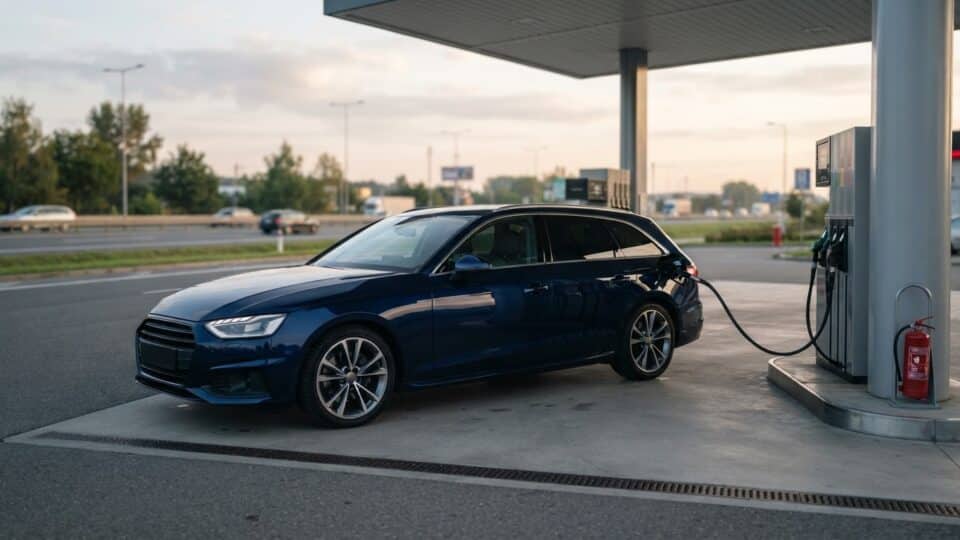
Diesel cars can still be a smart purchase in Romania in 2027, but they are no longer the default economical choice. High diesel prices, taxation based on emissions standards, the complexity of emissions-control systems and changes in the new-car market mean buyers need to run the full numbers before signing a contract.
The timing matters: on 29 November 2026, the Euro 7 regulation begins to apply to new types of passenger cars and light commercial vehicles. At the same time, the latest ACAROM figures show a 40.3% decline in new diesel registrations in Romania over the first 10 months of the year. These developments do not mean that a Euro 5 or Euro 6 diesel becomes unusable in 2027. They do, however, change how a car purchase—particularly a used one—should be assessed.
Diesel cars in 2027: what Romania’s car market tells us
According to ACAROM’s report published on 2 November 2026, 109,326 new passenger cars were registered in Romania between January and October, 10.1% fewer than in the equivalent period of 2025. The powertrain breakdown points to a strong move towards electrification, while conventional diesel engines have become a much smaller category.
| Powertrain, new passenger cars | Registrations in 10 months | Calculated share | Year-on-year change |
|---|---|---|---|
| Hybrid | 62,059 | 56.8% | +3.8% |
| Petrol | 18,475 | 16.9% | −34.9% |
| LPG | 13,078 | 12.0% | −20.2% |
| Battery-electric | 9,384 | 8.6% | +45.6% |
| Diesel | 6,330 | 5.8% | −40.3% |
At EU level, an ACEA report dated 24 November puts diesel’s share at 6.9% in the first 10 months of 2026, down from 9.2% in the same period of 2025. European registrations of electric and hybrid cars gained ground. New-car statistics, however, do not directly describe the existing vehicle fleet.
In Romania, ACAROM also reports 254,323 used passenger cars registered in the country for the first time over 10 months—around 2.33 times the number of new cars. This indicator does not include every transaction involving vehicles already registered in Romania. The report does not provide a fuel-type breakdown of all used-car transactions, so the decline in sales of new diesels cannot be used to estimate an identical fall in used-car demand or prices.
Euro 7 enters a new phase today: what it means for owners
EU Regulation 2024/1257, in its consolidated version of 23 September 2026, sets type-approval requirements covering pollutants, battery durability and other vehicle components. For passenger cars and light commercial vehicles, the requirements start applying to new vehicle types on 29 November 2026 and to the relevant new vehicles on 29 November 2027, subject to the regulation’s conditions and applicable exemptions.
A Euro 6 passenger car that has already been registered does not become Euro 7 simply because the timetable changes, nor does it automatically lose its right to be driven. Likewise, a Euro 5 car does not have to be scrapped solely because a more recent type-approval standard has been introduced. Owners must comply with road-use conditions, technical-inspection requirements and any local access rules.
Separately, the Council of the EU explains the rules on CO₂ emissions from new cars. The adopted framework sets a 100% reduction target from 2035 for the fleets of relevant new vehicles. In December 2025, the Commission proposed revising the target to 90%, with the remaining emissions offset through specific mechanisms. At the time of reporting, the proposal had not yet been adopted. These rules concern manufacturers and registrations of new vehicles; they are not a blanket ban on driving or reselling an existing diesel car in 2035.
| Milestone | What changes | Effect on an already registered diesel car |
|---|---|---|
| 29 November 2026 | Euro 7 for new M1/N1 types | Does not require an engine replacement or scrappage |
| 29 November 2027 | Euro 7 applies to the relevant new vehicles | Does not automatically invalidate existing type approval |
| 2028 | Planned full rollout of ETS2 | Possible indirect effect on fuel prices |
| 2035 | CO₂ targets for new cars; revision under discussion | Does not in itself ban the use of existing vehicles |
In Romania, Law No. 155/2023 on sustainable urban mobility regulates low-emission zones. These may include access restrictions and charges set by local authorities. Buyers should check the rules in the places where they regularly drive, including when travelling abroad. The information reviewed does not point to a general national ban on all diesel passenger cars from 2027.
Another factor is ETS2, the European emissions-trading system for fuels used in road transport and other sectors. The Council of the EU said on 9 October 2026 that preparations were under way for its full launch in 2028. Obligations are placed upstream, on fuel suppliers, rather than directly on each driver. The final effect at the pump will depend on the market and on how costs are passed on; the mechanism covers petrol as well as diesel. There is no fixed per-litre charge that can be added to an owner’s 2028 bill today.
Car tax: how much engine capacity and the Euro standard matter
From 1 January 2026, amendments to the Fiscal Code introduced by Law No. 239/2025 and Government Emergency Ordinance No. 78/2025 take account of both engine capacity and the emissions standard. Article 470 in the consolidated version consulted uses bands of 200 cc, or part thereof. The examples below are base calculations using the tax grid in force in 2026, used as a reference point for 2027 before any updates and local surcharges.
| Illustrative engine capacity | Euro 4 | Euro 5 | Euro 6 |
|---|---|---|---|
| 1,598 cc – 8 bands | 150.40 lei | 140.80 lei | 132 lei |
| 1,968 cc – 10 bands | 285 lei | 267 lei | 251 lei |
| 2,199 cc – 11 bands | 974.60 lei | 910.80 lei | 855.80 lei |
| 2,967 cc – 15 bands | 2,592 lei | 2,311.50 lei | 2,268 lei |
In the 1,968 cc example, the difference between Euro 5 and Euro 6 is only 16 lei a year under the basic grid. By contrast, moving from 1,968 cc to 2,199 cc for a Euro 6 vehicle increases the amount by 604.80 lei. That jump can materially affect an owner’s costs over several years. The same tax principle applies to conventional petrol passenger cars in the same engine-capacity category and with the same standard; diesel is not taxed separately under this formula.
The municipality of Constanța published its draft local-tax rules for 2027 on 4 November 2026. A draft should not be confused with a final decision. The actual amount must be checked in the taxpayer’s fiscal municipality and in the acts adopted for that year. InfoBuz has separately published an analysis of local taxes for 2027.
Diesel costs more than petrol: at what consumption level does it still pay?
Peko’s monitoring, published on 27 November, indicates a median price on 26 November of 8.92 lei per litre for standard petrol and 10.27 lei per litre for standard diesel, based on a sample of 1,399 filling stations. Diesel was therefore 1.35 lei per litre, or around 15.1%, more expensive. These are two benchmarks from the same day and methodology, not a forecast of prices next year.
For a petrol car using 7 l/100 km, fuel costs 62.44 lei per 100 km. A diesel must use less than about 6.08 l/100 km to cost less at the same prices. A diesel consuming 5.2 l/100 km is advantageous in this comparison, while one using 6.5 l/100 km no longer is. Calculations should use the real-world consumption of the vehicles being compared, not catalogue figures alone.
| Annual mileage | Diesel, 5.2 l/100 km | Petrol, 7 l/100 km | Full hybrid, 5.5 l/100 km |
|---|---|---|---|
| 10,000 km | 5,340 lei | 6,244 lei | 4,906 lei |
| 20,000 km | 10,681 lei | 12,488 lei | 9,812 lei |
| 30,000 km | 16,021 lei | 18,732 lei | 14,718 lei |
At 20,000 km a year, diesel saves around 1,807 lei compared with a conventional petrol car. In urban use, the comparison may be reversed: if the diesel uses 7.5 l/100 km, it costs 77.03 lei/100 km, versus 75.82 lei for a petrol car using 8.5 l/100 km. A full hybrid consuming 4.8 l/100 km would require around 42.82 lei/100 km. These differences illustrate the effect of driving conditions; models, temperatures and driving style can change the result.
Three-year total cost: why low fuel consumption does not guarantee savings
The purchase price is not entirely lost: the car retains a resale value. Total cost of ownership includes depreciation, fuel, taxes, maintenance, repairs and other recurring expenses. The following model compares three hypothetical used cars of a similar class, driven 60,000 km over three years. It is not a market valuation or a commercial offer.
| Component over 3 years | 2.0 Euro 6 diesel | 1.5 Euro 6 petrol | 1.5 full hybrid, over 50 g CO₂/km |
|---|---|---|---|
| Hypothetical purchase price | 45,000 lei | 42,000 lei | 56,000 lei |
| Hypothetical resale value | 30,000 lei | 29,000 lei | 39,000 lei |
| Depreciation | 15,000 lei | 13,000 lei | 17,000 lei |
| Fuel | 32,042 lei | 37,464 lei | 29,436 lei |
| Maintenance and repairs, hypothetical budget | 11,000 lei | 7,000 lei | 7,500 lei |
| Tax, basic grid held constant | 753 lei | 396 lei | 389 lei |
| Estimated total | 58,795 lei | 57,860 lei | 54,325 lei |
Under these assumptions, the diesel remains around 935 lei more expensive than the petrol car, despite saving more than 5,400 lei on fuel. The difference comes from depreciation, tax and the maintenance budget. To recover the hypothetical 6,357 lei gap in these costs, a fuel saving of 0.09036 lei/km requires around 70,350 km over three years, or 23,450 km annually. This is the model’s threshold, not a universal rule. A diesel bought substantially more cheaply, or one with an excellent service history, may have a much lower threshold.
Conversely, an additional repair costing 6,000 lei would absorb almost all the fuel savings accumulated over more than 66,000 km against the petrol car in the comparison. If the car needs such work, the total cost should be assessed rather than relying on the simple promise that a diesel engine uses little fuel.
What to check before buying a used diesel
A well-maintained car, even one with higher mileage, may be better value than one with an incomplete history. Checks should be carried out by a competent workshop, with the engine cold on first start and then at normal operating temperature, using diagnostics and a legal road test. An error code or an isolated reading is not always a diagnosis.
| System | What should be assessed | Why it matters |
|---|---|---|
| DPF – diesel particulate filter | Differential pressure, estimated loading, regeneration history, errors | Frequent regenerations may point to a usage, sensor or engine problem |
| EGR and engine cooling | Commanded and actual operation, temperatures, coolant loss | Incorrect temperature can affect consumption and regeneration |
| Injectors and fuel system | Cold start, fuel pressure, cylinder balancing, specialist checks | Correction values alone are not enough to condemn an injector |
| Turbocharger and intake | Requested versus actual pressure, sealing, oil consumption | A cracked hose can mimic an expensive turbo failure |
| SCR/AdBlue, where fitted | NOx errors, supply, dosing and warnings | Systems and costs differ between Euro 6 generations |
| Timing system, flywheel and transmission | Invoices, service intervals, noise and behaviour under load | Transmission repairs can radically alter the purchase budget |
The DPF should not be confused with a consumable that must be replaced at a set mileage on every model. Accumulated ash, engine condition, oil type and operating conditions all affect its lifespan. Removing the filter or disabling emissions-control systems is not a legal maintenance solution. European minimum requirements for roadworthiness testing classify the absence or clearly defective operation of manufacturer-fitted emissions-control equipment as a major deficiency for diesel engines. The actual inspection is carried out under the applicable national rules.
Also request the RAR Auto-Pass certificate. According to the Romanian Automotive Registry (RAR), the document is available online, has an official fee of 42 lei and is valid for 60 days. Depending on the available data, it may include odometer history, inspections, certain repairs and information on serious accidents. A certificate with no entries does not prove that the car has not had accidents or repairs, as the database may be incomplete. Before buying, request the documents and invoices, arrange an independent inspection and check that the VIN matches. See also InfoBuz’s analysis of maintenance and mileage.
Euro 5 or Euro 6? The choice also depends on where you drive
A Euro 5 diesel can be attractive on a limited budget if it has a good history, is technically compliant and suits the buyer’s routes. Euro 6 generally offers a more favourable outlook regarding emissions-based access restrictions, but not all subcategories and generations have the same characteristics. Not all Euro 6 cars use the same exhaust-treatment architecture. An additional SCR system entails maintenance, but can substantially reduce nitrogen oxide emissions under the conditions for which it was designed.
The emissions standard should be verified in the vehicle identity card, rather than inferred solely from the year of manufacture. Within a fixed budget, an unmaintained Euro 6 is not automatically a better choice than a verified Euro 5. For those who regularly drive in areas with strict restrictions, the advantage of a newer standard may become decisive. Research the rules at regular destinations before buying.
Resale value: a risk that cannot be calculated from new-car sales
Fewer new diesel cars on the market may have different effects on the used-car market. Demand from drivers who cover long distances may support certain models, while urban restrictions, engine-capacity taxation and repair costs may make others less attractive. The ACAROM statistics cited do not contain a series of transaction prices by model, mileage and powertrain that would justify a percentage depreciation forecast.
In the three-year scenario, selling the diesel for 25,000 lei rather than 30,000 lei would increase the total cost by 5,000 lei. If the car could be sold for 35,000 lei, the cost would fall by the same amount. This is why it is useful to compare listings for similar models and the time they take to sell, alongside a conservative estimate of residual value. Asking prices in listings are not, however, final transaction prices.
InfoBuz verdict: who does a diesel still suit in 2027?
For a driver covering more than 25,000–30,000 km a year, mostly outside cities, an efficient and properly checked diesel can remain a logical choice. For short journeys, frequent cold starts and annual mileage below 10,000–12,000 km, petrol or a full hybrid should generally be considered first. At intermediate mileages, the purchase price and condition of the car can completely reverse the comparison.
An owner who already has a well-maintained diesel does not need to replace it solely because Euro 7 has arrived. The cost of changing cars may outweigh any saving on fuel or tax. For buyers, the sound approach is to set a total budget, verify the Euro standard and history, calculate fuel use on their own routes and keep a reserve for repairs. Diesel does not disappear in 2027, but it becomes a choice that must be justified by how the car will actually be used.
InfoBuz.ro editorial analysis, researched on 29 November 2026. Statistics are those published for the periods indicated, while costs use November benchmarks and explicit assumptions. Taxes for 2027 depend on the applicable legislation and local decisions. We did not conduct fuel-consumption tests, collect individual workshop quotes or establish actual resale prices for specific models. The main image is an editorial illustration generated using artificial intelligence.


Discuția cititorilor
Ai o opinie sau o întrebare despre acest articol? Spune-ne ce crezi.
Fii primul care deschide discuția.
Te rugăm să păstrezi un limbaj civilizat și să discuți la subiect. Comentariile spam sunt filtrate automat.