
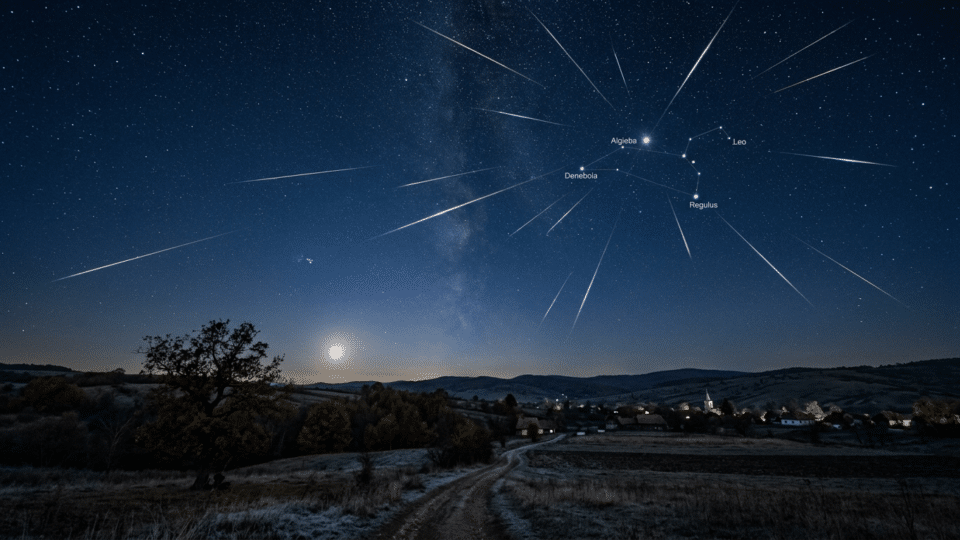
The November 2026 Leonids are worth approaching with two separate expectations. The first is astronomical: around the nights of 16–17 and 17–18 November, a clear, as-dark-as-possible sky may offer a chance to see meteors. The second is symbolic: time spent looking at the sky can be a useful exercise in attention and patience. It is not a way to predict what will happen in anyone’s life.
In brief: NASA and the American Meteor Society place the Leonids’ peak night in the 16–17 November 2026 window, while Timeanddate lists it as 17–18 November. For an observer in Romania, the practical conclusion is simple: check the sky on both nights, weather permitting. Visibility is not guaranteed, and the Leonids’ spectacular history does not mean that 2026 will bring a meteor storm.
Leonids in November 2026: what is known about the peak
The Leonids are associated with particles left in space by comet 55P/Tempel-Tuttle. When Earth passes through this debris field, the particles enter the atmosphere at high speed and burn up, leaving the bright trails known as meteors. The shower takes its name from its radiant—the point from which the trails appear to originate in the sky—which lies in the direction of the constellation Leo.
The radiant is a point of perspective, not the only place to look. Meteors can cross any part of the sky, and keeping your eyes fixed on Leo can make observing less comfortable and less effective. A broad area of sky, watched from a relaxed position, is generally the better choice.
For more astronomy information, see Weekly horoscope, 14–20 September 2026: bright Venus puts each zodiac sign’s wishes into perspective, which offers complementary details on this subject.
NASA and the American Meteor Society list Leonid activity from 6 to 30 November and highlight the night of 16–17 November. Timeanddate’s observing page lists the night of 17–18 November. The difference should not be treated as cause for concern: calendars may use different reference times and display conventions, and the moment of peak activity is not identical for every time zone or observing location.
For a realistic plan, the relevant window is therefore two nights. But do not turn that window into a promise of a particular number of meteors. Published estimates refer to favourable conditions, while what an individual actually sees depends on cloud, fog, artificial light, the horizon, the time of night and the time spent outdoors.
The Moon and realistic expectations for observing from Romania
In the calendar for Bucharest, the First Quarter is listed for 17 November 2026 at 13:47 local time. This means moonlight is a factor to consider around the peak, especially for fainter meteors. The American Meteor Society warns that the Moon can obscure such trails while it is above the horizon; the International Meteor Organization’s calendar, by contrast, considers significant interference near the peak unlikely.
These statements are not entirely at odds. The real effect depends on the time of observation, the Moon’s position and how dark the site is. More important than a debate over whether conditions are “good” or “bad” is not setting out with the idea of a guaranteed show. The Leonids have produced meteor storms at certain points in history, but specialist sources are not forecasting such an event for 2026.
From Romania, check the forecast close to the observing date. For a quick guide to local conditions, InfoBuz’s Romania weather page may be useful. In general, a clear night on the edge of a town or village will help more than a sky with good astronomical potential viewed from a heavily lit urban area.
Simple preparation, no telescope needed
The Leonids require neither a telescope nor binoculars. These instruments narrow the field of view, while a meteor can appear anywhere. What matters most is time, a safe location and the willingness to sit with your eyes raised without trying to control the outcome.
- Choose a location with as open a horizon as possible, away from direct lighting and traffic.
- Allow your eyes around 15–20 minutes to adjust to the dark; avoid your phone screen or turn its brightness down considerably.
- Watch a broad section of sky, not only the direction of Leo.
- Dress for staying still: cold quickly shortens patience, whatever the forecast says.
- Set aside at least an hour. A meteor shower does not work like a programme with effects on cue.
Responsible observing also includes one ordinary but important detail: do not stop in unsafe areas or watch the sky while driving. If you travel outside a built-up area, arrange transport in advance and stay somewhere you are permitted to be, without entering private property.
The zodiac as an exercise in reflection
In astrology, the constellation Leo can easily inspire symbols of self-expression or courage. Astronomy does not, however, say that people born under Leo—or any other zodiac sign—will see different meteors or have their destinies influenced by the Leonids. The sections below are for entertainment and offer a personal question, not a prediction about relationships, money, health or careers.
The shared idea for every zodiac sign comes from skywatching itself: you can wait, pay attention and still not immediately see what you hoped for. That does not make the time wasted. It simply means that some things do not follow the pace we would prefer.
Aries — what changes if you do not rush to a conclusion?
Choose a situation in which you felt the need to react immediately. While observing, note what information was missing at the time. A small gesture: delay for one day a response that has no genuine deadline.
Taurus — what is worth preparing before it becomes urgent?
Preparing for a cold night shows that comfort is not an indulgence but a condition for staying present. Your question: what modest resource—time, rest, order—would help you avoid functioning only in emergency mode?
Gemini — what do you notice when you do not fill the silence?
A lit screen can interfere with your eyes’ adjustment to the dark. As a symbolic exercise, put your phone aside for part of the evening. Notice which thought returns when you do not immediately distract yourself with a notification.
Cancer — where do you need a safe place to see more clearly?
Good observation begins with choosing a space where you feel safe. The question is not what you have to endure, but in which relationship, place or routine you can say more honestly: “Here, I can settle down.”
Leo — what remains valuable without applause?
The Leonids’ radiant bears Leo’s name, although meteors can appear anywhere in the sky. Use the detail as a metaphor, not an astrological rule: a contribution can matter even if it is not seen from the point where you expected it to be. Name a quiet piece of work you want to respect more.
Virgo — what is the difference between preparation and control?
You can check the weather, your clothes and your route, but you cannot order a meteor to appear. Choose a plan you can prepare well without trying to control every outcome. Write down one step that is genuinely within your reach.
Libra — who do you share the waiting with, without turning it into an obligation?
A night out under the sky can be more enjoyable with another person, but it becomes burdensome if everyone has to be enthusiastic in the same way. Ask yourself what an honest invitation looks like: one that also leaves room to decline.
Scorpio — what assumption could you check before believing it?
A bright point in the sky is not automatically a meteor; it may be an aircraft, a satellite or another object. Apply the rule to a personal situation: what fact do you need to check before giving a final interpretation to a silence, a message or a change?
Sagittarius — what broader direction is worth watching, not just the starting point?
The Leonids appear to come from one direction, but show up across the whole sky. For you, the question is: where are you following only one option too closely, even though opportunities or answers may appear elsewhere?
Capricorn — what can you be patient for without a guaranteed result?
An hour of observing cannot be judged only by the number of meteors seen. Choose a project worth continuing for its process, not only for quick validation. Set a realistic threshold of effort, not an impossible promise.
Aquarius — what becomes clearer when you reduce the noise?
In astronomy, city light can conceal subtle phenomena. In everyday life, noise may be digital, social or self-imposed. Identify one kind of noise you can reduce for an evening, without turning withdrawal into permanent isolation.
Pisces — what beautiful image needs to remain only an image?
The Leonids can inspire stories, but a story does not automatically become a fact. Your exercise is to hold on to an intuition or desire without forcing it to become evidence. What could you admire, for now, without drawing a conclusion about the future?
A successful evening is not measured only in meteors
There is a useful distinction between looking at the sky for a result and looking at it for the experience. If meteors appear, you have seen a phenomenon produced by comet particles entering Earth’s atmosphere. If none appear while you are watching, it does not mean you did anything wrong: observing conditions and natural variation matter.
As entertainment, the November 2026 Leonids can provide a small marker of rhythm in an already busy month. For a broader astrological reading of the period, compare this focused piece with the November 2026 horoscope for all zodiac signs. Keep the boundary clear, however: the sky offers phenomena to observe; the personal meaning you choose remains your own.
Frequently asked questions
When is the Leonids’ peak in 2026?
NASA and the American Meteor Society indicate the night of 16–17 November 2026, while Timeanddate lists 17–18 November. In Romania, it is worth watching the sky on both nights if the weather is clear.
Can the Leonids be seen with the naked eye?
Yes. No telescope or binoculars are needed. A dark location, a broad field of view and around 15–20 minutes for your eyes to adjust to the dark are more useful.
Will the Leonids be a meteor storm in 2026?
There is no forecast that justifies describing 2026 as a meteor-storm year. The Leonids have had spectacular historical episodes, but the number of meteors visible on a given night is not guaranteed.


Discuția cititorilor
Ai o opinie sau o întrebare despre acest articol? Spune-ne ce crezi.
Fii primul care deschide discuția.
Te rugăm să păstrezi un limbaj civilizat și să discuți la subiect. Comentariile spam sunt filtrate automat.