
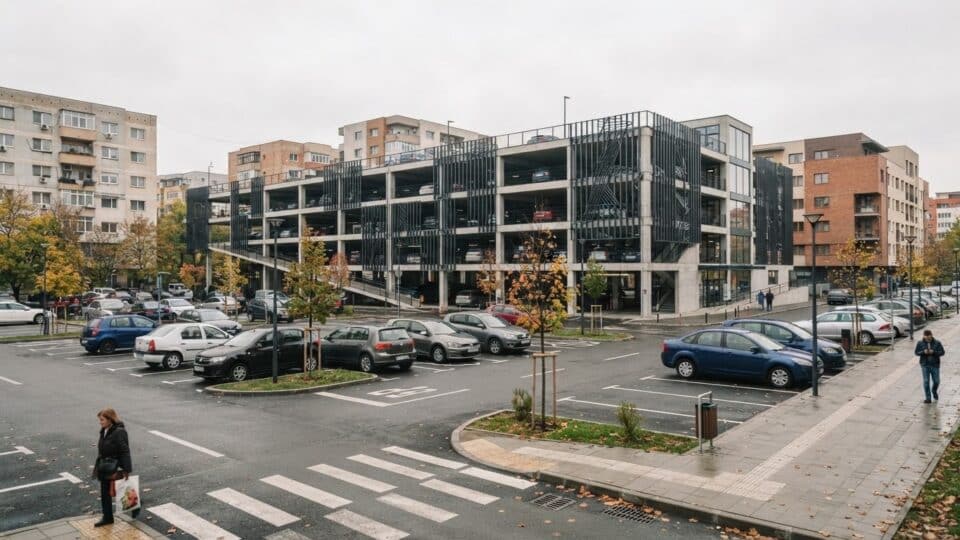
What does a public parking space cost in Romania? We examined four proposed multi-storey car parks in Constanța, estimated at RON 90.61 million excluding VAT, and a completed 516-space car park in Oradea. The striking result is that Constanța’s planned 616 spaces would replace roughly 293 existing ones, meaning just 323 net additional spaces. We calculate the cost per space, land used, maintenance and potential revenue over 10 years, separating verifiable public data from illustrative financial scenarios.
What does a public parking space cost? Why there is no single price
A rectangle marked in white paint may look like a simple investment. In reality, a parking space uses land, access infrastructure, drainage, lighting, signage and a maintenance system. A multi-storey car park also requires a structure, ramps, lifts, fire safety and technical equipment. Even an existing on-street space carries the economic cost of the public space it occupies, beyond the cost of the markings.
To compare projects in Romania, it is necessary to decide at the outset what “cost” means: the approved investment estimate, the signed contract, the final amount paid, operating costs or the value of the land. These are distinct figures. This study uses real documents from Constanța and Oradea, alongside financial scenarios clearly labelled as hypothetical; it does not claim to have audited the invoices of every local authority.
Three types of parking, three different cost structures
Surface parking involves preparing the land, road foundations, driving surfaces, markings and access. On-street parking occupies part of existing road infrastructure, where the effects on traffic lanes, buses, bicycles and pavements must also be considered. Multi-storey parking can accommodate more vehicles on a relatively small footprint, but requires an expensive structure and systems that need maintenance.
A fourth case, underground parking, can be even more complex because of excavation, groundwater, ventilation, fire protection and access ramps. No rule says one type will always be the cheapest in every locality. The choice depends on the site, mobility needs, planning rules, geotechnical conditions and the value of functions that could otherwise occupy the plot.
Real case: four proposed public multi-storey car parks in Constanța
Constanța Local Council Decision No. 458/2025 approves the feasibility study and technical-economic indicators for four multi-storey car-park projects: Progresului, the area near the Amicii kindergarten on Căpitan Dobrilă Eugeniu Street, the Dacia–Tomis III Market area, and Cireșica–Hortensiei Alley. The estimated total value of the four investments is RON 90,610,243.13 excluding VAT, or RON 109,638,394.20 including VAT, according to Article 2 of the decision.
The word estimated is essential. At a parking debate in September 2026, a City Hall representative said the studies for the four car parks had been completed, but construction funding had not been secured. The figures below are therefore not presented as money already spent or as car parks already opened. Sources: Local Council Decision No. 458/2025, including the feasibility-study annexes and Radio Romania Constanța, 17 September 2026.
The table that changes the comparison: 616 proposed spaces, only 323 net additional
The feasibility documentation shows 616 proposed spaces in total across the four sites and roughly 293 existing spaces on those plots. If the final configuration replaces those 293 spaces with the 616 proposed spaces, the capacity gain is 323 spaces. This is a major difference between the gross capacity of the four facilities and the number of spaces actually added to the city.
For the overall project, the estimated cost excluding VAT divided by 616 is about RON 147,095 for each space in the final capacity. Using only the 323 net additional spaces, the result rises to about RON 280,527 for each net new space. These are calculations derived by InfoBuz from official documentation, not invoiced prices. In practice, the number delivered must be verified after construction and formal acceptance.
| Constanța site | Existing spaces* | Proposed spaces | Net gain | Estimated cost excluding VAT |
|---|---|---|---|---|
| Dacia – Tomis III Market | ~79 | 177 | +98 | RON 23,389,727.76 |
| Cireșica – Hortensiei Alley | ~62 | 122 | +60 | RON 24,909,876.88 |
| Căpitan Dobrilă – Amicii kindergarten | ~67 | 180 | +113 | RON 26,702,117.04 |
| Progresului – KM 4–5 | ~85 | 137 | +52 | RON 15,608,521.45 |
| Total | ~293 | 616 | +323 | RON 90,610,243.13 |
Dacia, Cireșica, Căpitan Dobrilă and Progresului: how costs vary by site
The Dacia site proposes 177 spaces in place of around 79 existing spaces, at an estimated RON 23.39 million excluding VAT. Cireșica proposes 122 spaces in place of about 62, at RON 24.91 million. Near the Amicii kindergarten, 180 spaces are proposed in place of 67, at RON 26.70 million. On Progresului, 137 spaces are proposed in place of 85, at RON 15.61 million.
A simple ratio shows that the Cireșica project has an estimated investment cost of about RON 415,165 excluding VAT per net additional space, compared with around RON 236,302 at Căpitan Dobrilă. The differences may reflect the site, structural solution, equipment and the number of spaces being replaced; by themselves, they do not prove that a price is unjustified. The figures come from the same decision and technical-economic annexes.
| Site | RON per proposed space, excluding VAT | RON per NET new space, excluding VAT |
|---|---|---|
| Dacia | ~RON 132,145 | ~RON 238,671 |
| Cireșica | ~RON 204,179 | ~RON 415,165 |
| Căpitan Dobrilă | ~RON 148,345 | ~RON 236,302 |
| Progresului | ~RON 113,931 | ~RON 300,164 |
| Average across the four | ~RON 147,095 | ~RON 280,527 |
What a statistic can miss: a new car park often replaces old spaces
A project on a plot already used for parking may promise hundreds of spaces, but some replace existing capacity. Presenting only “177 spaces built” without saying that the site already held around 79 spaces overstates the net benefit to the city. The cost per gross space may suit comparisons between buildings, but the cost per net new space is more relevant when assessing whether a parking shortage is being reduced.
There are, however, benefits not captured by the net number: safer access, spaces reserved for accessibility, drainage, signage or the possibility of freeing pavements. Dividing the investment by 323 therefore does not, by itself, establish whether the project should or should not go ahead. The indicator must be read alongside service quality and other potential uses for the land.
Oradea: a completed 516-space car park near the County Hospital
One example of a completed investment is the multi-storey car park on Gheorghe Doja Street in Oradea, presented by the municipality at its opening on 30 September 2025. The building has 516 parking spaces, including 21 for people with disabilities, and a gross floor area of around 17,500 square metres, according to the announcement. The investment value announced at the opening was approximately EUR 12 million, funded from the local budget.
Dividing that approximate value by 516 gives around EUR 23,256 per space. This is an indicator derived from the total value announced, not a detailed invoice for an individual space. The car park also includes complex reinforcement works, access routes and electric-charging infrastructure. Comparison with the four Constanța proposals is indicative: this is an opened investment stated in euros, while those are feasibility estimates stated in lei. Source: Oradea City Hall, 30 September 2025.
From a RON 45.85 million contract to an announced investment of about EUR 12 million
In an earlier 2023 announcement, Oradea City Hall presented a construction contract for the car park near the hospital worth RON 45,854,744.67 excluding VAT. At the 2025 opening, it communicated an approximate total investment of EUR 12 million. The two figures may describe different scopes, dates and financial conditions; converting them into a single currency without the final contract, the appropriate exchange rate and complete annexes could be misleading.
We do not claim that the difference between these figures is “proven cost overrun”. A full check would require the final value of the construction contract, revisions, related works, design costs and payments. The initial contract presented by Oradea is a different source from the final announcement and must be read accordingly.
A space painted on the ground is not the same as a functional parking space
The rectangle occupied by a car is only one part of the facility. It needs manoeuvring aisles, access, visibility at entrances and exits, unobstructed pavements, space for people with reduced mobility and, in some cases, planted areas or separators. In multi-storey car parks, built area also includes ramps, structures, stairs, lifts and installations.
In Oradea, 17,500 square metres divided by 516 spaces equals around 33.9 square metres built per space. This figure is not the size of an individual parking bay, but a ratio that includes circulation and shared functions. Nor should it be applied without verification to a surface or underground project, where the configuration may differ.
Land provided free to City Hall is not necessarily free for the city
If land is already municipally owned, a project may not require an acquisition payment, but the plot still has economic value and possible alternative uses. Depending on planning rules, the same site could accommodate green space, a community facility, a school or a pedestrian scheme. The opportunity cost of land is what the community forgoes by choosing one function over another.
A rigorous report should present the budget’s actual expenditure separately from the estimated opportunity value. A hypothetical land valuation cannot be entered among payments made by City Hall. At the same time, describing a car park as “almost free” merely because the land was already public conceals a limited urban resource.
Which costs belong in the initial investment, and which may be in another contract?
The cost of a car park may include design and studies, documentation, permits, site preparation, demolition or relocation, foundations, asphalt or concrete, roofing, drainage, lighting, markings, fire safety, lifts, barriers, cameras and payment software. In a multi-storey structure, installations and long-term material protection can account for a substantial share.
Government Decision No. 907/2016 defines feasibility studies and the general estimate for public investments. An estimate is an estimated value for the project, not automatically equivalent to a construction contract or a final invoice. Read the estimate’s chapters and check whether land, utility connections and additional equipment are included before dividing the sum by the number of spaces.
Scenario 1: a 100-space surface car park with a hypothetical budget
Here is a financial example that is entirely hypothetical, not a verified Romanian estimate. We assume 100 spaces, a fit-out investment of RON 2 million, operating and maintenance expenditure of RON 180,000 a year, and an acquisition or opportunity value for the land of RON 2.5 million. Over 10 years, the fit-out expenditure plus operations would be 2 + 1.8 = RON 3.8 million, excluding land.
If the RON 2.5 million land value is included separately in the economic model, the total reaches RON 6.3 million over 10 years. The land value is not necessarily a payment made: in this example, it represents either a possible purchase or an estimate of the public resource occupied; the two interpretations must not be added together for the same land. VAT, financing, inflation, discounting, exceptional renewals and residual value are excluded.
Scenario 2: a 100-space multi-storey car park
For the same final capacity, we assume a hypothetical investment of RON 14 million and annual operating costs of RON 350,000. Over 10 years, the investment base plus operations is RON 17.5 million, excluding land, interest, discounting and other exceptional costs. Adding, separately, a hypothetical land value of RON 1 million produces RON 18.5 million in the simplified economic model.
The example does not claim that all multi-storey car parks in Romania cost RON 140,000 per space, nor that a surface car park of the same capacity is available in the same area. The structure’s advantage may be land saving: where 3,000 square metres are unavailable for surface parking, the real alternative is not necessarily to build the same capacity on the neighbouring plot.
Ten-year table: the investment does not end on opening day
Our model compares two hypothetical 100-space facilities. In this example, annual expenses are constant in nominal lei and no major repair investment is assumed. The table is useful for the calculation method, not as a basis for an actual procurement procedure, for which designers and economists must establish project-specific data.
A real investment needs scenarios for energy, staffing, IT contracts, structural repairs, inflation and service life. If evaluating financial viability, cash flows and a justified discount rate should be used, rather than simply adding 10 annual nominal budgets.
| Component, hypothetical example only | 100 surface spaces | 100 multi-storey spaces |
|---|---|---|
| Initial fit-out / construction | RON 2,000,000 | RON 14,000,000 |
| Annual operation and maintenance | RON 180,000 | RON 350,000 |
| 10-year operation | RON 1,800,000 | RON 3,500,000 |
| Capital plus 10-year operation, excluding land | RON 3,800,000 | RON 17,500,000 |
| Separate hypothetical land value | RON 2,500,000 | RON 1,000,000 |
| Simplified economic total, if land is included | RON 6,300,000 | RON 18,500,000 |
Parking revenue depends on paid hours, not only the number of spaces
A 100-space facility may be very busy at 10am and nearly empty at night. A space permanently occupied by an annual subscriber does not generate the same revenue as one used by several drivers paying by the hour. To calculate revenue from hourly charging, the relevant formula is spaces × chargeable hours × days × paid occupancy rate × effective realised tariff.
Example: 100 spaces × 10 chargeable hours/day × 300 days/year × 40% paid occupancy × a hypothetical RON 5/hour = RON 600,000 in gross revenue a year. This model excludes subscriptions, free parking, non-payment and fees, and does not represent the figures of an existing car park. It is important not to confuse the physical occupancy of a space with the hours actually billed and collected.
Sensitivity table: how revenue changes at 20%, 40%, 60% or 80%
Using the same imaginary 100-space car park, 10 chargeable hours a day and 300 days a year, we change only average paid occupancy. The illustrative rate remains RON 5 per hour. The differences show why a revenue estimate without demand measurements can turn a project into an optimistic calculation.
We do not interpret 80% as a recommendation to keep all spaces permanently full or to raise tariffs automatically. A public car park may serve access goals for visitors, patients and residents, sometimes with legally established free parking. High occupancy does not always mean high revenue if most spaces are reserved through low-cost subscriptions.
| Paid occupancy, scenario | Billable hours/year for 100 spaces | Gross revenue/year at RON 5/hour | Gross revenue over 10 years* |
|---|---|---|---|
| 20% | 60,000 | RON 300,000 | RON 3,000,000 |
| 40% | 120,000 | RON 600,000 | RON 6,000,000 |
| 60% | 180,000 | RON 900,000 | RON 9,000,000 |
| 80% | 240,000 | RON 1,200,000 | RON 12,000,000 |
Why a multi-storey car park is not automatically paid back by subscriptions
For the 100-space multi-storey scenario, 40% paid occupancy and gross revenue of RON 600,000 a year, subtracting RON 350,000 a year in operating costs leaves RON 250,000 a year before financing and major future investment. Compared with the hypothetical RON 14 million investment, a simple calculation suggests 56 years to recover it solely from that annual surplus, excluding land.
This would not be a complete realistic investment-recovery estimate, because repairs, demand, tariffs, costs and inflation change over decades. The point is to show why simply multiplying subscription fees by the number of spaces can create an illusion of rapid payback. A local authority may nevertheless justify the investment through hospital access or freed pavements, rather than commercial profit alone.
Parking tariffs in cities, and why they cannot be applied mechanically
In Bucharest, the public operator CMPB lists RON 5/hour for spaces and periods it regulates, alongside daily and subscription rates. In central Cluj, Cluj-Napoca City Hall lists, for example, RON 8/hour in Zone I and RON 3/hour in Zone II. These are tariffs published by those institutions, not national rates.
Such a comparison shows how strongly location influences potential income, but it does not establish what a new car park will collect. Residential facilities, barrier-controlled facilities, hospital car parks and those in tourist areas may have different schedules, restrictions and subscriptions. It is not sound to use the highest city-centre rate for every hour of the year in an outlying neighbourhood.
In Constanța, the reported shortfall does not automatically mean 90,000 drivers without a space
According to a 17 September 2026 report by Radio Romania Constanța, during a debate on parking regulations, the administration referred to around 130,000 cars and just over 40,000 public parking spaces in the municipality. The figures indicate serious pressure on public space, but they should not simply be subtracted to produce a count of drivers “without a space”.
Not all cars need a public space at the same time: some are parked on private property, in yards or garages, while paid spaces in commercial areas may be reused several times a day. A demand study should measure overnight residential parking, daytime occupancy, illegal parking and mobility alternatives by neighbourhood and time period.
The difference between residential parking and short-stay turnover parking
A space reserved for the same car all day may be useful to a resident, but it generates one parking service over a long period. In a hospital or retail area, a well-managed space can serve several visitors in succession. That is why the simple measure of “spaces per thousand residents” does not tell the whole story about accessibility.
Different policies require different rules: subscriptions, time limits, permits, time-based tariffs and real-time driver information. A central car park with permanently reserved spaces may fulfil a social purpose, but it will not have the same financial model as a turnover facility. Each project must be assessed according to the users it was designed to serve.
A parking space can save a pavement or remove it
If parking is created by taking over a pavement, the cost to pedestrians may not appear in the asphalt estimate. A person with a disability, a child in a pushchair or a pedestrian walking to school may be forced to navigate around cars. Conversely, a well-sited multi-storey car park can make it possible to clear pavements and reorganise the street.
For the context of real-world accessibility, InfoBuz documented a one-kilometre urban route for a wheelchair user. If an authority builds 100 new spaces, it is legitimate to ask for an assessment of the surrounding pavements and crossings as well. Public cost is not measured only by the number of cars that can be parked.
Adapted and free spaces: what Law No. 448/2006 says
Article 65 of Law No. 448/2006 provides that the relevant car parks must have adapted, reserved and marked spaces for people with disabilities, amounting to at least 4% of the total, but no fewer than two. Rights concerning the parking card and free parking apply under the law and its version in force.
These spaces require suitable dimensions and access routes, not merely a symbol painted on asphalt. In Oradea, the municipal announcement lists 21 spaces for people with disabilities out of 516. In an economic assessment, accessibility spaces are part of the public service; they should not be treated as a “revenue loss” to be removed to increase income.
Twenty millimetres of rain: the effect of an impermeable car park
A physical example helps explain drainage. Across a hypothetical area of 3,000 square metres, rainfall of 20mm deposits 60 cubic metres of water, or 60,000 litres. This is the volume of rain falling on the site, not the measured flow that must necessarily reach the sewer: actual runoff depends on infiltration, gradients, evaporation and surface type.
A well-designed car park may include channels, green areas, retention measures or permeable surfaces, subject to technical studies and conditions. If the plot was previously permeable, paving thousands of square metres may alter the water regime. InfoBuz has separately examined stormwater drainage and urban disruption caused by intense rain.
Urban heat and the cost of losing trees
A surface car park covered mainly with asphalt can accumulate heat in summer and reduce shade or vegetation if it replaces green land. A multi-storey car park may have a different ground footprint, but it still affects the landscape and may create local heat-island effects. The impact depends on materials, orientation, vegetation and spatial layout.
We do not assign an invented number of degrees Celsius to each Romanian car park. A real comparison would require surface and air temperatures to be measured at comparable points, at the same times and under the same weather conditions. A scheme with shade, trees and stormwater management can mitigate some effects without removing the need for parking spaces.
Parking near a hospital: why the investment is not judged by profit alone
A car park next to a hospital can reduce the search time for relatives and organise access for ambulances, staff and patients. Oradea linked the investment near the County Hospital to the need for parking spaces and the reconfiguration of access. These benefits matter even if the direct ratio between charges and investment does not point to commercial recovery within a decade.
But those benefits also need to be verified: where is the entrance, how easily can people with reduced mobility reach the hospital, what costs does a patient bear, and what happens to traffic at peak hours? A car park that creates additional congestion at a saturated junction may have a different impact from the intended one. Economic and mobility analysis should be read together.
Park-and-ride: the alternative that can change the calculation per space
A car park on the outskirts, connected to frequent public transport, can allow drivers to leave their vehicles before entering a congested central area. Its cost should not be assessed only through parking charges, but also through its potential to reduce city-centre traffic. Without buses or trains running at useful times, however, a park-and-ride facility can become underused land.
For Constanța, the Metropolitan Train project, which is examining seven corridors, shows why mobility must be discussed across the wider region. Car parks, buses and trains are not automatically mutually exclusive alternatives: depending on location and frequency, they can be complementary parts of a journey.
What it costs to maintain a public car park for 10 years
The list of expenses is not limited to lights and paint. It can include cleaning, snow removal, paving repairs, drainage-channel maintenance, concrete treatment, electrical inspections, lifts, ventilation, payment equipment, security, customer support, software updates and insurance. A building may also require major repairs unevenly distributed over time, rather than the same amount each year.
A report by California’s Metropolitan Transportation Commission describes such components and shows that operating and maintaining structured car parks entails substantial costs. US figures cannot be transferred directly as Romanian tariffs; this source is used only for cost classification, while hypothetical values in lei are modelled separately.
Why car parks with barriers, cameras and apps have hidden costs
A modern payment system may reduce the time taken to pay, but it must be powered, maintained, updated and secured. Barriers fail, cameras need maintenance, payment-processing contracts may carry fees, and apps depend on IT suppliers. At a public car park, continuity of access and the ability to exit in case of failure matter more than a striking interface.
For the risks associated with public technology contracts, read InfoBuz’s analysis of cities’ dependence on IT suppliers. The full cost of parking also includes data, technical support and an exit plan from a digital platform if it is used for payments or access control.
Feasibility study, budget, contract and acceptance: four different stages
A local council can approve a car park’s technical-economic indicators without the project having been funded, tendered, built or formally accepted. To state that money has been spent, the contract and actual payments must be documented. A feasibility estimate is a planning basis, and a winning bid may differ from the initial estimate.
In this analysis, the Constanța documents represent approved estimates for four projects. The Oradea car park represents a completed project with an approximate total value publicly announced. Both types of information are useful, but they should not be placed in the same ranking of “final prices per space” without adjusting for methodological differences and obtaining detailed settlement records.
What it means when a public car park is too cheap to sustain itself
Some municipalities choose low residential tariffs for social reasons or to organise public space. That can be a legitimate decision, but the difference between income and costs should be transparent. If operations are subsidised, taxpayers bear part of the expenditure whether or not they use the space.
Transparency does not mean every car park must turn a profit: these are also public services. But the budget should clearly show what the community receives for the subsidy, including accessibility, cleared pavements and shorter search times. For context on investment finance, InfoBuz has explained when local public debt can support development and when it pushes the bill into the future.
Six indicators for deciding where to build a car park
A serious demand study should quantify real street occupancy at several times of day, average parking duration, the number of spaces that will disappear because of the new project, cost per net additional space, distance to important functions, and the impact on public transport and pedestrians. It should also include drainage capacity, land status, maintenance cost and accessibility for people with disabilities.
Without these data, City Hall risks building an expensive car park where demand is temporary while a neighbouring street remains blocked by illegal parking. Counting subscription applications is not enough if some people submit multiple applications or if the same spaces are used at different times.
Documents City Hall should publish for each car park
The basic list is: the approval decision, feasibility study, existing-site plan, proposed and net capacity, general estimate, funding source, procurement-procedure report, construction contract, contract amendments, payments, formal acceptance and the annual operating budget. For parking revenue, occupancy rates, tariffs and the number of subscriptions are useful. Documents may require anonymisation or the removal of protected information.
In Romania, Government Decision No. 907/2016 defines investment documentation, while Law No. 544/2001 establishes the framework for access to public-interest information. A clear request stating the project and decision number can allow more rigorous verification than a general question about “how much the car park cost”.
| Public document | What it says about cost | What it cannot establish on its own |
|---|---|---|
| Feasibility study and local council decision | Estimate, capacity, proposed solution | Actual expenditure paid |
| Construction contract | Awarded price and contracted scope | Final cost at acceptance |
| Contract amendments / revisions | Changes and justifications over time | Total actual payment |
| Work statements, payments, acceptance | Accepted quantities and financial flows | Social or economic benefit |
| Parking register and usage data | Occupancy, revenue, subscriptions | Net profit without operating costs |
| Annual maintenance budget | Cleaning, installations, staff, repairs | Exceptional costs in future years |
Template request to City Hall for calculating the real cost
“Hello. Under Law No. 544/2001, please provide, for the investment project [name and address]: the number of spaces existing before the investment; the number of spaces delivered and operational at formal acceptance; the value of the initial estimate, the construction contract, contract amendments and actual payments, stating whether VAT is included or excluded; the value of any land acquired; operating and maintenance costs for the latest financial year; revenue from tariffs and subscriptions; and any repairs under warranty.”
A response giving only the total approved cost does not allow investment recovery to be calculated. Request capital costs, operating costs and actual revenue separately, and if the car park replaced existing spaces, request the net capacity created. Do not request the publication of passwords, sensitive technical plans or users’ personal data.
Four questions that can change the conclusion about the cheapest space
First: is the cost divided by all spaces in the car park, or only by new spaces? Second: was the land purchased or already publicly owned? Third: are we looking at the contract value, an estimate or actual payments? Fourth: are facilities of the same type, in the same period, with the same level of safety and equipment being compared?
A car park that appears expensive in gross-value terms may clear pavements and allow more efficient use of an urban plot. A very cheap surface car park may lock up valuable land for decades. An investment analysis should show both sides rather than seek a single winner on the basis of a brief ratio.
Frequently asked questions about the cost of a public parking space
What does a proposed space in a multi-storey car park cost in Constanța? Based on the 2025 estimates, the derived average is around RON 147,095 excluding VAT per space in the proposed capacity, or RON 280,527 excluding VAT per net additional space. Have the car parks been built? In September 2026, the authority said funding for the four projects had not been secured. Has the amount been spent? No; it is the feasibility-stage estimated value.
How much did the Oradea County Hospital car park cost? At its 2025 opening, City Hall announced approximately EUR 12 million for 516 spaces. Do parking tariffs cover the investment? That depends on occupancy, tariffs, costs and the period assessed. Does public land have zero cost? It may have no acquisition cost, but it has opportunity value. Are car parks only commercial investments? No; they can have social and mobility objectives.
Official sources and InfoBuz calculation methodology
The central source for Constanța is Local Council Decision No. 458/2025, including the attached feasibility studies and estimates. Funding status as of 17 September 2026 and the figures publicly discussed are reported by Radio Romania Constanța. For the completed Oradea project, we use the opening announcement of 30 September 2025 and the announcement concerning the initial contract.
For the assessment framework, we consulted Government Decision No. 907/2016, Law No. 448/2006, Article 65, Bucharest Parking tariffs, Cluj-Napoca City Hall tariffs and the MTC report on structured-parking costs. Editorial update: 23 November 2026. We calculated final capacity and the net gain in spaces separately using figures from Constanța’s studies. The 10-year scenarios, occupancy rates, land values and tariffs in the simulations are hypothetical and do not represent a financial audit conducted by InfoBuz or standard prices in the Romanian market.


Discuția cititorilor
Ai o opinie sau o întrebare despre acest articol? Spune-ne ce crezi.
Fii primul care deschide discuția.
Te rugăm să păstrezi un limbaj civilizat și să discuți la subiect. Comentariile spam sunt filtrate automat.