
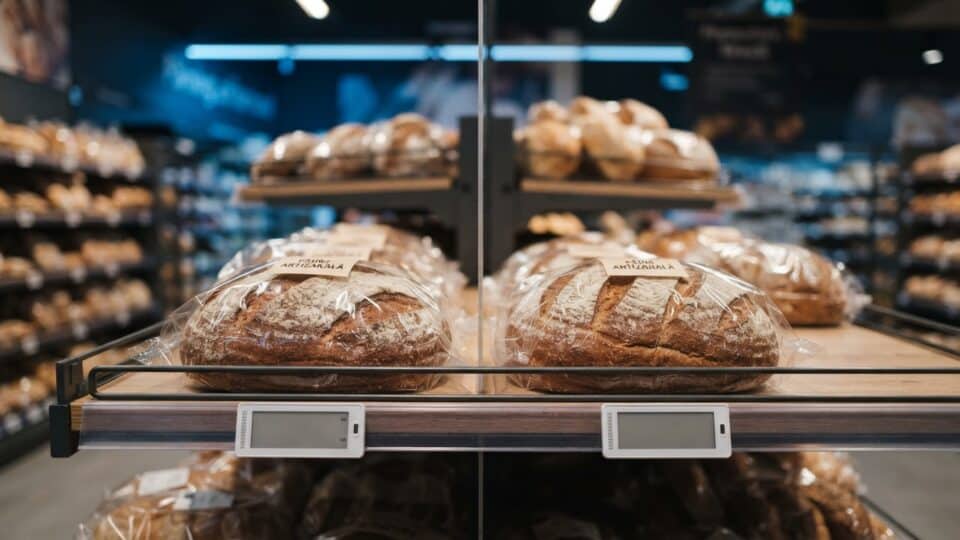
Bread prices across cities: why do we pay more for the same loaf in different places? The same variety, brand and weight can appear at different prices on the shelves of Romanian shops. The difference is not automatically explained by the price of wheat, nor does it in itself prove wrongdoing. A loaf’s price reflects production costs, distribution, the risk of unsold goods, local competition and retail strategy. InfoBuz explains the mechanism, sets out what public sources say and proposes a verifiable comparison method, without presenting mathematical examples as prices actually observed in stores.
Bread prices across cities: why the same product can have two prices
The price on a label is a commercial decision at the point of sale, shaped by an entire chain of costs. Two stores in the same chain may face different supply conditions, customer traffic, premises costs, competitors a few hundred metres away and local promotions. Two stores from different chains may also start with different procurement contracts, delivery schedules and mark-up policies. Therefore, the same physical product does not guarantee a single nationwide retail price.
Importantly, this is a general economic explanation, not the conclusion of an investigation into the commercial contracts of a particular retailer. Assigning a price difference to a specific cause—transport, rent or margin—would require data on the company’s costs and policies. A photograph of two labels alone cannot reveal that information. The price difference itself can, however, be rigorously documented by any consumer.
The first trap: “the same bread” means more than two similar-looking packages
A proper comparison starts before the price is recorded. Two products called “white bread” may differ in weight, producer, flour type, recipe, ingredients, production process, shelf life and whether they are fresh or previously frozen. A 400 g loaf and a 500 g loaf are not identical. Nor do two loaves of the same weight but with different ingredients and brands establish the price of the same item.
For a strict comparison, ideally record the barcode (GTIN/EAN), full name, brand, net quantity, shelf price, time and store. The barcode helps identify the retail variant, but does not replace checking the packaging and batch where relevant. Always separate the standard price from a price conditional on a loyalty card or app; otherwise, you are comparing different promotional mechanisms rather than normal prices.
Unit price or price per kilogram? The difference can reverse the conclusion
Suppose bread A costs RON 4.50 for 400 g, while bread B costs RON 5.20 for 500 g. A looks cheaper if one considers only the amount on the label. But one kilogram of A would cost RON 11.25, while one kilogram of B would cost RON 10.40. In this example, the loaf with the higher unit price is cheaper per kilogram. A and B are hypothetical products used for demonstration; they do not represent a survey of prices in shops.
| Illustrative example | Unit price | Weight | Calculated price/kg |
|---|---|---|---|
| Bread A | RON 4.50 | 400 g | RON 11.25/kg |
| Bread B | RON 5.20 | 500 g | RON 10.40/kg |
| Same variety, store X | RON 4.20 | 400 g | RON 10.50/kg |
| Same variety, store Y | RON 5.00 | 400 g | RON 12.50/kg |
The final two rows show something else: if the variety really is identical, the difference between RON 4.20 and RON 5.00 is RON 0.80 per loaf, or roughly 19% relative to the lower price. To reproduce the calculation, divide the price difference by the cheaper product’s price and multiply by 100. The choice of percentage base matters: measuring against the higher price would produce a different percentage. Do not confuse the two formulas.
The anatomy of a price: from wheat and flour to the shelf
The final price is not simply flour turned into dough. A bakery’s costs include raw materials, water, yeast or sourdough starter, salt, energy for mixing and baking, wages, equipment maintenance, cleaning, packaging, rent or depreciation of the premises, quality checks and transport. Retailers then bear the cost of receiving goods, handling, display, staff, logistics, losses from unsold products and store overheads.
The price of wheat is an important benchmark, but it is not a direct formula for the cost of bread. Wheat becomes flour through an industrial process, and flour is only one economic component of the finished product. Even if a raw material becomes cheaper, the shelf price does not necessarily fall on the same day or by the same percentage: inventories, contracts, energy, wages and other costs adjust at different times. Conversely, a small rise in the price of flour does not automatically justify every increase attributed to it.
The cost chain in seven links
- Agriculture: cereals, inputs, storage, harvest conditions and product availability.
- Milling: turning cereals into flour, energy, logistics and yield.
- Baking: recipe, labour, ovens, machinery, production losses and quality control.
- Packaging: bags, labelling, batch identification and related operations.
- Distribution: loading, route, delivery frequency and volumes at each stop.
- Retail: premises, staff, electricity, retail losses and local competition.
- Consumer: final price including taxes, promotions and any costs of getting to the store.
Why distance from the bakery does not by itself explain price differences
A natural intuition is that bread made closer to a shop should always be cheaper. In reality, kilometres are only one part of transport costs. What matters is how many stores are on the route, how many units reach each one, how frequently deliveries are required and how many products return unsold. A well-loaded truck on a long route can have a lower cost per loaf than a delivery vehicle making frequent stops with small volumes.
Bread has another particular feature: it has a relatively short selling window, and a freshness policy requiring replenishment several times a day can raise costs. In high-volume stores, stock may turn over quickly. In outlets with lower sales, some of the quantity may remain on shelves. A retailer may incorporate that risk into its pricing model. These are possible mechanisms, not demonstrated justifications for a specific difference between two stores.
Rent, wages and competition: three cities, three contexts
A store in a busy central area may pay more for retail space than one on the outskirts. In other cases, high customer traffic may offset those costs through much larger sales volumes. Wages, too, are not passed through mechanically and proportionally into the price of each loaf; centralised production, self-checkouts, staffing levels and productivity alter the relationship.
Competition matters just as much. A retailer next to several rival stores may choose to keep prices for staple products very low to attract customers. In an area with few alternatives, competitive pressure may be weaker. A single observation cannot demonstrate that a difference is caused by market power, and any suspicion of anti-competitive conduct requires a specific analysis and competent authorities.
The same supermarket chain does not necessarily mean the same price
Retail chains may operate national, regional or local offers, while a convenience store may have a different cost structure from a hypermarket. A temporary promotion, a discount on limited stock or a loyalty offer can create visible differences even a few kilometres apart. Before accusing a retailer of arbitrarily charging different prices for the same product, the effects of promotions, store format and the comparison date must be excluded.
Significant differences between identical products have also been documented in comparisons of major online retailers. In November 2026, an analysis published by Ziarul Financiar found variations among retailers for staple goods, based on data gathered by a specialist platform. That is evidence of price dispersion among sellers, not a study exclusively about bread or a measurement of differences between cities. The distinction is essential to interpreting the source correctly.
What Eurostat shows—and what it cannot demonstrate about Romania’s cities
Eurostat’s comparative data for 2025, published in 2026, place Romania at the lowest price level in the EU for the aggregated category “bread and cereals”. For food and non-alcoholic beverages overall, Romania’s price level was around 80% of the EU average. The “bread and cereals” category covers more than an ordinary loaf: it includes flour, rice, pasta and other bakery products. The indicator is national and compares countries, not supermarket aisles in Constanța, Iași, Cluj-Napoca or Bucharest.
Moreover, a low price level relative to the European average does not automatically mean bread is affordable for every household. Affordability depends on incomes, household size, housing and transport costs, and other items in the shopping basket. Eurostat notes that price-level indicators are expressed relative to the EU average and do not rank each family’s purchasing power. Source: Eurostat, Comparative price levels for food, beverages and tobacco, 2025 data.
Why a map of bread prices is not automatically a map of poverty
One city may have higher average prices and higher average incomes; another may have cheaper bread but a larger share of household budgets spent on food. A serious assessment must relate costs to a comparable budget, rather than simply placing two shelf labels side by side. If the question is where bread is “more affordable”, it becomes: how many kilograms of a defined product can be bought with a comparable income after unavoidable expenses?
Even then, the result may mislead if average wages are used, as they do not describe low-income households. A sound editorial analysis should compare median disposable income, household type and the cost of a food basket. In the absence of such data, InfoBuz explicitly separates price from affordability. We do not publish a false ranking of cities “where life is hardest” based on the cost of one loaf.
How to check prices yourself: Monitorul Prețurilor and the receipt
Romania’s Competition Council provides the Monitorul Prețurilor (Price Monitor) platform, designed to inform consumers about prices published by participating chains. It can be used to select locations, stores and available products. The platform states that its data are for information only, may vary between reporting and purchase, and that the price valid for the transaction is the one displayed at the point of sale. Do not assume that the platform includes every Romanian store and every type of bread.
For your own comparison, start with the exact product, check that it is available in both locations, record the regular price and any discount conditions, then keep a screenshot showing the date and store. If you have receipts, they can confirm the amount actually paid. A comparison made at different times—for example, a Monday price against a Saturday price after a promotion—does not allow the difference to be attributed solely to the city.
The InfoBuz method: how a genuine investigation in eight cities should be conducted
We propose a public, reproducible protocol for a future monitoring exercise: select at least three identical products by code and weight, use a comparable number of stores per city, collect data in the same time window and distinguish between store types. Such a project could include Bucharest, Constanța, Cluj-Napoca, Iași, Timișoara, Brașov, Oradea and Craiova, but mentioning these cities does not mean that we have already collected a representative sample. Such research must be carried out, documented and checked before a ranking is published.
Minimum record for every observation
- City, address and store format: convenience store, supermarket, hypermarket or bakery.
- Date and time window; retain a screenshot or photograph of the label.
- Full product name, brand, manufacturer and barcode, where available.
- Net quantity in grams and calculated price per kilogram.
- Shelf price, checkout price where a receipt exists, any difference and any loyalty conditions.
- Offer status: standard price, national promotion, local promotion or clearance discount.
- Actual availability of the product and any substitutions, which should not be mixed into the same sample.
- Aggregation rule: median, price distribution, number of observations and participating stores.
Why the median? Because one very expensive store or a single discount can distort a simple average when the sample is small. Ideally, we would publish the median as well as the minimum, maximum and interquartile range, with the sample size. If a brand is available in only two of the eight cities, it cannot be extrapolated to all of them. And if locality A has only convenience stores and B only hypermarkets, the comparison concerns store format as well as geography.
Calculation example: what can a small difference mean for a household budget?
Take a purely illustrative case: an identical variety costs RON 2/kg more in store Y than in store X. A household consuming an average of 600 g of bread a day buys around 18 kg in a 30-day month. The difference would be RON 36 per month or, maintaining the same pace across 12 identical months, RON 432. If the household buys 1 kg per day, the difference rises to RON 60 per month. These are arithmetic operations, not estimates of average national consumption.
| Assumption | Consumption in 30 days | Difference of RON 2/kg | Impact in 30 days |
|---|---|---|---|
| Consumption A | 12 kg | RON 2/kg | RON 24 |
| Consumption B | 18 kg | RON 2/kg | RON 36 |
| Consumption C | 30 kg | RON 2/kg | RON 60 |
Any potential saving must, however, be weighed against the journey to the shop. If saving RON 0.80 on a loaf requires driving several additional kilometres, fuel, time and other impulse purchases may outweigh the benefit. A useful comparison considers the full basket and real shopping habits, not just the price of one product used as an advertising benchmark.
Why a higher price is not automatically unlawful
In a market economy, retailers may charge different prices within the law and competition rules; there is no general obligation for every store to sell at the same price. A difference may raise legitimate questions, but by itself it is not evidence of an anti-competitive agreement, a misleading practice or unlawful discrimination. Facts and a case-specific legal analysis are needed.
Consumers do, however, have a clear information rule: Government Decision No. 947/2000 governs the display of the selling price and, where applicable, the unit price. The value must be displayed clearly, legibly and in a way that is easy to identify. A comparison can be misleading if the per-kilogram price is missing where it should be displayed, or if the price communicated on the shelf differs without explanation from the amount charged. The official text is available on the ANPC website; some product categories have exemptions provided for by the regulation.
What to do if the checkout price differs from the shelf price
Photograph the label and check that it belongs to the exact product bought, with the correct weight and variant. Ask the store’s customer service to check it, keep the receipt and record the date. If the problem remains unresolved, a complaint to the National Authority for Consumer Protection (ANPC) can include a photograph of the label, the receipt, a product description and the retailer’s response. Within its remit, the ANPC can check compliance with consumer-information rules and legislation on commercial practices.
If the suspicion concerns coordination of prices between companies, the legal framework and evidence are different, and the relevant authority is the Competition Council. Do not confuse a complaint about an incorrect label with an allegation of a cartel. Neither course of action is justified by a simple mathematical price difference without context.
In-store baked bread versus industrial bread: a different product, a different cost model
A shop may sell packaged bread from a factory, bake on site products prepared industrially, or operate its own bakery. To customers, all may appear to be “fresh bread”, but in accounting terms they are different models: equipment and staff at the point of sale, finished products transported from a factory, or semi-prepared components requiring final baking. Freshness, recipe and shelf life affect the choice, but do not automatically establish a universal hierarchy of quality.
A responsible investigation would avoid, for example, comparing a 600 g sourdough loaf made in an artisan bakery with a 300 g industrial product and concluding that one city is “twice as expensive”. For geographical analysis, the same retail item should be used. Comparing quality or nutritional value would require a separate analysis of composition and products.
Five questions retailers and producers should answer
- Is there a single pricing policy for the variety examined, or are prices set by region and store format?
- What share of differences between locations can be documented as resulting from logistics and delivery schedules?
- How are unsold products handled, and how much does this risk affect pricing strategy?
- How are discounts available only to loyalty-card customers communicated in relation to the standard price?
- How can a customer transparently check whether the price of an identical product differs between stores in the same chain?
Answers should be requested specifically, for defined products and periods. If a retailer declines to disclose confidential contractual information, the lack of an answer does not automatically prove an irregularity; explanations that are provided can, however, be tested against public data and shelf observations. A journalistic inquiry must preserve this distinction rather than turn a hypothesis into a verdict.
Frequently asked questions about bread prices in Romania
Is it illegal for the same bread to cost differently in two cities?
No. A price difference is not, in itself, prohibited. Problems may arise in specific situations: inaccurate information for consumers, misleading commercial practices or breaches of competition rules. These cannot be established merely by comparing two labels.
Why can 500 g bread be better value than 400 g bread?
Because the price per kilogram is the relevant criterion when products are comparable. Divide the price in lei by the quantity in kilograms. For products with different ingredients and quality, the unit cost is necessary but not sufficient for a recommendation.
Can I use Monitorul Prețurilor to demonstrate differences?
It is a useful starting tool, but the data must be checked on the date of purchase. Not every store or product is necessarily included, and offers can change. Dated screenshots and, where available, receipts are useful for an investigation.
Does Romania have the cheapest bread in the EU?
Eurostat ranked Romania lowest in the EU for the 2025 price level of the aggregated “bread and cereals” category. This does not mean every bread variety in Romania is cheaper than every equivalent in every EU country, nor that all Romanian cities have the same price level.
What matters more for a household: a low bread price or a cheap basket?
In most practical decisions, the basket, shopping frequency and the cost of getting to the store matter. Bread can be an easy indicator to track, but one label does not describe a household’s real spending.
Conclusion: the real question is not simply “where is bread more expensive?”
The useful distinction is between an observed price, a plausible economic mechanism and a demonstrated cause. A label shows the displayed price. Transport, competition, rents, stock turnover and promotions are mechanisms that may influence it. But only checked data and explanations can show how much each factor contributed in a particular store or city.
Romania may have a low European price index for bread and cereals while residents of two localities find different prices for the same item. There is no contradiction: the first is an aggregated statistical indicator, the second a local transaction price. The best protection for shoppers is a proper comparison—identical product, same quantity, same period and real per-kilogram cost—followed, where appropriate, by a well-documented complaint.
Sources, methodology and limitations of the analysis
- Eurostat — Comparative price levels for food, beverages and tobacco, 2025 data published in 2026, PPP methodology and definition of the “bread and cereals” category.
- Competition Council — Monitorul Prețurilor, information platform and conditions governing the use of displayed prices.
- ANPC — Government Decision 947/2000, rules on displaying the selling price and unit price.
- Ziarul Financiar, 10 November 2026, independent comparison of staple goods among online stores; it does not measure bread prices between cities.
- InfoBuz context: Why food becomes more expensive between farm and shelf and Inflation and household budgets in 2026.
InfoBuz editorial note, 23 November 2026: this article is an explanatory analysis documented from public sources, not an original price survey conducted in shops. The figures in the tables are hypothetical scenarios, marked as such, and the cities listed for a possible study are methodological proposals. We do not attribute margins or legal breaches to retailers without evidence. The article may be updated separately if a verifiable sample is collected, with dates, varieties, cities and receipts.


Discuția cititorilor
Ai o opinie sau o întrebare despre acest articol? Spune-ne ce crezi.
Fii primul care deschide discuția.
Te rugăm să păstrezi un limbaj civilizat și să discuți la subiect. Comentariile spam sunt filtrate automat.