
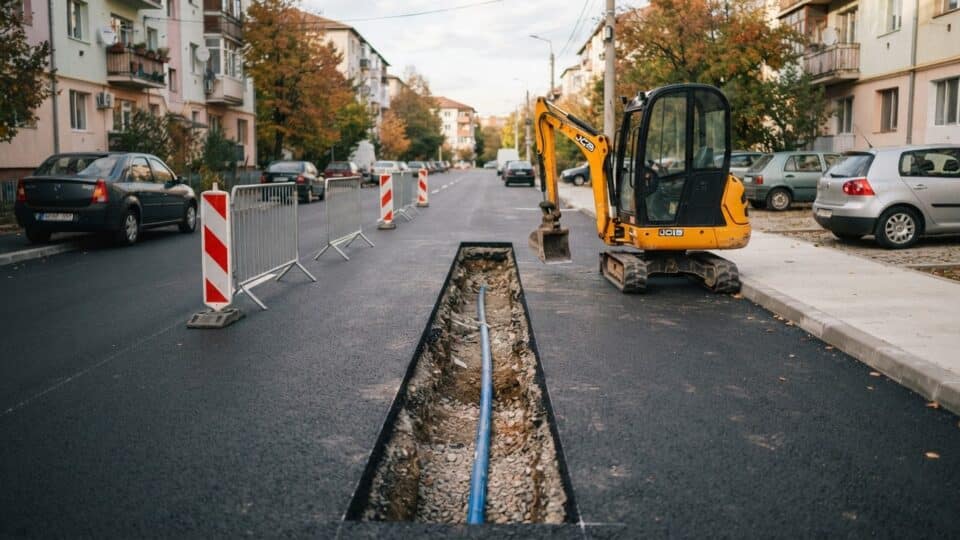
Broken asphalt shortly after resurfacing immediately raises a question: was the same street paid for twice? In reality, the answer depends on the paperwork. We examined a specific case in Cluj-Napoca, official data for Bucharest and Constanța’s rules for utility works. This article explains why a newly paved road may be reopened, how settlement occurs, who may pay for reinstatement and which documents should be requested before claims of waste or illegality are made.
Editorial illustration generated for InfoBuz; it is not a photograph of a street identified in the cases examined.
Broken asphalt after resurfacing: why the issue is more complicated than it looks
For a driver, the image is straightforward: a street has fresh asphalt, then a transverse cut appears a few weeks later, followed by a patch in a different colour. For the road authority, however, the background may involve overlapping projects, a damaged pipe, a new service connection or a connection stage that could not be completed immediately. Without the records of the intervention, it is not possible to know which explanation applies at a particular location.
A road can be opened after resurfacing because of a legitimate emergency, a poorly coordinated works schedule or a planned technical sequence. The three situations should be investigated separately. The right question is not simply “why was it dug up?” but “who approved the intervention, who reinstated the road structure, what checks were carried out, and who bears the cost of any later repair?”
Documented case in Cluj-Napoca: asphalt reopened after 10 days
In a case reported on 16 December 2025, residents of Nădășel Street in Cluj-Napoca complained that a section of recently laid asphalt had been dug up around 10 days after the work. A City Hall representative told the local publication that the intervention belonged to the gas operator and was needed to connect a new pipe to the existing network, after notification and scheduling requirements had been met.
According to the explanation provided to the publication, the stretch had been temporarily closed in order to allow traffic through, and the operator bore the cost of the additional intervention. The source is a Știri de Cluj report of 16 December 2025. This analysis does not have the invoices, permits or handover records for the case, so it cannot independently verify the exact cost or the quality of the reinstatement. The case shows that a rapid road cut does not automatically demonstrate unlawful spending.
Constanța and Tulcea: concerns over poorly reinstated trenches reported in 2026
In a report published on 25 August 2026, Radio Romania Constanța reported on roadworks and carriageway interventions in Constanța and Tulcea, including manhole covers that had not been brought up to road level and trenches where the reinstated layer was sinking. The report cited positions taken by local authorities and criticised the way some works had been left.
The report does not make it possible to estimate the share of affected streets, nor does it automatically establish a particular company’s responsibility in every case. It does, however, justify verifiable questions: how many intervention permits were issued, how many handovers included reservations, how many defects were found during the warranty period, and from whom costs were recovered. These are data that an administration should be able to document.
Bucharest: 5,340 streets, but different administrative responsibilities
In a 25 February 2026 statement, Bucharest City Hall said that, of the capital’s 5,340 streets, 880 were administered by the City Hall through the Street Administration, while the other 4,460 fell under the city’s sectors. It also cited deterioration around manholes and along utility routes, alongside the effects of winter and freeze-thaw cycles.
These figures describe the allocation of road administration in Bucharest on the date of the statement, not the number of streets dug up after resurfacing. Even so, the fragmentation of responsibility matters: a resident may report a pothole to one institution, while approval of an intervention, supervision of the work and monitoring of the warranty involve other bodies. The first check is to identify the road’s exact administrator.
Who may open a road, and whose approval is needed?
Government Ordinance No. 43/1997 on the road regime sets out the framework for road administration and the conditions for placing or carrying out works within road areas. Article 48 addresses underground public-utility works and the need for approval from the road administrator, under the conditions provided by law. The official text of Government Ordinance No. 43/1997 should be consulted in the updated version relevant to each intervention.
In practice, the authorisation regime varies according to the type of work: a new investment, a service connection, scheduled maintenance or a fault. Depending on the circumstances, the intervention may require the administrator’s clearance, permits and traffic-restriction rules. It is not correct to assume that every carriageway opening without a visible signboard was unauthorised, but a lack of information warrants checking the institution’s records.
A water or gas fault cannot wait for the resurfacing schedule to end
A ruptured pipe, gas leak or dangerous cable may require prompt intervention even on a recently modernised street. In such cases, protecting people and restoring service take precedence over preserving an immaculate asphalt surface. The administrative procedure for faults may follow different rules from those for scheduled investment works.
Public scrutiny should distinguish an emergency from poor planning. If there is a confirmed incident, ask what risk existed and when it was identified. If it was a connection announced months in advance, it is legitimate to ask why it was not incorporated into the modernisation programme. The same photograph of an excavator cannot settle that distinction.
Individual service connections: thousands of small decisions can affect an entire road
A new household may request connections to water, sewerage, gas, electricity or telecommunications. Each operator has its own processes and technical conditions. If property development intensifies after a street has been resurfaced, new requests for interventions in the road area arise. The phenomenon is more pronounced where housing development has not been accompanied by complete infrastructure.
Some solutions are worth considering at the design stage: utility corridors, spare ducts, prepared connections and coordinated extensions. But not all networks can be installed in the same corridor, and not every solution is feasible or safe. The choice must be made through the design and permitting process, taking account of the protection of existing networks.
What it means when accepted roadworks are reopened later
The acceptance of a modernisation project confirms, under the applicable procedure, that the work has been checked against the relevant documents. It does not permanently prevent any intervention in the carriageway. A network that fails after acceptance may be repaired, but the obligations of the network owner and responsibility for restoring the road to the required condition must be established.
For that reason, a street file should track two timelines: the acceptance of the original road investment and subsequent utility interventions, each with its own permit and record. If these files cannot be matched by street and road segment, residents see only two work sites and cannot determine whether avoidable expenditure occurred.
Constanța: what Local Council Decision No. 188/2025 actually provides for utility works
Constanța Local Council Decision No. 188/2025 approves regulations for technical utility works on the city’s public and private property. The document includes conditions for permits, handover of the site, reinstatement of the road structure, quality checks and the responsibilities of utility owners. It is a concrete source for reviewing a local intervention, not a single standard applicable across Romania.
The regulations provide a 48-month warranty for certain road-reinstatement works, under the conditions and for the street categories defined there. In the annexed quality and warranty agreement, Article 5.2 requires certain technical deficiencies to be remedied within a maximum of two days after notification by the road administrator. This deadline belongs to the cited local mechanism and does not amount to a national promise to repair every pothole within 48 hours.
| Mechanism in the Constanța regulations | What a reader can check | Interpretation caution |
|---|---|---|
| Intervention permit and clearances | Number, date, address and holder | Procedures vary by type of work |
| Site handover and reinstatement | Record and technical conditions | A final photograph does not prove compaction |
| Acceptance and quality documents | Date, participants and any reservations | Do not confuse acceptance of the network with acceptance of the roadwork |
| Warranty for reinstatement | 48-month regime for the works and categories defined | It is not a universal national deadline |
| Remedying technical deficiencies | Administrator’s notification and the deadline in the agreement | The annex’s two-day deadline depends on the stated conditions |
A four-year warranty does not mean every uneven surface is automatically compensated
To trigger an obligation to remedy a defect under warranty, the work, the date from which the warranty runs, the precise section and the nature of the defect must be identified. Settlement in the backfill of an excavation may have a different cause from a pothole occurring some distance away because of traffic loading or poor drainage. An expert assessment, a record or an inspection by the road administrator may clarify the link.
Editorially, a warranty is a verifiable accountability mechanism, not a promotional figure. The important question is how many notifications were sent and how many remedies were actually completed under warranty, with acceptance records. Without those data, it cannot be said that every non-compliant intervention is repaired.
Why settlement often follows the trench line, rather than the rest of the road
A road structure works as a set of layers that transfer loads to the ground. When it is cut for a pipe, existing material is removed, work is carried out in a confined space and new backfill is placed. If the new material is not laid and compacted properly, that area may behave differently from the surrounding road.
A study by Iowa State University’s Institute for Transportation examined settlement in utility-cut reinstatements and associated it with poorly controlled moisture and compaction, as well as structural effects at trench edges. This is international technical research, not an assessment of Romanian resurfacing works in 2026.
Layered compaction: what a photograph of finished asphalt does not show
The technical process is not simply a matter of filling a hole with soil and laying asphalt on top. Foundation and backfill materials, layer thickness, compaction moisture and the equipment used all influence the ability to withstand traffic. Under many procedures, concealed works must be checked before the final layer covers what will no longer be visible.
That is why a sound body of evidence includes reinstatement documentation, relevant test reports, photographs of the stages of work and acceptance records. The specific requirements are those in the design, technical specifications and applicable regulations. This article does not invent a universal compaction percentage suitable for every material or every street.
Cut edges: how cracks form between old and new asphalt
A road excavation creates a joint between the existing structure and the new reinstatement. If the edges are broken up, not properly profiled or inadequately sealed, water can enter the supporting layers and traffic loads can worsen cracking and settlement. Over time, a narrow cut may produce deterioration that extends beyond the geometry of the original excavation.
In the annex dealing with the warranty agreement, Constanța’s 2025 regulations require the reprofiling of broken trench edges before asphalt is laid. The local document therefore addresses a defect that may only become visible months later. The requirement does not, however, justify reinstatement across arbitrary areas: any extension must be technically justified and documented.
Why manhole covers left below road level affect road quality
A cover that has not been raised to the appropriate level can cause wheel impacts, discomfort, noise and, in certain circumstances, risks for vehicles, motorcyclists or cyclists. The difference in level may result from a lack of coordination between roadworks and network elements, settlement around the cover or a later intervention. The diagnosis is not the same in every case.
For a report, a photograph should show the precise location, direction of travel, approximate dimensions and the danger involved, without exposing people. Where there is an immediate danger, notify the competent authority promptly and do not enter the carriageway to measure the uneven surface yourself. The Radio Romania Constanța report illustrates the relevance of this type of defect.
Why repairing a trench involves more than a thin layer of asphalt
Depending on the case, reinstating road infrastructure involves the subgrade, backfill, foundation layers and asphalt layers. If the supporting layer continues to settle, a new asphalt skin may temporarily conceal the problem rather than resolve it. The right solution depends on the cause identified through inspections and technical checks.
A technical report by the United Kingdom’s Transport Research Laboratory finds that well-designed and properly executed reinstatements can perform well over the long term. A road trench is therefore not destined to settle; the difference lies in design, materials, execution and verification of the work.
Who pays for a second resurfacing: City Hall, utility operator or contractor?
There is no answer that is “always City Hall” or “always the utility company”. It depends on the ownership and administration of the road, who requested the intervention, who signed the reinstatement undertaking, local rules and whether the work is under warranty. In the Cluj case, the municipal representative said the gas operator bore the additional expense.
In Constanța, the regulations in Local Council Decision No. 188/2025 assign reinstatement and remedying obligations to utility owners, subject to the terms of the decision and the agreements. That is not evidence that every intervention in the city was paid for exclusively by private actors. For a particular street, payment documents must be obtained and the relationship between the beneficiary, operator, contractor and administrator clarified.
The cost of a 120-metre trench: a calculation exercise, not a market price
Imagine an excavation 120 metres long and a reinstatement strip 1.20 metres wide: the area is 144 m². At a strictly hypothetical cost of 250 lei/m² for a defined part of the reinstatement, the result is 36,000 lei. If edge treatment or technical requirements increase the width to 1.50 m, the area becomes 180 m² and the same unit value would produce 45,000 lei.
The 9,000 lei difference is not a verified invoice, nor is it evidence of unjustified additional expenditure. The real price must be broken down into milling or removal, excavation, backfill, compaction, transport, asphalt materials, testing, traffic management and other costs under the estimate. Some do not increase in a linear way with area. The formula is included only to show how a quantity in a payment document can be checked.
| Calculation element (strictly hypothetical) | Option A | Option B |
|---|---|---|
| Trench length | 120 m | 120 m |
| Reinstatement width | 1.20 m | 1.50 m |
| Resulting area | 144 m² | 180 m² |
| Illustrative rate | 250 lei/m² | 250 lei/m² |
| Mathematical value | 36,000 lei | 45,000 lei |
| Difference from A | — | 9,000 lei |
What repeated roadworks cost residents beyond the bill of quantities
A street that is opened again can cause delays, diversions, time costs for drivers and transport operators, more difficult access for pedestrians and traders, and additional risk around restrictions. These costs are not the same as the amount paid from a municipal budget for the work. Even where the utility operator pays for the entire worksite, the community may bear the inconvenience.
Calculating the social cost requires measured traffic volumes, additional journey time, the duration of restrictions and an explicit method for valuing time. This article does not arbitrarily assign an hourly value to every driver or call the resulting sum “stolen money”. If traffic data are unavailable, the effects should be described qualitatively, without inventing a figure.
How to find out whether a street was genuinely resurfaced twice
The first step is to identify the exact segment, not merely the street name. A long arterial road may have works at different points at the same time. The second is to establish the date of acceptance or of the initial intervention, followed by the date and cause of the new opening. The third is to compare the geometry of the new work with the area previously resurfaced.
The relevant documents are the resurfacing contract and estimate, the excavation permit, the road administrator’s clearance, the network owner’s work order, the plan or sketch of the intervention, the acceptance record for the reinstatement and any warranty documents. Only these links can establish whether the same work was repeated or whether an intervention took place on another section.
How to check for double payment from public funds without making unfounded accusations
A double payment means more than two photographed layers of asphalt in the same place. It is necessary to establish who was invoiced, for which quantity, under which contract, from which funding source, and whether the later payment was borne by or recovered from the responsible operator. An operator may restore at its own expense a road originally paid for from the budget, without there being a second payment from public funds.
A serious allegation requires payment records, work statements, handover records, any recovery of costs, and explanations from the institution and contractor. A viral photograph or social-media post can be a journalistic lead, but it does not replace accounting evidence and the right of reply.
| Situation | Who may bear the cost | Evidence to check |
|---|---|---|
| Utility intervention after resurfacing | The utility operator, depending on the case | Agreement, invoices, payment records |
| Defect in reinstatement found during warranty | The party bound by the warranty | Notification and remedy record |
| Scheduled street rehabilitation | Administrator/beneficiary under the funding arrangement | Contract and budget source |
| Repair required because of a fault | Responsibility follows from the applicable documents | Intervention order and reinstatement record |
| Unclear additional work | Unknown without documents | Work statement and actual payment |
What city halls can do before laying asphalt: a shared utilities schedule
A well-coordinated programme can synchronise planned road-authority works with investments by water, sewerage, gas, electricity and telecommunications operators. Before modernising an arterial road, an authority can request lists of anticipated projects and connections, identify overlaps in timing and determine when certain work should be completed before the final surface layer is laid.
A schedule does not eliminate future faults, and an important utility intervention cannot be deferred solely to protect asphalt. But if investments have been known about for months, a joint review reduces the risk of inefficient sequences. In March 2026, local media reported on Bucharest’s intention to coordinate operators’ programmes more strictly; the real effectiveness of such an initiative is measured by interventions actually avoided, not the number of meetings.
A geographic works register: a straightforward solution often missing from the debate
A publicly accessible map could show the road segment, type of intervention, authorised period, administrator, network owner, reinstatement contractor, acceptance date and warranty period, without exposing sensitive technical details of the networks. Residents could then see whether a pothole remained under warranty and where to report it.
There is no need to publish detailed plans of strategic pipelines or the coordinates of sensitive installations. The register could disclose levels of information compatible with infrastructure security and data protection. Its benefit is chronological verification: the same stretch of road would not disappear from its works history after each new layer of asphalt.
Why warranties should be tracked on a map, not only in a file
If a section is accepted in 2026, a local warranty may run until 2030, depending on the applicable clauses. A report made in 2028 should be linked automatically to that work and sent to the responsible parties. Without a geographic record, identifying a contractor can take time and procedural deadlines may be harder to monitor.
A register can link the notification, inspection, remedial order, confirmation of completion and outcome of the check. This is not evidence that every authority has such a tool; it is a proposed administrative practice that can be assessed locally. Aggregated indicators can be published without disclosing protected commercial data.
Seven documents to request under Law No. 544 for a repaired street
For a specific segment, the competent authority can be asked for: (1) identification of the administrator; (2) the number and date of the road contract; (3) the date on which resurfacing was accepted; (4) permits for subsequent interventions; (5) the identity of the intervention’s beneficiary and contractor; (6) reinstatement records and the warranty; and (7) whether invoices, penalties or sums recovered as a result of the new work exist. Specify the period and precise address to avoid an overly general response.
Law No. 544/2001 provides the framework for access to information of public interest, with deadlines, exemptions and avenues for challenge. Not every document may be supplied in full if it includes exempt information; in some cases, versions with protected data removed may be provided. For deadlines and a general request template, see InfoBuz’s guide: City Hall not responding? Petitions and Law No. 544.
| Document/information | Why it matters |
|---|---|
| Original street contract | The area and cost originally committed |
| Date of original acceptance | When the investment was completed |
| Clearance and excavation permit | Who authorised the reopening |
| Work order and beneficiary | Who requested the intervention |
| Plan and area actually affected | Whether it overlaps the resurfaced section |
| Reinstatement acceptance and warranty | Who checks it, and until when |
| Invoice and cost recovery | Whether additional budget spending occurred |
A template for an official request without accusations
A sample message reads: “Under Law No. 544/2001, please provide the information and, insofar as they may lawfully be supplied, the documents concerning road and utility works carried out on [street name], section [landmarks], during [dates]. I request the dates of acceptances, excavation permits, beneficiaries, contractors and any warranty remedies, as well as information on who bore the cost of reinstatement.”
Add the email address at which a response is requested, and separate individual segments or projects if there have been many interventions. A precise request may be easier to resolve than one asking only “who is stealing the asphalt?” It also allows responses to be checked against document numbers and exact dates.
What residents can photograph—and what they should not do
From public space and under safe conditions, residents can document the date, place, road signs, the surface condition before and after the intervention, and the works information board if there is one. Ideally, retain the original photographs, with their date and several visible landmarks. Avoid manipulated images that alter the proportions or chronology of events.
Do not enter a worksite, cross active traffic lanes for a photograph, open access chambers or touch pipes and cables. If there is a dangerous pothole or an unsigned worksite, notify the responsible authority immediately. When publishing, respect the rights of people captured in images, especially children.
Five indicators showing whether a city has improved coordination
A useful municipal report could show: the number of planned post-resurfacing interventions per kilometre of rehabilitated street; the average duration of restrictions; the share of works accepted without reservations; defects found under warranty at 6, 12 and 24 months; and sums recovered from operators for reinstatement or remedies. These indicators need to be calculated using the same definitions and periods in order to compare years.
This analysis contains no verified ranking of Romanian cities by the number of repeated resurfacing works. A national statistic would require consolidated data from road administrators, projects and operators, which this article does not claim to have compiled. It proposes a method of verification, not an invented league table.
| Proposed indicator | Required definition | Risk of interpretation |
|---|---|---|
| Cuts after rehabilitation/km | A fixed interval after acceptance | Misleading if faults are not separated out |
| Duration of restrictions | Hours and days per segment | Not equivalent to the total project duration |
| Acceptances with reservations | Percentage of checked reinstatements | Depends on the procedure and scope of inspection |
| Defects under warranty | Validated notifications/total works | Without a unified register, omissions are possible |
| Recovered expenditure | Documented payments from operators | The sum should not be confused with the total roads budget |
How to distinguish a justified intervention from defective work
The two are not mutually exclusive. An intervention may be justified while its reinstatement is still poorly executed. Conversely, a cut made shortly after resurfacing may be well reinstated and funded by the operator, with no new cost to taxpayers. Sound analysis uses two separate criteria: the necessity and coordination of the intervention, and the quality and accountability of the reinstatement.
This framework avoids both automatic excuses (“it was a fault, so nothing needs checking”) and automatic accusations (“it was dug up quickly, so money was stolen”). In a real investigation, the two questions require separate evidence and answers.
Frequently asked questions about asphalt dug up after resurfacing
Is it illegal to dig up a newly paved street? Not automatically: authorised interventions or emergencies may exist, subject to the applicable rules. Who repairs it? That depends on the operator, administrator, contractor and the specific commitments. Is there a warranty? Yes, in many cases, but the duration and procedure vary; in Constanța, Local Council Decision No. 188/2025 provides a 48-month regime for the works defined by those regulations.
Can the amount paid be found out? Yes, through contractual documents, payment records and public information, within the limits of the law. Why does asphalt sink after reinstatement? There may be issues with backfill, compaction, drainage or joints, but diagnosis requires technical verification. How do I report it? Identify the administrator, provide the exact location and request a registration number and a warranty check.
Other InfoBuz articles on roads, cities and public investment
For the effects of roadworks on mobility, see InfoBuz’s article on the rehabilitation of Tomis Boulevard and peak-season traffic jams. For problems hidden beneath the city’s surface, read the analysis of stormwater drainage and urban flooding.
Carriageway reinstatement also affects pedestrian access. The guide to one urban kilometre for a wheelchair user explains why a kerb, trench or blocked pavement can interrupt an entire route.
Verifiable sources, reporting limits and InfoBuz methodology
The core documents are Constanța Local Council Decision No. 188/2025 and its attached regulations, Government Ordinance No. 43/1997 on the road regime, Bucharest City Hall’s statement of 25 February 2026, the Nădășel case reported by Știri de Cluj, and Radio Romania Constanța’s report of 25 August 2026.
For the technical mechanisms, this article used Iowa State University research on settlement in reinstatements and Transport Research Laboratory testing of trench reinstatements. Methodology and limitations: this article is a documentary analysis of public sources, written on 23 November 2026. We did not personally inspect these streets, obtain invoices or contracts for every intervention, or carry out a national audit of money spent. The cost scenarios are illustrative only, and the article image is generated rather than depicting an identified real worksite.


Discuția cititorilor
Ai o opinie sau o întrebare despre acest articol? Spune-ne ce crezi.
Fii primul care deschide discuția.
Te rugăm să păstrezi un limbaj civilizat și să discuți la subiect. Comentariile spam sunt filtrate automat.