
Updated: 22 November 2026 la 10:57. Articolul a fost revizuit pentru a reflecta informațiile disponibile la această dată.
Constanța Metropolitan Rail is at the planning stage: seven corridors are being assessed, not approved for construction. We explain the market consultation notice, the timetable, the technical options and the potential effects on commuters.
Constanța metropolitan rail: routes under review, not lines ready to open
The Constanța metropolitan rail project should not be confused with the current operation of regional or inter-regional trains. As of 21 November 2026, publicly presented documents point to a market consultation to prepare a feasibility study, rather than a firm decision to build all seven routes.
A genuine metropolitan system would need to provide frequent, predictable services, connections with local transport and a fare system that is easy to understand. Any benefits for Năvodari, Medgidia, Eforie or communities around Constanța depend on the final route, station locations, journey times and ticket costs. None of these elements is yet a new service in operation.
In a county with intensive seasonal tourism, transport demand needs to be modelled separately for peak and off-season months. The same infrastructure may serve tourists and commuters, but the optimal frequencies and capacity differ.
For context, see InfoBuz’s analysis of urban accessibility and barrier-free transport.
The current status: market consultation, not trains already approved
The Constanța County Sustainable Development Association (ADDJC) published notice MC1040184 in SEAP on 18 November 2026, for a market consultation on services to prepare the feasibility study for the project, “Introducing and subsequently developing Constanța Metropolitan Rail services”. This is a preliminary stage for a potential investment, not a contract to build seven lines or an official opening date.
The initiative is examining the use and modernisation of existing railway infrastructure, as well as links with buses, conventional trains, park-and-ride facilities, walking and cycling. The aim is more predictable transport for commuters and tourists, but viability must be demonstrated through studies and funding.
The seven proposed rail corridors under review
- Constanța – Mangalia – 2 Mai.
- Constanța – Ovidiu – Năvodari – Petromidia / Capu Midia – Corbu.
- Cernavodă City / Cernavodă Pod – Medgidia – Constanța – Anghel Saligny tunnel – Poarta 1.
- Medgidia – Nicolae Bălcescu – Mihail Kogălniceanu International Airport.
- Medgidia – Valea Dacilor – Cobadin – Negru Vodă.
- Medgidia – Dorobanțu (Culmea) – Lumina – Năvodari.
- Eforie Nord – Techirghiol.
These are potential, indicative corridors. The study may alter the options, establish phases or remove alternatives that cannot be justified economically or technically. They should not be read as an already confirmed train timetable.
Why Constanța needs an integrated metropolitan network
The Constanța area combines varied travel flows: employees commuting to the city and port, journeys to suburban communities, trips to the airport and the seasonal peak on the Black Sea coast. Road transport is often exposed to congestion, incidents, works and a lack of fast alternatives.
A useful rail service means more than lines on a map. Passengers need memorable timetables, coordinated connections, accessible stopping points, simple tickets and real-time information. Otherwise, infrastructure may be underused.
What the feasibility study needs to assess
The documentation is intended to examine technical and operational scenarios, estimated journey times, frequency, capacity, compatibility with freight trains and existing infrastructure, signalling and safety upgrades, the condition of stations and halts, and the case for new stops.
The study must also assess accessibility for people with reduced mobility, investment in platforms and station buildings, lighting and surveillance solutions, maintenance and operating costs, environmental impact and the sustainability of funding. Without these checks, any figure for total cost would be speculative.
How it could work for commuters
A purely illustrative example: if a traveller drives daily along a congested route, and a rail station is conveniently accessible from both home and work, rail may become attractive because it is predictable. But if the final part of the journey requires two further transfers, that advantage may be lost.
That is why the study should compare door-to-door travel time, not only the minutes spent on the train. A Park&Ride, Bike&Ride or Kiss&Ride system can extend the catchment area of stations if it is implemented properly and safely.
Port, airport and coast: three different challenges
For the port, the issue is staff connectivity and compatibility with freight rail traffic. For the airport, the distance to the terminal, service frequency and coordination with flights matter. On the coast, demand rises significantly at certain times and services need to be sized for sustainable year-round operation.
There are infrastructure challenges as well: line capacity, electrification, station access, level crossings, interoperability and potential civil-engineering works. The feasibility study must identify realistic options and phased costs.
Official consultation timetable
The market consultation notice was published on 18 November 2026. The deadline for interested operators and experts to submit proposals is 15 January 2027, 23:59, while the consultation process is scheduled to run until 15 February 2027, 23:59. These are consultation deadlines, not deadlines for delivering the full infrastructure.
The published materials refer to an indicative 2026–2034 analysis timetable, but this period is not a firm promise that all corridors will enter service.
How much it could cost and where the money could come from
As of 21 November 2026, the cited notice contains no validated final cost estimate for all corridors. Funding could involve national, local or European resources, depending on approved projects, the rules of funding programmes and institutional partnerships. A feasibility study must establish the cost-benefit case, phasing and potential sources; it cannot present them as guaranteed.
What to watch next
The relevant milestones are publication of the consultation outcome, the launch of the feasibility-study procurement procedure, selection of the consultant, presentation of the scenarios assessed, the cost-benefit evaluation and the funding decision. Until then, maps, timetables and ticket prices remain assumptions.
InfoBuz will cover any political statements and administrative acts with legal effect separately, to distinguish announcements from verifiable progress.
Frequently asked questions
Is Constanța Metropolitan Rail already running?
No, not in the sense of the new service described by the project. Options for introducing and developing it are being studied.
Will all seven routes be built?
That cannot be stated at this point. They are potential corridors for assessment.
When does the market consultation end?
According to the published information, on 15 February 2027, after the 15 January 2027 deadline for receiving proposals.
Sources and photograph
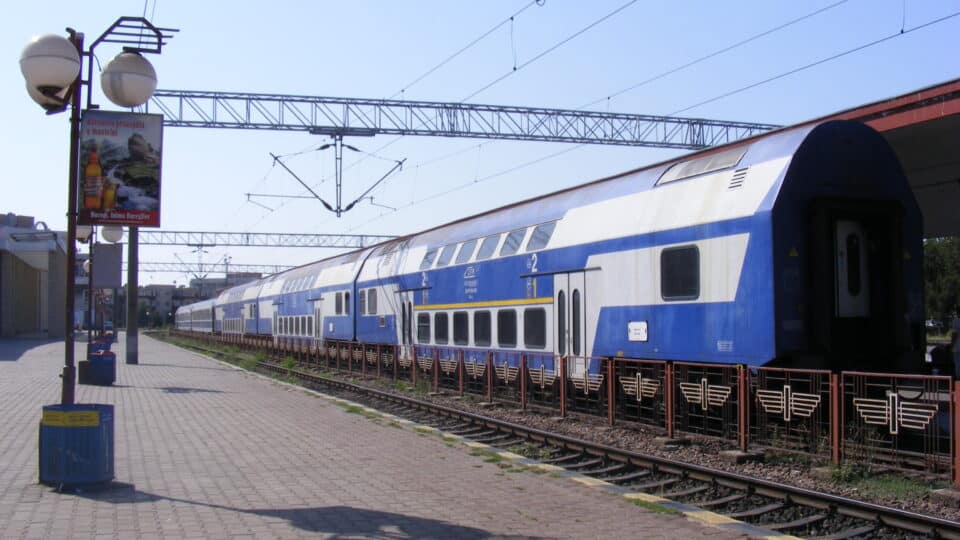
Documentary reference: report on SEAP notice MC1040184, 19 November 2026; procedures can be checked through SEAP, Romania’s electronic public procurement system. Real photograph from Constanța railway station, 2012: TrainSimFan / Wikimedia Commons, CC BY-SA 4.0; it does not depict a metropolitan train in service. Checked on 21 November 2026.
What the seven corridors mean
The corridors under review are not seven lines ready to open. A feasibility study must compare demand, infrastructure, stations and costs.
The reality of commuting
For passengers, frequency, bus connections, integrated fares and door-to-door travel time matter, not just the train’s speed.
Operating costs
The budget must include infrastructure, trains, maintenance, staff and any subsidies. An opening date cannot be guaranteed without funding and an approved project.
Sources
CFR: https://www.cfr.ro/; Constanța City Hall: https://www.primaria-constanta.ro/.
What makes a commute competitive
A metropolitan train does not compete with the car solely on time spent aboard. A commuter also has to factor in the trip to the station, waiting, transfers and the final leg. A fast line with low frequency may be less useful than a moderately fast one that is well coordinated with buses.
Demand studies should include peak-hour flows, school and employee trips, accessibility for people with reduced mobility and the seasonality of tourism.
Stations and urban integration
Station location directly affects the number of users. Safe pedestrian access, bicycle parking, links with local transport and real-time information are essential. A station far from residential areas and without connecting transport may see limited use.
Planning needs to be coordinated with housing and industrial development. The project is not limited to tracks and rolling stock; it is also an urban-planning intervention.
How the seven options compare
Each corridor can be assessed in terms of length, number of stations, investment required, estimated demand, journey time and compatibility with existing rail traffic. The options may require upgrades, electrification, signalling or solutions to capacity conflicts.
Without access to technical studies and updated cost estimates, it would not be responsible to declare one corridor the most cost-effective or give an exact opening date.
Who pays after opening
Even once infrastructure has been built, trains require energy, staff, maintenance and repairs. Ticket revenue may cover only part of the costs, with the balance potentially requiring public-service contracts. This needs to be planned before investment begins.
A sustainable project has public indicators for punctuality, frequency, passenger numbers and cost per passenger, not simply photographs from the opening ceremony.
Constanța metropolitan rail: the decisive questions
Before comparing the seven corridors, it is necessary to know the proposed frequency, population served, distance to stations and compatibility with existing trains. A route requiring little investment is not automatically the most effective if few commuters can use it. It is also important for the studies to show operating costs after opening.
A complete assessment requires checking primary documents and the period to which figures refer. For the public, the value of analysis lies in context, methodology and the ability to reproduce calculations, not in dramatic wording unsupported by documentation.
How the seven corridors should be assessed objectively
Each route has a different demand profile. The corridor to Mangalia and 2 Mai may have a strong tourism component, while links to Medgidia or industrial areas may serve daily commuting. The airport corridor needs to be assessed against the number of passengers and employees, flight times and access to the terminal. These are planning assumptions, not findings of the study, which has not yet been completed.
A transparent methodology could use a criteria matrix: population served, accessible jobs, initial investment, annual operating cost, rail capacity, environmental impact and potential for integration with buses. The weighting of those criteria should be published before an option is selected, to avoid retrospectively justifying a political decision.
A practical example: door-to-door travel time
Suppose a commuter walks 10 minutes to the station, waits an average of 15 minutes, travels for 25 minutes and then walks a further 10 minutes to work. The total journey is 60 minutes. If a direct bus or car journey reliably takes 40 minutes, the train will not automatically be the preferred option, even if the rail segment is fast.
This example is illustrative and does not describe actual journey times on any corridor in the project. It shows why frequency and station accessibility can matter as much as the rolling stock’s top speed. A service every 15 minutes would produce a lower average waiting time than one every 30 minutes, assuming random arrivals.
What compatibility with freight trains means
The railway network around Constanța also serves freight transport, which is essential to the port. A metropolitan service with frequent departures must be introduced without creating unsustainable capacity conflicts. The study needs to examine the number of available tracks, signalling, passing points, platform lengths and train headways.
In some cases, upgrading existing infrastructure may be sufficient; in others, more extensive investment will be needed. The choice cannot be made from a map alone, without operating simulations and traffic estimates.
Accessibility and safety at stations
A useful station has step-free access, lighting, clear signage, information on delays and safe pedestrian routes. People with reduced mobility need compatible platforms and rolling stock, while parents with pushchairs benefit from the same improvements.
For new stations, location needs to be coordinated with pedestrian crossings, bus stops and urban development. A stop near an industrial area but without a safe walking route to employers may be far less useful than its distance on a map suggests.
Who decides fares and subsidies
Metropolitan fares, season tickets and integration with local transport do not follow automatically from building infrastructure. Agreements are needed between authorities, operators and any funders of the public service. A single ticket can simplify commuting, but requires revenue-sharing arrangements and compatible validation systems.
Operating costs must be budgeted over multiple years. Energy, staff, train maintenance, cleaning and security do not disappear after opening. The study therefore needs to show not only the initial investment, but also who will pay the difference between ticket revenue and the cost of the service.
Public indicators for tracking the project
The public should be able to follow the date on which the study is contracted, its cost, the delivery deadline, the options assessed, the funding decision and the timetable for each stage. After any service is launched, the basic indicators would be punctuality, frequency, passenger numbers and occupancy.
At present, 15 January 2027 is the deadline for submitting proposals in the market consultation, while 15 February 2027 is the consultation end date. These dates are not opening deadlines. For official information, documents should be followed in SEAP using identifier MC1040184.
Frequently asked questions about the project
Will the train reach the airport? A Medgidia – Nicolae Bălcescu – Mihail Kogălniceanu Airport corridor is under review, but the final solution is not confirmed. Are there prices for season tickets? The consultation notice includes no final fare. Will trains be running by 2034? The indicative analysis horizon is not a commitment to put services into operation.
Which route will be built first? It cannot be responsibly determined before the study results and funding decision. Can existing lines be used? This is one of the options under review, but capacity and the works required must be established technically.



Discuția cititorilor
Ai o opinie sau o întrebare despre acest articol? Spune-ne ce crezi.
Fii primul care deschide discuția.
Te rugăm să păstrezi un limbaj civilizat și să discuți la subiect. Comentariile spam sunt filtrate automat.