
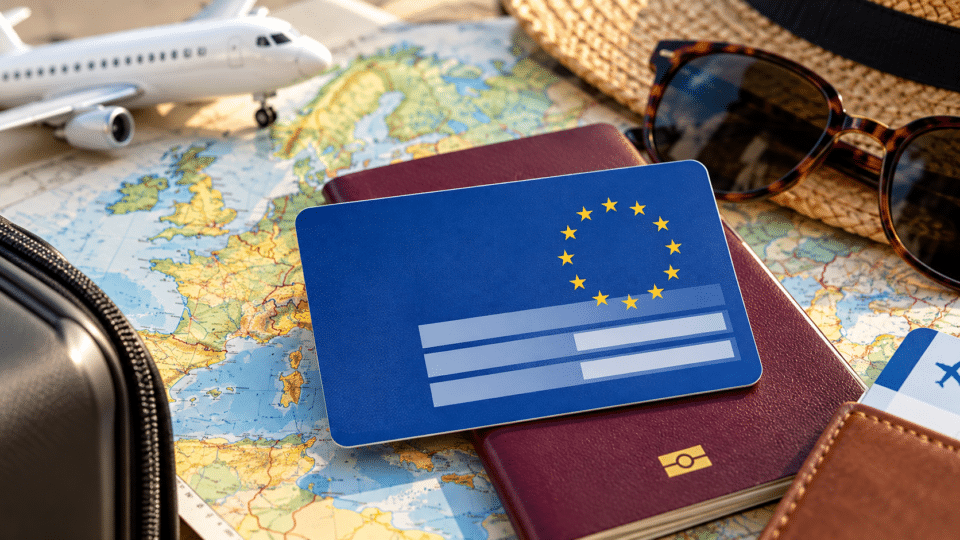
A European Health Insurance Card (EHIC) gives access to medically necessary healthcare during a temporary stay in other participating European countries, but it does not guarantee that every treatment will be free. This is an important distinction for Romanians travelling for holidays, work or study: the card proves insurance entitlement; it is not an insurance policy that automatically pays every medical bill.
In August 2026, the European Commission republished information on the card, including its limits in relation to private healthcare and repatriation. For a well-prepared trip, the two tools — the EHIC and suitable travel insurance — can complement one another.
For related information, see European tourism is growing, but Romania lost overnight stays in 2026, which examines an issue directly connected to this subject.
Where you can use the European Health Insurance Card
According to the European Commission, the EHIC is valid in the 27 EU member states, as well as Iceland, Liechtenstein, Norway, Switzerland and the United Kingdom, under the conditions applicable to public healthcare systems or providers contracted by them. It is not a universal international card: travellers should not assume that it works in every European country or at destinations outside this area.
A card issued in Romania is intended for using healthcare entitlements during a temporary stay in another participating country; it does not replace Romania’s national health card within Romania. People who establish their habitual residence in another country may need other insurance-coordination documents, such as the S1 form.
What “medically necessary” treatment means
The rule is not limited to serious accidents or ambulance emergencies. Care is considered necessary when, taking account of the patient’s condition and the length of their stay, treatment cannot reasonably be postponed until they return home. The assessment is made by the healthcare provider in the country visited.
Possible examples include a consultation for a problem arising during a holiday, treatment for a fracture, or certain services connected to a pre-existing chronic illness. The Commission says this may also include necessary pregnancy care. For services requiring specialist equipment, such as dialysis or chemotherapy, availability should be discussed with the local provider before travelling.
It does not include travel undertaken for the purpose of receiving planned medical treatment. That situation is subject to different rules and may sometimes require prior authorisation.
Why you may still receive a bill
The card provides treatment on the same terms and at the same cost as people insured locally; it does not automatically mean treatment is free. If a country charges a co-payment, the EHIC holder may also have to pay it. In some countries, patients pay the amount first and then apply for reimbursement under that system’s procedures. This is why it is essential to check which institution provides the service and whether it is contracted by the public system.
For example, a tourist may visit a private clinic near their hotel and only discover after the consultation that it is not part of the public system. In those circumstances, the EHIC does not automatically cover the bill. Another tourist may be treated in a public hospital but still owe a co-payment required of insured people in that country. These examples are illustrative; actual costs depend on the country, provider and treatment.
What the European Health Insurance Card does not cover
- Private healthcare that is not part of the relevant public or statutory system.
- Medical repatriation or special transport back to Romania.
- Usually, rescue operations in certain tourist settings, such as some mountain-rescue interventions.
- Lost or stolen belongings and other risks typically covered by travel insurance.
- Treatment for which the journey was made specifically to receive it, outside separate authorisation arrangements.
Be wary of claims that travellers could “pay thousands of euros”: private services or repatriation can result in high costs in some cases, but no figure is universal, and an alarming example should not be presented as the official rate in every country.
How to get the card in Romania
The card is free for people who meet the insurance eligibility requirements and is issued by the competent health insurance fund. Romania’s cardeuropean.ro platform allows applications to be submitted online. Users create an account, complete the application and select the territorial health insurance fund with which they are registered as insured.
The platform’s login page states that if the wrong territorial fund is selected by mistake, the application is redirected to the appropriate one and the applicant is notified by email. Check your details, delivery address and the card’s validity period before leaving. It is not prudent to apply for the card on the eve of a trip in the expectation that it will be ready immediately.
If you forgot or lost your card
In exceptional circumstances, the competent institution may issue a provisional replacement certificate, which gives rights equivalent to the card during its period of validity. Requests are made to the insurance institution. Do not wait for an emergency before finding the contact details for your health insurance fund.
If you need medical help in another EU country, call 112 in an emergency. In other situations, look for providers affiliated with the local public system and keep medical records, bills and proof of payment. Before travelling, also consult the European Commission’s page for your destination country: conditions and reimbursement arrangements vary.
EHIC or travel insurance? A useful comparison
| Situation | EHIC | Travel insurance |
|---|---|---|
| Medically necessary care in a participating public healthcare system | Yes, under local rules | Depends on the policy |
| Consultation at an exclusively private clinic | In principle, no | May be covered if the policy provides for it |
| Medical repatriation | No | May be covered, subject to terms |
| Lost luggage | No | May be covered if included |
Before buying a policy, check the exclusions, coverage limit, 24/7 assistance and whether planned activities — skiing, diving or trips to remote areas — are covered.
Frequently asked questions
Is the European Health Insurance Card free?
Yes. Standard issuance is free for insured people. The medical services accessed with it may involve local co-payments.
Is it valid in the United Kingdom?
The European Commission includes the United Kingdom among the destinations where the EHIC works, subject to the applicable conditions.
Does it cover treatment for a pre-existing condition?
It may cover treatment necessary during the stay, taking account of the duration and purpose of the trip. For specialist therapies, arrange availability before departure.
Safe travel also requires identity documents. If you have an incident abroad, see InfoBuz’s guide, What to do when you lose your passport abroad.
Official sources
European Commission — European Health Insurance Card; European Commission — update of 6 August 2026; Your Europe — questions and answers in Romanian, revised in August 2026; European Card Romania — information for insured people; European Card Romania — submit an online application.





Discuția cititorilor
Ai o opinie sau o întrebare despre acest articol? Spune-ne ce crezi.
Fii primul care deschide discuția.
Te rugăm să păstrezi un limbaj civilizat și să discuți la subiect. Comentariile spam sunt filtrate automat.