
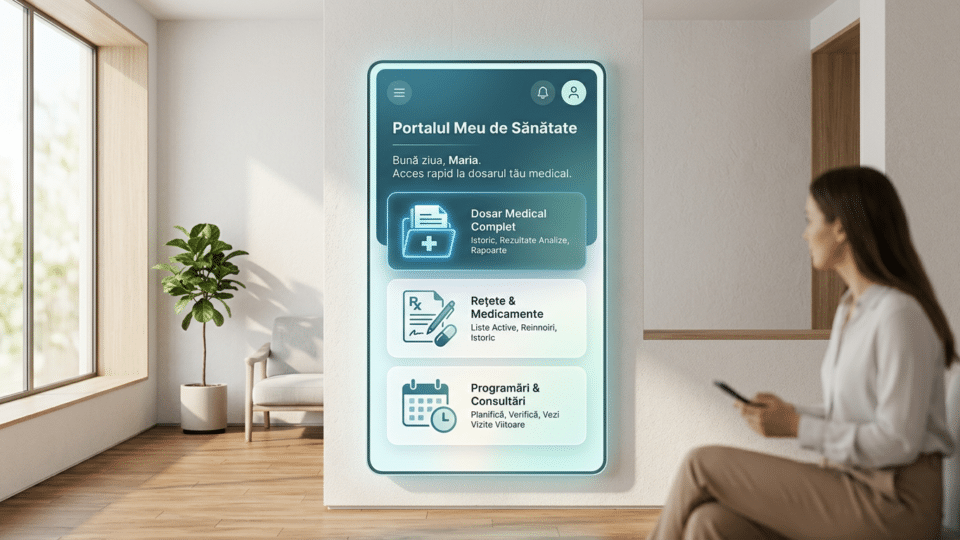
The e-HealthaMea portal is no longer merely a legislative promise: Romania’s National Health Insurance House (CNAS) announced its launch on 1 September 2026 at portal.esanatateamea.ro. As of 26 October 2026, a patient can create an account and view certain information from the CNAS ecosystem. Online doctor appointments, however, are being rolled out as an expanding module, rather than as a service guaranteed for every practice, specialty or locality.
In brief: Law No. 157/2026 requires CNAS to make the portal available in the second half of 2026 and provides for providers to use the appointments portal in the fourth quarter. In practice, CNAS says appointments are being introduced in stages for outpatient providers that request credentials and publish their availability. Having a portal account does not automatically mean access to every doctor.
The e-HealthaMea portal: what Law No. 157/2026 requires
Law No. 157/2026, published in Romania’s Official Gazette on 20 July 2026 and effective from 23 July 2026, amended Health Law No. 95/2006. It requires CNAS to develop, administer and make the e-HealthaMea portal available to insured people from the second half of 2026.
The law describes secure access to personal medical information, electronic services for interacting with providers of medical services, medicines and medical devices, and digital services for monitoring health status.
For more information on CNAS, see also When PIAS goes offline: what patients can request and who is responsible for continuity of care, which offers additional details on the subject.
The law also provides that the electronic appointments portal must be used by all providers from the fourth quarter of 2026. Until then, it refers to a pilot project intended to make the system operational.
The important wording is “the fourth quarter”, rather than a specific day. Law No. 157/2026 does not establish a separate legal deadline of 1 October. Any more precise date should be attributed to the document or institution that announces it, rather than presented as a rule written directly into the law.
What patients can currently see in the portal
In its launch communication, CNAS said citizens access the portal through ROeID and listed its initial functions. According to official information republished by AGERPRES, an enrolled user can view:
- their insured status and medical services package;
- prescriptions issued in the past five years;
- their health history for the past 10 years, within the limits of data available in the system;
- payments settled by CNAS;
- information on the national health card and health insurance fund;
- specialist outpatient providers that accept online appointments.
CNAS also says medical forms issued by providers that have a contractual relationship with health insurance funds may reach the portal and become visible to the patient.
That is not, however, confirmation that every user has a complete clinical record containing every test result, imaging examination, consultation or document ever produced in Romania’s public and private systems. The official wording refers to data that exist and have been transmitted through CNAS infrastructure. Documents from non-contracted providers, records not yet digitised, or information not reported electronically may not appear.
Online appointments: a legal requirement, but access is conditional in practice
This is where the gap between the legal framework and a patient’s practical experience becomes clear. The law sets the fourth quarter of 2026 as the period in which providers are to use the portal. CNAS has explained, however, that at the initial stage the appointments sub-module is intended for specialist outpatient care, and interested providers must request credentials. The list is updated as they join and activate their availability.
Whether an appointment is available therefore depends on several conditions being met at once: the provider must be present in the module, the specialty must be listed, the doctor or facility must publish open slots, and the service must be functioning at that time.
| What the source promises or confirms | What it means for patients | Limitation to bear in mind |
|---|---|---|
| The law requires use of the appointments portal in the fourth quarter of 2026 | There is a legal obligation directed at providers | The law does not publish a list of practices already connected, nor detailed rules on possible exemptions |
| CNAS confirms online appointments for specialist outpatient care | Patients can search for providers that accept this channel | Not every doctor, specialty or county necessarily has published slots |
| CNAS describes phased connection and the request for credentials | Coverage is gradually expanding as providers enrol | No complete national public record of all active providers had been identified at the time of reporting |
| CNAS says an account is not compulsory | Medical services can also be accessed through the usual channels | The portal does not automatically replace telephone calls, front desks or providers’ own booking systems |
A Ziarul Financiar report of 8 October, based on data presented by CNAS and journalistic testing, indicated more than 50,000 accounts and around 2,500 appointments. The publication also reported that some appointment attempts could not be completed, while the reported number of doctors active in outpatient care was about 4,000. These figures and observations are useful as a snapshot, but do not amount to a national audit of the platform or a measure of all users’ satisfaction.
The fact that the portal has active accounts and functions published by CNAS shows that the service is not purely theoretical. At the same time, the number of accounts does not show how many patients actually found an available doctor’s appointment, or how many providers use the booking system consistently across all parts of the country.
Patients are not required to create an account
CNAS has explicitly stated that access to medical services is not conditional on creating an e-HealthaMea account. The national health card remains valid. This is particularly relevant for people who do not use a smartphone, do not have a ROeID account, or prefer telephone and in-person contact.
The Romanian College of Physicians has taken a similar position on communication channels. The organisation has called for e-HealthaMea appointments to operate as an additional option alongside telephone, in-person and providers’ own booking systems. This is a professional position, not a rule amending the law, but it confirms that the move to digital booking should not be read as the immediate removal of traditional channels.
How to check whether you can use the service for your consultation
The most useful way to approach the portal is as an additional channel, not the only route to a doctor. For an outpatient consultation, the practical steps are:
- Go to the portal and log in using the method specified by CNAS, including ROeID.
- Check your insurance status and the providers shown for online appointments.
- Search for the specialty and the time slots published by the provider you want.
- If you cannot find a slot or cannot complete the booking, contact the provider directly and ask which appointment channels it accepts.
- Keep important medical documents in your own records until you have checked that they appear correctly in the portal.
For data that appear incorrect or are missing, the public sources reviewed do not set out a single, exhaustive procedure for correcting every category of information. In practice, patients should first contact the provider that issued the document, the relevant health insurance fund or the CNAS support channel indicated for the issue, depending on the nature of the problem.
What remains unclear at the end of October 2026
CNAS has confirmed the launch and the initial functions, but several details remain insufficiently specified publicly for users to estimate real coverage in their area. No complete, up-to-date national list of all providers accepting appointments through the portal had been identified. Nor has a single public matrix clarified which functions are active for each type of provider: booking, cancellation, rescheduling, documents, results or history.
The phrase “health history for the past 10 years” should not be read as a promise of a universal clinical archive. It describes what the portal can make available from data integrated into the CNAS system, not every medical record ever generated for an individual.
Modernising the PIAS infrastructure is part of a National Recovery and Resilience Plan (PNRR) investment administered at health-system level. The Ministry of Health documentation refers to interoperability, cybersecurity and improved performance. These goals explain the project’s direction, but cannot on their own demonstrate that every function is already available without errors to every patient.
The real test of the fourth quarter will be less about whether the website exists than about verifiable public data: how many providers publish slots, how many appointments are completed, which categories of documents are visible, and how quickly errors are resolved. For now, e-HealthaMea is a launched public service with concrete functions, but its use still depends on provider integration and the system’s technical maturity.
Frequently asked questions
Is an e-HealthaMea account required to see a doctor?
No. CNAS has said that access to medical services does not depend on creating an account in the portal, and the national health card remains valid.
Can I book any doctor online through e-HealthaMea?
Not automatically. Online appointments depend on the provider being present in the appointments sub-module, the specialty being offered, and the slots the facility publishes.
Does the portal’s history mean all my medical records are digitised?
No. CNAS refers to data and forms available in its system. Records that have not been integrated, were issued by non-contracted providers or were not sent electronically may be absent.
What is the legal deadline for using the appointments portal?
Law No. 157/2026 indicates the fourth quarter of 2026 for providers’ use of the portal. The text of the law does not set an exact date of 1 October.
Sources consulted
- Law No. 157/2026 amending Article 280 of Law No. 95/2006
- CNAS: e-HealthaMea portal launched on 1 September 2026 — statement republished by AGERPRES
- Ministry of Health — PNRR investment to optimise the Health Insurance IT Platform
- Ziarul Financiar — usage data and testing of online appointments after the e-HealthaMea launch
- TVR Info — e-HealthaMea launch and phased introduction of appointments









Discuția cititorilor
Ai o opinie sau o întrebare despre acest articol? Spune-ne ce crezi.
Fii primul care deschide discuția.
Te rugăm să păstrezi un limbaj civilizat și să discuți la subiect. Comentariile spam sunt filtrate automat.