
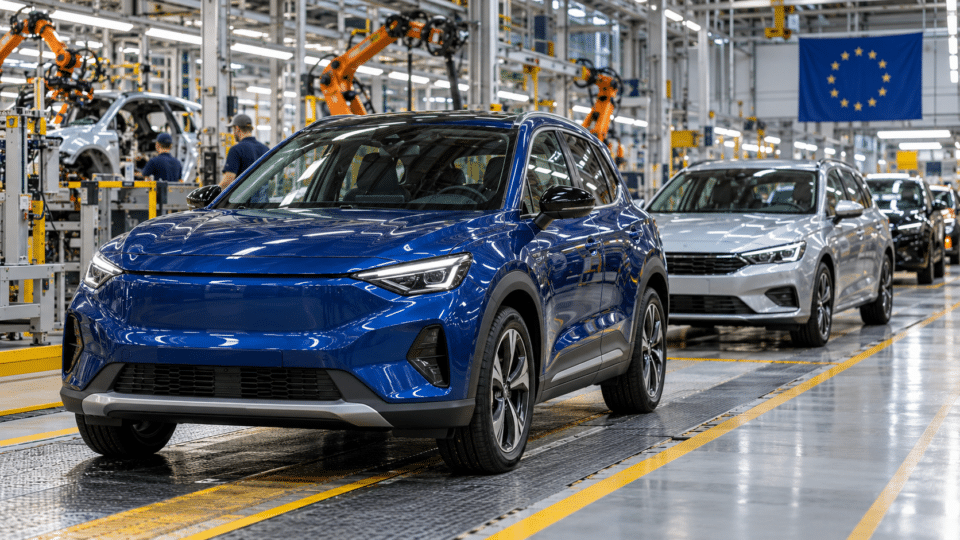
In 2025, nearly 4.8 million of the 12.6 million passenger cars produced in the European Union were electric or hybrid. That is about 38%, rounded by Eurostat to “nearly 40%”. It is a real industrial shift: a year earlier, production in these categories stood at 3.9 million units.
But the figure does not mean that 40% of cars on European roads are electric, nor that almost half of the cars produced were fully electric. The statistic covers three distinct technologies, with different use cases and charging requirements. For a buyer in Romania, that distinction matters more than the large percentage in the headline.
For more information based on Eurostat data, see Romania ranks third in the EU for risk of poverty: what Eurostat’s 27.4% figure means and who is most affected, which offers complementary details on the subject.
In brief: Electrified car production in the EU has risen quickly, but factories, the new-car market and the existing vehicle fleet are three different snapshots of the same transition.
EU electrified car production: what is included in the nearly 40% figure?
According to data published by Eurostat, 17% of passenger cars manufactured in the EU in 2025 were fully electric, 7% were plug-in hybrids and 14% were hybrids that do not charge from a plug. Together, these categories make up the nearly 40% share.
| Powertrain type in EU production, 2025 | Share of total passenger cars produced | What to keep in mind |
|---|---|---|
| Battery-electric (BEV) | 17% | The car is charged solely from an external source of electricity. |
| Plug-in hybrid (PHEV) | 7% | It has an internal-combustion engine and a battery that can be charged from a plug. |
| Hybrid without a plug | 14% | It uses an internal-combustion engine and an electric system, but cannot be externally charged. |
Nearly 40% is therefore not synonymous with “nearly 40% electric cars”. Fully electric cars represented 17% of total production. Non-plug-in hybrids made an almost equally large contribution to the result, although their use and reliance on charging stations are fundamentally different.
Eurostat puts the statistical value of electric and hybrid passenger-car production at €139 billion in 2025, compared with €123 billion in 2024. This is not the value added retained in the EU, carmakers’ profit or the amount paid by buyers; it is a trade-statistical measure of the goods produced.
Factories, showrooms and the vehicle fleet do not move at the same pace
Production shows what leaves factories. Registrations show what new-car buyers choose. The vehicle fleet, meanwhile, shows what drivers actually use day to day. Confusing these three data series can lead to mistaken conclusions.
In the EU new-car market, ACEA reported a 17.4% share for fully electric passenger cars in 2025, equivalent to 1,880,370 units. The category the association calls hybrid-electric accounted for 34.5% of the market, while plug-in hybrids accounted for 9.4%. These classifications should be read within their own methodology and not automatically overlaid on Eurostat’s production categories.
The broader direction is clear: electrification has moved beyond marginal status in the new-car market. It has not, however, rapidly replaced the existing fleet. Eurostat estimates that there were about 7.6 million fully electric passenger cars in the EU at the end of 2025. In 19 of the 22 Member States for which data were available, cars using alternative forms of energy accounted for less than 10% of the vehicle fleet.
That is the practical difference between an industry changing its supply and a road reality that changes slowly. Passenger cars remain in use for many years, and the used-car market reflects this shift with a delay.
Romania: hybrids drive the market, but the vehicle fleet remains old
In Romania, the gap between new cars and those already on the road is even more visible. Eurostat says passenger cars using alternative fuels accounted for 20.2% of new registrations in 2025, under the institution’s statistical definition. At the same time, 39.1% of passenger cars in the national fleet were at least 20 years old.
The APIA series, calculated using DGPCI data and published for 2025, uses a broader category called “electrified”. Under this definition, the category reached 55.2% of newly registered passenger cars. APIA’s release reports 155,855 new passenger-car registrations in 2025 and a decline of about 9% for fully electric models.
There is no automatic contradiction between the high share of “electrified” cars and weak BEV performance. The explanation is primarily one of composition: hybrids, including those without a plug, carry substantial weight in the aggregate category. For anyone comparing options, this means that the term “electrified” is not enough to assess whether charging will be needed at home, at work or while travelling.
A proper comparison also requires attention to the source. APIA and ACAROM published slightly different annual totals for Romania’s 2025 market. The difference does not justify adding or combining the series; they may reflect different extraction dates and reporting methodologies. This article uses the APIA figure strictly for the category and series reported by APIA.
Chinese imports and EU exports describe two simultaneous realities
In 2025, the EU imported electric and hybrid passenger cars worth €45.1 billion and exported such cars worth €64.7 billion, according to Eurostat. At this broad-category level, the EU’s exports were therefore greater than its imports in value terms.
At the same time, China supplied 42% of EU imports of fully electric passenger cars. The percentage does not refer to all electrified cars, batteries, raw materials or software. It does, however, show why industrial dependencies do not disappear simply because the EU is producing a growing volume of electric and hybrid passenger cars.
The European Commission treats battery competitiveness and supply-chain resilience as separate issues for the automotive industry. A technical assessment by the Commission’s Joint Research Centre finds that the EU has no clear competitive advantage over its main competitors in battery production, and identifies vulnerabilities related to raw materials, costs and industrial capacity. Assembling a passenger car in Europe therefore does not guarantee European control over every high-value component.
What changes for used-car buyers
The data do not support a certain prediction about used-car prices, repair costs or how much a model will be worth in several years. They do show, however, that the future supply of second-hand vehicles will gradually include more electrified technologies than the market does today.
For a used car, the general “hybrid” label is not sufficient information. It is worth distinguishing from the outset between:
- BEVs: real-world range, battery history, charging speed, compatibility with the charging network and the remaining battery warranty;
- PHEVs: the realistic ability to charge regularly and the battery’s condition, because using the car solely with its internal-combustion engine can substantially change consumption compared with the expected scenario;
- non-plug-in hybrids: the maintenance history of the hybrid system and the exact type of system, without assuming it offers the same practical benefits as a BEV.
Public infrastructure is expanding, and the European AFIR regulation sets requirements for alternative-fuel networks, interoperability and user information. Still, the existence of EU targets and funding does not demonstrate that charging is already equally accessible in every town or on every route. Before long journeys, drivers can check traffic conditions in Romania, but planning charging stops remains separate from traffic information.
The large figure is an industrial signal, not a verdict on the transition
The nearly 40% figure confirms that European factories are substantially adjusting their output. It would nevertheless be wrong to read it as evidence that Europe has completed its transition to electric mobility, or that Romanian drivers have moved to fully electric cars at the same pace.
In 2025, the industry’s statistical result had three distinct components: 17% fully electric passenger cars, 7% plug-in hybrids and 14% hybrids without a plug. In Romania’s old vehicle fleet, the shift will be felt gradually. Buyers will encounter these technologies more often in the new-car market and, later, in the second-hand market, but the specific decision will continue to depend on the exact technology, access to charging and the verifiable cost of use.
Frequently asked questions
What share of EU car production was fully electric in 2025?
According to Eurostat, 17% of passenger cars produced in the EU in 2025 were fully electric. The nearly 40% figure also includes plug-in hybrids and hybrids that do not charge from a plug.
Why does the Eurostat percentage differ from the share of “electrified” cars reported in Romania?
The sources use different categories. Eurostat uses statistical classifications for production or alternative fuels, while APIA uses an aggregate category of “electrified” passenger cars. The percentages must be read together with each source’s definition.
Does higher electrified-car production mean Romania’s vehicle fleet is changing quickly?
Not automatically. New registrations are only the annual inflow, while the existing fleet is renewed over time. Eurostat reports that 39.1% of passenger cars in Romania were at least 20 years old in 2025.
Sources consulted
- Eurostat — EU trade in electric and hybrid cars up in 2025
- ACEA — New car registrations: +1.8% in 2025; battery-electric 17.4% market share
- Eurostat — Passenger cars in the EU, Statistics Explained
- APIA — December 2025 car market: detailed analysis of vehicle registrations in Romania
- European Commission / JRC — Battery Technology in the European Union: 2025 Status Report





Discuția cititorilor
Ai o opinie sau o întrebare despre acest articol? Spune-ne ce crezi.
Fii primul care deschide discuția.
Te rugăm să păstrezi un limbaj civilizat și să discuți la subiect. Comentariile spam sunt filtrate automat.