
An AGM, EFB or conventional car battery should not be chosen solely on price, amperage or whether it fits under the bonnet. In a vehicle with Start-Stop, energy recuperation or intelligent charging management, an unsuitable battery may have a shorter service life, limit the Start-Stop function and contribute to electrical warnings. Some models also require the new battery to be registered or adapted in the vehicle’s electronic system.
Two batteries may have the same nominal 12 V voltage, the same amp-hour capacity and similar dimensions without being interchangeable. The difference lies in their electrochemical technology, resistance to charge-discharge cycles, compatibility with the management system and the vehicle’s approved specification. VARTA explicitly explains that a vehicle factory-fitted with an AGM battery should normally receive another AGM battery, while an EFB may sometimes be replaced with an AGM if the application and adaptation are compatible.
This InfoBuz guide explains the difference between AGM, EFB and conventional batteries; how to read Ah and CCA figures correctly; why electrical errors can appear after an incorrect replacement; how the battery sensor works; and when coding is needed on VW, Škoda, Audi or SEAT vehicles. It also includes a diagnostic approach intended to prevent the purchase of a new battery when the real problem is the alternator, a hidden electrical draw or an oxidised connection.
Quick answer: which battery should you choose for your car?
The starting rule is the carmaker’s specification, verified against the VIN and the vehicle’s actual configuration. The label on the battery currently fitted is useful, but not infallible: a previous owner may already have installed the wrong battery.
| Vehicle configuration | General choice | What must be checked |
|---|---|---|
| Car without Start-Stop, with a conventional system | Conventional battery meeting OEM requirements; EFB may be a compatible option | Permitted technology, Ah, CCA, dimensions, polarity |
| Basic Start-Stop, factory-fitted with EFB | Equivalent EFB; sometimes an upgrade to AGM | Whether the vehicle accepts AGM and any BMS adaptation |
| Start-Stop / energy management with factory-fitted AGM | Equivalent AGM, not a downgrade to EFB or conventional | OEM parameters, installation location, charging system |
| Vehicle with a battery monitoring system | The type required by the manufacturer, possibly with registration | Sensor, coding/adaptation, post-installation diagnostics |
In a technical guide published in 2026, ADAC recommends consulting the manual, ensuring that the new battery matches the required type and dimensions, and choosing a cold-cranking current at least equal to the specification. Capacity in Ah should remain close to the manufacturer’s recommendation. These rules matter more than a commercial offer.
AGM, EFB or conventional: the three technologies explained
1. Conventional battery: suitable for vehicles designed for it
A conventional starter battery, also called a flooded or SLI (Starting, Lighting, Ignition) battery, is a lead-acid battery with liquid sulphuric-acid electrolyte. Its main purpose is to supply a high current to start the engine and power the 12 V electrical system. The alternator recharges it while the engine is running.
It is a normal choice for many cars without Start-Stop and without special cycling requirements. It should not be presented as a “bad” technology: it does its job when the vehicle was designed for this battery type. But using an ordinary battery in a vehicle that requires EFB or AGM can subject it to cycles and energy demands for which it was not designed.
A modern conventional battery may be labelled “maintenance-free”, but that does not make it an AGM battery. The term refers to construction and maintenance, not tolerance of Start-Stop use.
2. EFB: an improved flooded battery for repeated cycles
EFB means Enhanced Flooded Battery. It is still a lead-acid battery with liquid electrolyte, but its plates and materials are modified to tolerate repeated cycling better than a conventional SLI battery.
VARTA cites significantly improved cycling resistance compared with a conventional battery under the applicable test conditions. EFB is frequently used in cars with less demanding Start-Stop systems and may also suit certain cars without Start-Stop that have many electrical consumers or see intensive urban use.
The difference from AGM is not merely price. EFB remains a flooded technology, and the vehicle’s energy-system type determines whether it provides the necessary performance.
3. AGM: electrolyte absorbed in glass fibre and high cycle resistance
AGM means Absorbent Glass Mat. Its electrolyte is retained in a glass-fibre structure and the battery uses a pressure-regulated valve construction. This gives it favourable characteristics for repeated charging and discharging, high starting currents and supporting electrical consumers while the engine is off.
AGM is found in vehicles with complex Start-Stop systems, brake-energy recuperation and numerous comfort systems. AGM does not mean lithium-ion, nor is it entirely free from risks linked to overcharging or handling. It remains a lead-acid battery, and the charger type, charging profile and installation conditions matter.
Nor is every AGM battery automatically compatible with every car. An AGM battery with the wrong dimensions, reversed polarity or a capacity not accepted by the management system can be unsuitable even if it uses the required technology.
Comparison table: AGM vs EFB vs conventional battery
| Criterion | Conventional (SLI) | EFB | AGM |
|---|---|---|---|
| Technology | Lead-acid, liquid electrolyte | Improved lead-acid, liquid electrolyte | Lead-acid, electrolyte absorbed in glass fibre |
| Typical use | Without Start-Stop | Basic Start-Stop; demanding use | Advanced Start-Stop and high energy requirements |
| Cycle resistance compared with SLI | Reference | Higher | Generally very high |
| Brake-energy recuperation | Normally not the specified choice | Depends on system and specification | Frequently used in demanding systems |
| Can replace factory AGM? | No | Not recommended | Yes, if it meets the specification |
| Can replace factory EFB? | Not for Start-Stop applications | Yes, with the correct specification | Sometimes, after compatibility has been checked |
| Automatically requires coding? | Cannot be decided from the battery alone | Depends on the vehicle | Depends on the vehicle |
| Purchase cost | Usually lower | Intermediate | Usually higher |
Indicative comparison based on VARTA and Exide documentation. Exact performance differs between models, product lines and tests; this table does not replace the vehicle application catalogue.
Can EFB be replaced with AGM? What about AGM with EFB?
AGM → AGM: this is the rule for a vehicle factory-fitted with AGM. Cutting costs by moving to EFB or a conventional battery is not an equivalent replacement. The energy-management system may be configured for the performance and behaviour of an AGM battery.
EFB → EFB: this is the usual replacement solution, provided capacity, starting current, dimensions, terminals and any adaptation instructions are respected.
EFB → AGM: manufacturers including VARTA indicate that such an upgrade may be recommended for demanding use, but application compatibility must be checked. Exide notes that a change in technology may require the vehicle to be reprogrammed. Physically installing the battery and driving away is not necessarily sufficient.
AGM → EFB: this is a downgrade and is not recommended for a vehicle designed for AGM. The fact that the car starts immediately after installation does not prove long-term compatibility.
For more information on car batteries, see also Car will not start? The correct order for jump leads and when to stop, which provides complementary details on this subject.
Conventional → EFB/AGM: this should not be done solely because a product appears “premium”. Check the intended charging voltages and strategy, battery location, installation space and compatibility confirmed by the manufacturer. EFB can make sense in some demanding applications, while AGM should be selected only when it suits the vehicle.
Why an unsuitable battery can cause electrical errors without a control module being faulty
In modern cars, the battery is more than a reserve for the starter motor. It stabilises the 12 V supply, and several electronic modules may monitor voltage and energy status. A drop below certain modules’ operating threshold can result in stored errors.
VARTA explains that insufficient power during work on the vehicle can create undervoltage errors and lead to the loss of volatile settings, such as stored window positions or the need to reinitialise systems. This is not a reason to ignore every warning: some may indicate independent faults and require proper diagnosis.
1. Start-Stop no longer switches off the engine
The Start-Stop function may be restricted when the battery’s state of charge is insufficient or when the management system does not estimate enough energy for a restart. After a battery replacement, some cars need adaptation or time to recalculate their state of charge. Start-Stop may also be inhibited for other reasons: engine temperature, air conditioning, outside temperature, diesel particulate filter regeneration or other conditions defined by the manufacturer.
2. Low-voltage messages appear
A discharged battery or poor connection can result in low voltage or undervoltage DTCs, including in modules with no internal fault. The solution is not to replace the electronic unit immediately: first check the power supply, connections, history of voltage drops and the conditions under which the error was stored.
3. Comfort functions are limited
In certain vehicles, energy management can temporarily deactivate or restrict consumers such as some comfort functions in order to preserve energy needed for starting. That does not prove that heated seats, the multimedia system or climate control have separately failed.
4. The BMS still “thinks” the battery is old
Some systems estimate battery condition from use over time. If the new battery is not registered where the manufacturer requires this step, energy-management calculations may remain unsuitable for the newly fitted battery. Behaviour differs between self-adapting systems and those requiring intervention with a diagnostic tester.
5. A weak battery is confused with an alternator fault
Low voltage can result from a degraded battery, but also from a charging problem, a regulator, damaged cables or poor connections. Replacing the battery without checking the charging circuit may cause the new part to discharge prematurely.
Important: an unsuitable battery can contribute to such symptoms, but a dashboard error alone does not establish the cause. Proper diagnosis combines electrical testing with reading fault codes and the conditions in which they occurred.
What do Ah, CCA, EN and battery-label dimensions mean?
A car battery label may show figures such as 12 V, 70 Ah, 760 A (EN). This is an illustrative example, not a recommendation for a particular vehicle.
12 V: the nominal voltage of the auxiliary electrical system
For the vehicle considered in this article, the lead-acid starter battery is used in a nominal 12 V electrical system. The nominal value is not the same as the voltage observed at rest or during charging.
Ah: nominal capacity, not “starter-motor power”
Amp-hours (Ah) indicate nominal electrical capacity measured under standardised conditions. They do not directly represent the maximum current available for starting. An 80 Ah battery is not automatically more suitable than a 70 Ah battery if the car was designed for a different size, weight, energy profile or software-configured capacity.
CCA: cold-cranking current
CCA (Cold Cranking Amps) indicates the ability to supply high current at low temperature, measured under a standardised method. It is particularly important for engines requiring high starting current, including many diesels.
Compare figures expressed under the same standard. If one battery states CCA under EN and another under a different method, the numbers should not automatically be treated as identical. In general, a cold-cranking current equal to or above the specification may be acceptable, but it does not solve a mismatch of technology, dimensions or capacity.
Dimensions, polarity, mounting and gas venting
You must check length, width, height, terminal position, terminal type and size, hold-down arrangement and any ventilation system required by the manufacturer. A longer casing may not fit under the cover or may not be secured properly. Incorrect polarity may make connection impossible without dangerous improvisation.
For batteries located in the boot or passenger compartment, the ventilation route and compatible construction are particularly important. ADAC recommends reinstalling ventilation components where fitted. An AGM battery is not completely gas-free in all circumstances and must not be installed without regard to safety instructions.
Where to find the correct specification: VIN, manual, catalogue and OEM code
Before ordering, begin with the owner’s manual and an application catalogue that identifies the car by VIN (vehicle identification number), engine, year, equipment level and Start-Stop system. Also check the original battery code if it can be established from the manufacturer’s documentation.
It is not enough to select only “Skoda Superb 2014” or “Volkswagen Golf diesel” in an online shop. Within the same generation, engines, electrical packages, destination countries and equipment levels may differ, with different battery specifications. In addition, the currently fitted part may not be the original factory item.
An example without claiming a universal part: for a diesel car with Start-Stop, choosing a battery may require confirmation of AGM or EFB type, capacity and starting current through the manufacturer’s catalogue or the original OEM label. It is not correct to invent a capacity or part number from the vehicle’s year and engine alone.
Registering the new battery: what BMS is and why some cars require adaptation
BMS, or battery management system, together with a sensor monitoring current and voltage, may estimate state of charge (SOC), state of health (SOH), use over time and energy available to consumers. On some vehicles, the control unit adapts the charging strategy and limits certain functions when the estimated reserve is low.
When a new battery is fitted, some vehicles automatically learn its new condition, others require registration by diagnostic equipment, and some older models have no special procedure. VARTA’s technical documentation on battery coding describes several manufacturer strategies: self-adaptation, a specific BEM code, or entering parameters such as capacity, technology, manufacturer and identifier.
Registration is not the same as clearing fault codes. A tester can erase a DTC, but that does not automatically mean that the system has accepted the new battery. Nor can adaptation compensate for fitting a technology physically incompatible with the vehicle.
Practical VW, Škoda, Audi and SEAT example: what to check with VCDS
On many Volkswagen Group models, including some Škoda, VW, Audi and SEAT vehicles, systems may require battery registration. Ross-Tech, the developer of VCDS, states that the procedure differs according to the control-unit type and the vehicle’s specific configuration.
Ross-Tech documentation describes, among other things, systems using address 61 – Battery Regulation and systems where battery information is managed through address 19 – CAN Gateway. Some platforms have adaptations called Battery adaptation – Rated battery capacity, Battery manufacturer, Battery serial number and Battery technology. On other platforms, the menus and coding method differ.
A responsible workshop procedure includes:
- Identifying the vehicle and carrying out a VCDS Auto-Scan before work begins.
- Saving the existing adaptation data and any relevant faults.
- Checking by VIN the required technology, capacity and starting current.
- Physically replacing the battery in line with manufacturer instructions and electrical-safety requirements.
- Determining whether that platform requires registration or self-adaptation.
- Updating parameters only by the correct procedure for the identified control unit.
- Making final checks of supply voltage, errors and functions, without assuming Start-Stop will be active immediately.
Do not enter invented values into an unfamiliar control unit. Ross-Tech provides examples for several module generations, but a screenshot or adaptation channel intended for an Audi does not automatically apply to a Škoda from the same year. Some codes and serial numbers matter for registration traceability; others are tied to the specific management system. Use the current documentation for the module and the service procedure.
The battery sensor on the negative cable—often identified in VAG documentation as J367—also warrants checking where diagnosis indicates a communication or measurement problem. A code associated with the sensor does not automatically mean that the battery is faulty, nor that the sensor should be replaced without further measurements.
What battery voltage indicates: 12.9 V, 12.6 V, 12.2 V—and why a multimeter is not enough
A resting-voltage measurement can be useful, but it should be taken after a sufficient period at rest, once the battery no longer has surface charge from recent charging. ADAC recommends avoiding a measurement immediately after a journey and gives separate indicative benchmarks for conventional and AGM batteries.
| Indicative condition | Conventional | AGM Start-Stop |
|---|---|---|
| Fully charged, under reference conditions | about 12.70 V | about 12.90 V |
| Approximately 80% charged | about 12.50 V | about 12.65 V |
| Approximately 50% charged | about 12.20 V | about 12.25 V |
| Heavily discharged, under the reference-table conditions | about 11.80 V | about 11.80 V |
Source: ADAC, “Autobatterie testen”, March 2026, table using Banner Batterien data. These are state-of-charge benchmarks, not a universal diagnosis of battery health. Temperature, measurement conditions, battery profile and wear can alter interpretation.
A battery reading 12.8 V after charging may nevertheless have a reduced ability to provide starting current. Conversely, a good battery discharged by an electrical consumer left on can show a low value without necessarily requiring replacement.
A proper test can include available starting current, internal resistance, state of charge, SOH assessment, voltage during starting and verification of actual charging. A professional Start-Stop battery tester is preferable to a conclusion based on a voltage figure alone.
The alternator reads 14.3 V: does that mean the entire system is sound?
Not necessarily. A value such as 14.3 V measured at a particular moment with the engine running may be consistent with charging operation, but does not by itself prove that the alternator, regulator, cables and charging strategy are all perfect. In some intelligent systems, voltage can vary under control according to temperature, state of charge and driving conditions.
When diagnosing a Start-Stop vehicle, resting voltage, behaviour under load, charging current, sensor operation and any module faults all matter. No single “good” reading replaces testing under different conditions.
If a new battery discharges within a few days, check the charging circuit and parked current draw after the modules have entered sleep mode before buying another one. InfoBuz has a separate guide on how to distinguish a hidden electrical consumer from a worn battery.
How long does a car battery last, and why can short trips wear it out faster?
Service life is not fixed and cannot be guaranteed from AGM, EFB or conventional technology alone. Age, temperature, urban use, state of charge, long periods parked, electrical consumers, the alternator and installation quality all matter.
ADAC notes that short trips, long periods without use and high temperatures can shorten battery life. In winter, starts can put greater strain on the battery, while simultaneous use of demisting, heating and other consumers can reduce the available reserve.
A car used almost exclusively for journeys of a few kilometres may not recover enough energy after repeated starts. A smart charger suited to the battery technology and connected in line with vehicle instructions can help maintain charge in some situations. It is not, however, a solution for a faulty alternator, persistent parasitic drain or a battery with internal damage.
Readers interested in long-term maintenance can also see InfoBuz’s analysis of what happens to a car after 200,000 km and which components age even when the vehicle appears to be fine.
How to charge an AGM or EFB battery without damaging it
A quality charger must be selected for the battery’s voltage and technology. Some chargers have distinct AGM and flooded-battery modes; others use automatic programmes that comply with permitted specifications. Do not assume that a gel-battery mode is automatically suitable for AGM.
VARTA recommends following the battery and charger manufacturers’ instructions to avoid overstressing and overcharging. On cars with a sensor on the negative terminal, the vehicle manufacturer may specify charger connection points; an incorrect connection can affect how the system observes the energy transferred.
Do not open an AGM battery case to top up liquid, and do not use improvised “reconditioning” procedures or arbitrary charging voltages. If the battery is swollen, damaged, leaking or smells unusual, stop work and seek specialist help.
Replacing a battery at home: why it can be more complicated in modern cars
On an older car without advanced management systems, replacement may seem relatively simple. But on many modern vehicles, interrupting the power supply, making a connection error or omitting adaptation can create secondary problems. ADAC expressly recommends having replacement carried out by a professional, especially on models with Start-Stop and sensors.
As a general safety principle for a 12 V battery installed in a conventional car, with the engine off and under conditions specified by the manufacturer, the negative terminal is generally disconnected first, then the positive; when reconnecting, positive is connected before negative. This is not a complete procedure applicable to every vehicle, particularly hybrids or vehicles with special configurations.
Use protective equipment, avoid acid contact and short circuits, keep away flames and sparks, and follow the specified connection points and service steps. A battery is heavy, contains hazardous substances and can deliver very high current in a short circuit.
After installation, some cars may require reinitialisation of the windows, clock or other settings. A warning light should be addressed through diagnosis, not by assuming it will always disappear on its own.
Common mistakes when buying an AGM, EFB or conventional battery
- Choosing on Ah alone: ignoring technology, starting current and BMS compatibility.
- Thinking any 12 V battery will do: nominal voltage does not mean full compatibility.
- Replacing AGM with EFB to save money: this may be a manufacturer-unrecommended downgrade.
- Fitting a conventional battery to Start-Stop: ordinary batteries are not designed for the system’s demands.
- Ignoring polarity and mounting: a physically unsuitable battery can be dangerous.
- Relying on the fitted battery: a previous owner may already have installed the wrong part.
- Not checking the alternator: a charging problem can damage the new battery too.
- Not checking hidden consumers: a new battery does not repair a parasitic drain.
- Skipping registration required by the vehicle: the BMS may retain unsuitable data for the new battery.
- Changing VCDS parameters at random: channels vary by generation and control unit.
- Judging its condition only by 12.6 V: voltage alone does not measure starting reliability.
- Using the wrong charger: its programme and connection must suit the technology and vehicle.
How much do brand and price matter? The criteria that come before the logo
A product from a well-known manufacturer does not become suitable through reputation alone, and the most expensive battery is not automatically the best for every vehicle. Before comparing prices, eliminate models that do not meet the required technology, starting current, accepted capacity, dimensions, polarity and installation requirements.
Only then compare warranty terms, manufacturing date or storage condition, the availability of proper installation and testing services. A battery stored for a long time without maintenance may need testing or recharging before installation.
A simple financial calculation is the total cost over the actual period of use, rather than the price on the label. If an unsuitable battery wears quickly and requires another intervention, the initial saving may disappear. There is, however, no standard service life guaranteed for AGM over EFB across all vehicles.
What happens to the old battery: recycling is part of the replacement
Lead-acid car batteries must not be put in household rubbish or stored or dismantled using improvised methods. They contain materials requiring specialist collection and treatment.
The European Commission explains the aims of Regulation (EU) 2023/1542 on battery collection and recycling. For starting, lighting and ignition (SLI) batteries, the European framework provides systems for taking back used batteries, including return obligations through relevant distributors, subject to the law.
In practical terms, hand the old battery to a retailer or authorised collector and check the local take-back procedure. Do not try to empty the electrolyte or recover the materials inside yourself.
Checklist before ordering a battery: 12 points to check
- Have I identified the exact vehicle by VIN and engine?
- Do I know whether it has Start-Stop and which technology the manufacturer specified?
- Have I confirmed whether the OEM battery was conventional, EFB or AGM?
- Does the Ah capacity meet the specification or fall within the accepted tolerance?
- Is CCA at least at the required level, compared under the same standard?
- Are the dimensions and hold-down arrangement correct?
- Are the polarity and terminal type identical to the vehicle’s requirements?
- Have I checked the ventilation system and installation location?
- Have I tested the old battery before declaring it faulty?
- Have I ruled out alternator, connection and parasitic-draw problems?
- Do I know whether the car requires the new battery to be registered with a tester?
- Have I chosen a workshop able to carry out installation, testing and adaptation?
Frequently asked questions about AGM, EFB, Start-Stop and VCDS
What is the difference between an AGM and an EFB battery?
AGM retains electrolyte in glass-fibre materials and is often used in applications with high cycling and energy-management demands. EFB is an improved flooded battery suited to many less demanding Start-Stop systems.
Can I fit an ordinary battery to a Start-Stop car?
It is not recommended if the vehicle requires EFB or AGM. A conventional SLI battery may start the car temporarily, but it is not an equivalent replacement and may wear prematurely.
Can I replace an EFB battery with an AGM one?
Sometimes, yes, if the manufacturer or application catalogue confirms compatibility and the energy-management system is adapted where necessary. It is not a blanket rule for every car.
Can I replace AGM with EFB?
For a car factory-fitted with AGM, this is an unrecommended downgrade. Battery manufacturers recommend replacing AGM with AGM.
What does Ah mean on a car battery?
It is the nominal capacity, expressed in amp-hours, under standardised conditions. It is not the same measure as cold-cranking current.
What does 760 A EN or CCA mean?
It indicates the ability to supply current for starting under low-temperature conditions, according to the stated test standard. Values must be compared between batteries tested under equivalent conditions.
Is a higher-Ah battery automatically better?
No. It must comply with the manufacturer’s specification, dimensions and limits accepted by the management system.
Does every car battery need to be coded with VCDS?
No. Whether adaptation is necessary depends on the vehicle and the management-system architecture. Many VW, Škoda, Audi and SEAT models require configuration, but not all use the same procedure.
What is J367 on some VAG cars?
It is a designation used for a battery monitoring sensor or module, depending on configuration. An associated error requires diagnosis of the sensor, wiring, supply and communication, rather than automatic battery replacement.
If the battery has 12.6 V, does that mean it is good?
Not necessarily. Resting voltage roughly indicates state of charge, but does not confirm the battery’s actual starting capacity or state of health.
If the alternator shows 14.3 V, can I rule out a charging problem?
No. It is a single measurement that must be interpreted in light of the configuration and operating conditions. Diagnosis also checks current, supply under load, connections and any faults.
Why does Start-Stop no longer work after battery replacement?
The BMS may need adaptation, the state-of-charge estimate may need to stabilise, or normal operating conditions may not yet be met. There are also other causes unrelated to the battery; diagnosis is needed if the problem persists.
Can a weak battery cause warning lights in other modules?
Yes. Undervoltage events can produce secondary errors. However, a warning light can also indicate a real fault unrelated to the battery.
How long does an AGM or EFB battery last?
There is no universal lifespan. It depends on product quality, charging, temperature, usage profile and the condition of the electrical system.
Is it safe to replace the battery myself?
For modern vehicles, particularly those with Start-Stop or battery management, ADAC generally recommends a specialist workshop. There are electrical, chemical and configuration risks; the manufacturer’s manual and procedure take priority.
Conclusion: do not buy “a 12 V battery”—buy the correct battery for the car’s system
AGM, EFB and conventional batteries use different technologies for different energy demands. In a vehicle without Start-Stop, a conventional battery may be exactly the right choice. In a vehicle factory-fitted with AGM, a cheaper EFB product is not the appropriate replacement simply because it has the same amp-hour figure.
A responsible choice begins with the OEM specification, continues with checking Ah, CCA, dimensions and polarity, and ends with correct installation and registration where required. If there are starting problems or electrical errors, the battery, charging system, connections and current draw at rest should be tested before parts are replaced.
The best car battery is not the most expensive one, nor the one with the largest figure on its label, but the one compatible with the vehicle and correctly installed.
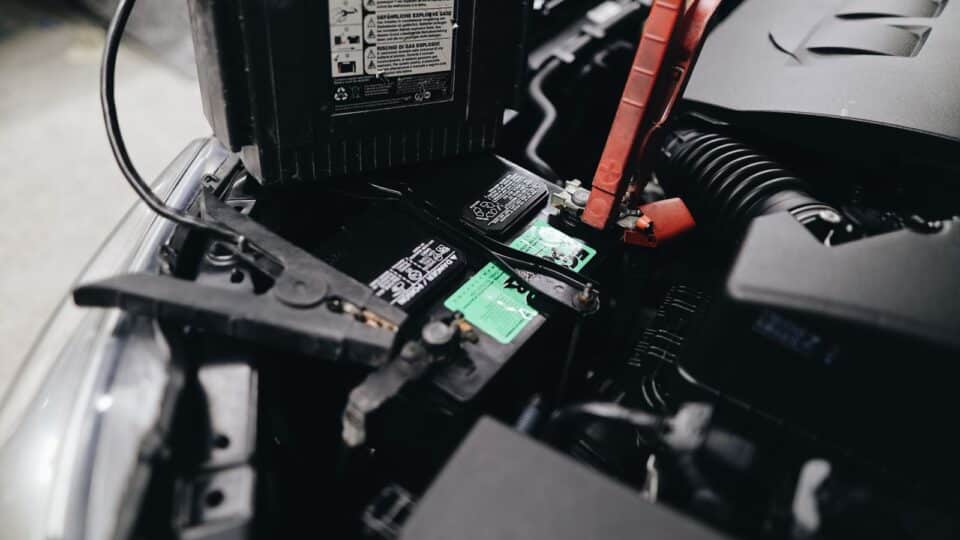
Illustrative featured image: photograph by Julia Avamotive / Pexels, used under the platform’s licence. It does not depict an experimental AGM–EFB–SLI comparison.
Technical and documentary sources
- VARTA – EFB and AGM differences: uses, replacement rules and compatibility.
- VARTA – Start-stop battery replacement.
- VARTA – Changing a start-stop battery, installation and energy management.
- VARTA – Voltage stabilization during battery exchange, undervoltage risks.
- Exide – Car Battery Replacement Guide, 27 March 2025.
- Exide – AGM, EFB and conventional technology comparison.
- ADAC – Buying a car battery: criteria for type, capacity and dimensions (2026).
- ADAC – Replacing a car battery: replacement and safety (23 February 2026).
- ADAC – Testing a car battery: resting-voltage table (23 March 2026).
- Ross-Tech Wiki – Battery Replacement: modules 19/61 and VCDS procedures on VAG platforms.
- VARTA – Correct battery charging and maintenance.
- European Commission – Regulation (EU) 2023/1542 and used-battery collection.
Editorial research: 24 October 2026. This article describes general principles for 12 V lead-acid auxiliary batteries; it does not replace a vehicle manual, VIN-based part identification, electrical testing at a workshop or safety procedures specific to hybrid/electric systems. Parameters and values in the examples are indicative, not installation recommendations for any particular make or model.






Discuția cititorilor
Ai o opinie sau o întrebare despre acest articol? Spune-ne ce crezi.
Fii primul care deschide discuția.
Te rugăm să păstrezi un limbaj civilizat și să discuți la subiect. Comentariile spam sunt filtrate automat.