
Updated: 27 October 2026 la 00:12. Articolul a fost revizuit pentru a reflecta informațiile disponibile la această dată.
Secret Romania does not mean places nobody has heard of. It means striking destinations that often remain outside the main tourist circuits. Beyond Bran, the Transfăgărășan highway and crowded resorts lie lakes with unusual colours, medieval ruins, watermills still in use, fragile peat bogs and museums where the history of a community can be explored at length. This guide brings together 20 places in Romania, selected for their variety rather than ranked artificially.
For more travel information about Romania, see Romania Few People Know: 25 spectacular hidden places a few hours from the major cities, which offers complementary details on the subject.
We checked locations, the nature of the sites and general access conditions through institutional tourism sources, museum pages and administrators’ documentation on 26 October 2026. Where a site is under restoration, has seasonal opening hours or can only be visited with a guide, this is noted. Where a landscape is fragile, we recommend permitted paths rather than dramatic and dangerous shortcuts.
InfoBuz editorial note: “lesser-known” is a relative description, not an official visitor statistic. Prices, opening hours and access may change; check the official source before travelling. The list does not suggest that all 20 sites can be visited on the same trip.
Secret Romania on the map: the 20 places and their counties
| No. | Destination | County / region | Main experience |
|---|---|---|---|
| 1 | Blue Lake, Baia Sprie | Maramureș | nature and geology |
| 2 | Garden of Dragons, Gâlgău Almașului | Sălaj | rock formations |
| 3 | Károlyi Castle, Carei | Satu Mare | history and architecture |
| 4 | Meziad Cave | Bihor | guided underground tour |
| 5 | Colțești Fortress, near Rimetea | Alba | medieval ruins |
| 6 | Râpa Roșie, near Sebeș | Alba | geological landscape |
| 7 | Câlnic Fortress | Alba | UNESCO heritage |
| 8 | Racoș Geological Complex | Brașov | basalt, crater and lake |
| 9 | Vârghiș Gorge | Harghita / Covasna | gorge and karst terrain |
| 10 | Mohoș Peat Bog | Harghita | mountain peat bog |
| 11 | Teleki Castle, Gornești | Mureș | Baroque architecture and historic gardens |
| 12 | Ulmet Trovants | Buzău | geosite in Buzău Land |
| 13 | Amber Museum, Colți | Buzău | geology and local history |
| 14 | Rudăria Watermills | Caraș-Severin | living technical heritage |
| 15 | Șușara Waterfall, Sasca Montană | Caraș-Severin | gorge hike |
| 16 | God’s Bridge, Ponoarele | Mehedinți | natural arch |
| 17 | Duca Cula, Măldărești | Vâlcea | boyar architecture |
| 18 | St Nicholas Church, Densuș | Hunedoara | medieval architecture |
| 19 | Alexandru Ioan Cuza Palace, Ruginoasa | Iași | modern history |
| 20 | Bucovinian Village Museum, Suceava | Suceava | architecture and traditions |
20 spectacular places in Romania, with visiting details
1. Blue Lake, Baia Sprie – Maramureș
A short distance above Baia Sprie, on Mine Hill, a small lake holds an unusual geological story. Water filled an area affected by former mining works, while dissolved substances and light alter its apparent colour across the seasons. Blue, turquoise or green reflections may appear, but there is no guarantee that visitors will see a particular colour on the day of their visit. It is a destination for observing nature and photography, not an invitation to swim.
Planning a visit: For a longer circuit, the local tourism centre describes a route of around 6 km, with waymarks and elevation gain. Follow the route currently marked on site, avoid unstable edges and do not enter the water. See the route description published by Baia Sprie’s tourism administration.
2. Garden of Dragons, Gâlgău Almașului – Sălaj
A few kilometres from Jibou, erosion has shaped silhouettes in rock that the imagination can turn into characters, towers or animals. The Garden of Dragons is a nature reserve of approximately five hectares, where the appeal comes from the interplay between isolated rocks and forest. Local legends can enrich a walk here, but should not be confused with the geological explanation for the formations. The contrast is particularly appealing in low light, when shadows deepen their outlines.
Planning a visit: The site can be included in a day trip from the Jibou area. In the reserve, footwear with good grip is more useful than smart shoes: wet soil and edges can be slippery. Do not climb on fragile rock blocks. For contact details and indicative opening hours, see the visitor information page.
3. Károlyi Castle, Carei – Satu Mare
In the centre of Carei stands an aristocratic residence that may surprise visitors who associate Romanian castles only with the Prahova Valley or Hațeg Country. Károlyi Castle tells the story of the noble family that influenced the region, while also housing exhibitions and rooms dedicated to local cultural figures. Its exterior, architectural details and park all deserve attention; it is more than a backdrop for photographs.
Planning a visit: The local operator generally announces visiting hours from Tuesday to Saturday, 9am to 5pm, and on Sunday afternoons, but has also announced individual closures, including on 25 October 2026. Check the museum’s updated notices before setting out.
4. Meziad Cave – Bihor
A visit to Meziad Cave takes an outing from the green landscape of the Pădurea Craiului Mountains into an underground system of large chambers and karst formations. You do not need to be a caver to enter the developed tourist section, but the visit must take place under the operator’s and guide’s conditions. In a space with a constant temperature, the contrast with the outdoors is immediate: damp walls, controlled lighting and echoes entirely change the pace of a visit.
Planning a visit: The operator indicates organised entries, generally every hour, and temperatures of about 9–12°C. A jacket and non-slip footwear are suitable even in summer. Opening hours change seasonally, so check the current timetable and group-booking arrangements. Do not leave the route or disturb underground wildlife.
5. Colțești Fortress, near Rimetea – Alba
On the rocky hill near the village of Colțești, the walls of the former Toroczkay family fortress stand in sharp contrast to the Trascău Mountains landscape. The medieval fortification, built after the invasions of the 13th century, is not a castle reconstructed for tourists: its ruins, keep and surviving wall fragments tell a story of defence, noble power and destruction. The panorama over the surrounding countryside is one reason to take the walk slowly.
Planning a visit: The national tourism route Attractive Romania notes pedestrian access from a marked dirt road, says the site is under restoration, and sets out conditions for advance arrangements. The ruins do not have the safeguards of a restored building: avoid unstable walls, steep edges and visits during heavy rain.
6. Râpa Roșie, near Sebeș – Alba
On the edge of Sebeș, a steep reddish escarpment can look, from some angles, like a monumental façade of columns, gullies and ridges. The formations are the product of erosion and natural processes shaping the slopes, not the ruins of a building. Unlike a museum attraction, Râpa Roșie looks different according to light, vegetation and weather. Sometimes it is enough to admire it from a safe viewpoint, rather than attempting climbs on its crumbly slopes.
Planning a visit: Check the condition of local roads and paths before the trip; after rain, the ground can become very slippery. The reserve needs protection: do not dislodge rocks, climb unstable ridges for photographs or leave traces. It can be paired with Câlnic Fortress or Sebeș’s historic centre.
7. Câlnic Fortress – Alba
While many visitors head for the largest fortresses, Câlnic offers a medieval experience on a human scale. The complex began as a noble residence in the 13th century and became a community fortification, with a keep, walls, chapel and spaces adapted to local residents’ needs. It is a UNESCO World Heritage site. A visit clearly shows how a building of status became a refuge and a centre of community life.
Planning a visit: According to the Attractive Romania profile, the complex can be visited with a ticket and has opening hours unlike those of an ordinary church. Câlnic is easy to combine with a trip to Râpa Roșie; there is no need to rush through five fortresses in one day for the journey to be worthwhile.
8. Racoș Geological Complex – Brașov
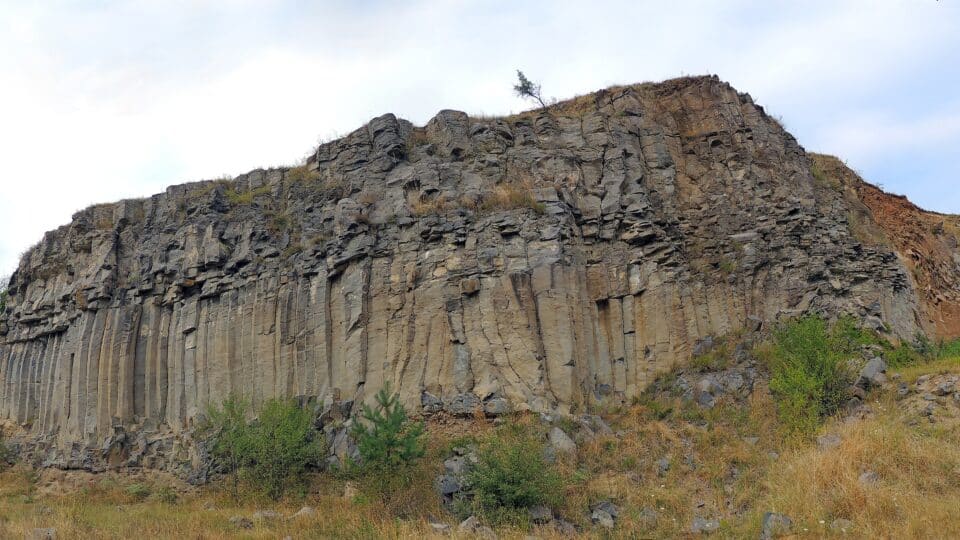
Near Racoș, a former volcanic landscape and traces of basalt extraction create an unusual succession of colours and textures. The protected area includes basalt columns, the Emerald Lake and the extinct volcano area. The columns show how cooling lava can form regular fractures; the lake occupies a former quarry, so its appearance should not be mistaken for that of a natural lake untouched by human intervention.
Planning a visit: The complex is a protected area. The local tourism source says visitors must use marked roads or be accompanied by a guide authorised by the custodian. Check the rules and any entry charge. The edges of old quarries and steep banks are not suitable for improvised exploration.
9. Vârghiș Gorge – Harghita / Covasna
Vârghiș Gorge is a route where limestone walls, forest, paths and cave entrances follow one another over a surprisingly compact distance. There is no need to enter the caves for the excursion to be striking: walking beside the water and crossing the gorge sections already offers a strong experience. The area is known for its many cavities and natural heritage requiring protection, including bat colonies.
Planning a visit: The Visit Harghita profile describes a gorge section of about four kilometres. Choose the route according to weather and water levels. Caves should only be explored under conditions allowed by the custodian, with appropriate equipment and guidance. Do not mistake the outdoor tourist path for a caving expedition.
10. Mohoș Peat Bog – Harghita
A peat bog is more than a place with water among trees. At Mohoș, a former volcanic basin gradually became a peat bog with pools of water, mosses and vegetation adapted to poor, wet soils. The landscape has a quiet beauty: dark water, mosses and distinctive plants make a visit an ecology lesson. Lake Sfânta Ana is nearby, but the two sites offer very different experiences.
Planning a visit: The administrators set out the essential rule: stay on the wooden boardwalk. Do not collect plants or peat, and follow staff instructions. Ticketing and access conditions are explained on the Visit Harghita page. Check availability before travelling, as habitat protection takes priority over unrestricted access.
11. Teleki Castle, Gornești – Mureș
In Gornești, not far from Târgu Mureș, Teleki Castle stands out for the Baroque architecture of the residence and its relationship with the surrounding park. Built in the 18th century on the site of an earlier fortification, the complex reflects how Transylvanian nobility combined comfort, social display and landscape design. Its interest lies in the history of the estate and details that cannot be reduced to a photograph of its façade.
Planning a visit: Visit Mureș recommends guided tours booked in advance by telephone. Do not assume that all rooms or parts of the park are accessible every day. Gornești can be included in a heritage weekend in Mureș County.
12. Ulmet Trovants – Buzău
At Ulmet, on a hillside, cemented sandstone blocks take almost implausible forms: spheres, mushroom-like shapes, plateaux and contours that seem hand-modelled. Trovants are not living organisms, and stories about “stones that grow overnight” should be separated from geological explanations. Their forms result from natural cementation and erosion processes. The site is part of the UNESCO International Geopark Buzău Land.
Planning a visit: Buzău County Council says access begins from the village of Ulmet, with a walking stretch of about 500 m before the stepped path, and notes an entry charge. See the directions and contact details for the Bozioru tourism centre. The reserve is not a place to carve, move or collect stones.
13. Amber Museum, Colți – Buzău
Not far from the striking landscapes of Buzău Land, the commune of Colți tells the story of a less familiar natural resource: amber. The museum devoted to the material displays specimens, jewellery, extraction tools and explanations of local mining activity. It is an ideal complement to a visit to the trovants, revealing two different geological phenomena and the ways they shaped the community’s culture and economy.
Planning a visit: According to Buzău County Council, the museum is open from Wednesday to Sunday, with seasonal hours. It can be reached from DN10 via Pătârlagele and Sibiciu. Avoid collecting minerals or fossils from protected areas, and check in advance for any closure days.
14. Rudăria Watermills – Caraș-Severin
In the village of Eftimie Murgu, also known by its older name, Rudăria, a number of watermills with traditional wheels and mechanisms turn the valley into an open-air museum of rural technology. The county tourism platform describes 22 mills that can be visited and that still have a role in community life. Their appeal does not lie in modern equipment, but in the relationship between water, wood, stone and the local need to grind grain.
Planning a visit: Visit without obstructing people who still use the mills, and do not touch moving mechanisms. A conversation with local residents may offer more context than a quick walk between the buildings. Visit Caraș-Severin provides the location and description of the complex.
15. Șușara Waterfall, Sasca Montană – Caraș-Severin
For those looking for a hike that alternates between valley, rock and water, Șușara Waterfall is an appealing choice in the Sasca Montană area. The path crosses terrain where gorge walls and vegetation create the impression of a natural corridor. The experience should not be reduced to the moment of reaching the waterfall: the walking sections, sound of water and changing light are part of the visit.
Planning a visit: Visit Caraș-Severin documents a blue-cross-marked route of about 8 km and medium difficulty, which continues past the waterfall towards Cărbunari. Do not confuse the duration of this full route with a short walk to the waterfall; check the weather, the state of footbridges and any park warnings.
16. God’s Bridge, Ponoarele – Mehedinți
In the commune of Ponoarele, a large stone arch spans the landscape like an engineering work. God’s Bridge, however, is a natural karst formation, linked to the evolution of cavities and limestone terrain. The site is compelling for the contrast between its monumental form and the surrounding village, as well as for local stories that offer a cultural reading distinct from the geological one. Other attractions of the Mehedinți Plateau are nearby, making it suitable for an unhurried circuit.
Planning a visit: Ponoarele can be reached by road on DJ670, and the attraction is listed by the VisitRomania tourism portal. For photographs, use safe viewpoints: limestone edges and areas beneath the bridge should not be explored in rain or unstable conditions.
17. Duca Cula, Măldărești – Vâlcea
In Oltenia, a cula was not merely an elegant boyar house. Its thick walls, protected windows and internal layout show how closely living and defence were linked. At Măldărești, Duca Cula provides an introduction to this distinctive regional architecture. Notice the relationship between domestic rooms, defensive features and spaces for display. Such a stop changes the perspective on Romanian heritage, often reduced in popular guides to castles and fortresses.
Planning a visit: According to Attractive Romania, the site can be visited with a ticket during published museum hours. Confirm any works or restrictions before travelling. In the same locality, visitors can compare Duca Cula’s architecture with other local monuments without conflating their respective histories.
18. St Nicholas Church, Densuș – Hunedoara
In Hațeg Country, the church at Densuș appears to be assembled from pieces belonging to several eras. Stone blocks and reused ancient fragments combine with its structure and old paintings, making it an easily recognisable monument. Several theories exist about its origins and construction phases; dramatic claims of uninterrupted antiquity stretching back two millennia should not be presented as certainties. A careful visit is an encounter with a history still being interpreted by specialists.
Planning a visit: The church is part of the new cultural route “Legend and Stone”, reported in April 2026. It is an active religious space: respect services and do not turn a visit into a photo session that disturbs the community.
19. Alexandru Ioan Cuza Palace, Ruginoasa – Iași
When Alexandru Ioan Cuza is mentioned, many people immediately think of Iași and the Union of the Principalities. Ruginoasa offers a more intimate perspective: the palace and museum collections evoke private life, decisions and the atmosphere of a period of political and social change. The architecture of the building, transformed in the 19th century, has its own story beyond the biography of the ruler. It is a good stop for those seeking a museum where historical narratives can be explored without the rush of major tourist flows.
Planning a visit: The Moldova National Museum Complex announces opening hours from Wednesday to Sunday, 10am–5pm, with last entry at 4.30pm, although public holidays may bring closures. Guided tours for groups must be requested separately. Allow time for the grounds around the residence, not only photographs of the entrance.
20. Bucovinian Village Museum, Suceava – Suceava
Near the Princely Seat Fortress, the Bucovinian Village Museum brings together traditional homesteads, installations and buildings that explain how rural life in the region was organised. It is not merely a collection of attractive houses, but a lesson in domestic space, crafts, community and adaptation to climate. The exhibits were brought together and displayed in a museum setting, which protects them and allows comparisons between local styles. For families with children, brief stops at each homestead can turn a visit into a conversation about life a century ago.
Planning a visit: The museum announces seasonal opening hours and official prices; from October to March, hours are shorter than in summer. Do not rely on very old blog information, and check for possible access changes during special events.
How to turn the list into a realistic holiday
The right choice depends on the season, transport and the kind of experience you want. For a cultural weekend, combine Ruginoasa with other attractions in the Pașcani–Iași area. For an outing in Alba, Râpa Roșie and Câlnic can form part of an itinerary slow enough to allow proper visits. In Buzău, the Ulmet Trovants and the Amber Museum in Colți can be grouped into a trip of several days, bearing in mind that secondary roads and paths may take more time than distances in kilometres suggest.
In Caraș-Severin, the Rudăria mills are a cultural experience, while Șușara requires walking on a trail; do not schedule them for the same time after a long journey. In Harghita, Mohoș requires adherence to conservation rules, while Vârghiș Gorge calls for checking the weather and trail conditions. For a holiday with young children or people with reduced mobility, the museums in Carei, Ruginoasa or Suceava may be more practical than gorges, quarries or ruins on hillsides.
What to check before leaving, especially from October to March
- Official opening hours: look up the museum’s or custodian’s page the day before, especially around public holidays and in the cold season.
- Road access: distinguish between the paved road to a locality and the path or dirt road of the final kilometres.
- Weather conditions: gorges, quarries, lake edges and clay slopes can become unsafe after rain, frost or snow.
- Tickets and guiding: some sites have scheduled visits or group tours rather than unrestricted entry at all times.
- Nature protection: do not leave boardwalks in peat bogs, collect rocks or enter undeveloped caves without authorisation.
- The full budget: factor in transport, parking, possible accommodation and meals; the admission ticket is not the only cost.
How to travel responsibly in places that are not yet crowded
Making a place better known can bring income to a community, but it can also put pressure on the environment. Do not block farm roads, park on pastures or enter private property simply because an app suggests a shortcut. At the watermills, respect the people who still use the installations. In villages with religious sites, avoid photographing people without permission and keep noise down. In geosites and protected areas, a photograph is the right souvenir, not a stone taken home.
If you prefer another way of discovering the country, without driving long distances, also see the InfoBuz guide “Spectacular Romania Without a Car: the most beautiful train journeys”. This article is complementary, since some of the destinations above require local transport or walking.
Frequently asked questions about Romania’s lesser-known places
Which are most suitable for a family trip?
Depending on age and mobility, consider Károlyi Castle, Ruginoasa Palace, the Bucovinian Village Museum and the Amber Museum in Colți. Check accessibility, opening hours and the actual duration of the visit.
Which places should I choose for unusual landscapes?
Racoș, the Garden of Dragons, Râpa Roșie, Blue Lake and the Ulmet Trovants offer different geological perspectives. Respect protected-area boundaries and do not turn viewpoints into places for improvised climbing.
Are there good destinations in winter?
Museums and some cultural complexes can be visited in the cold season if they are open. Check seasonal hours for Meziad Cave, historic estates and the Village Museum. Gorges, rocky paths and old quarries require extra caution in icy conditions.
Can all 20 places be seen on one itinerary?
In theory, yes, over a long journey through several regions, but it is not an efficient recommendation for a short holiday. It is better to choose three or four nearby sites and leave time for visits, meals and unforeseen road conditions.
Discovering Romania begins at a slower pace
Secret Romania is not a promise that visitors will have every site to themselves. It is an invitation to seek out places with a clear identity, genuine heritage and landscapes worth understanding. The 20 suggestions in this guide span nature, geology, architecture and traditions. With access information checked and a realistic plan, they can become memorable trips without sacrificing safety or respect for local communities.
Sources for research and planning
- Baia Sprie Tourist Information Centre – Blue Lake.
- Attractive Romania – Colțești Fortress and visiting conditions.
- Visit Harghita – Mohoș Peat Bog and protection rules.
- Buzău County Council – trovants and access.
- Visit Caraș-Severin – Rudăria Watermills.
- National Museum of Bucovina – opening hours and prices.




Discuția cititorilor
Ai o opinie sau o întrebare despre acest articol? Spune-ne ce crezi.
Fii primul care deschide discuția.
Te rugăm să păstrezi un limbaj civilizat și să discuți la subiect. Comentariile spam sunt filtrate automat.