
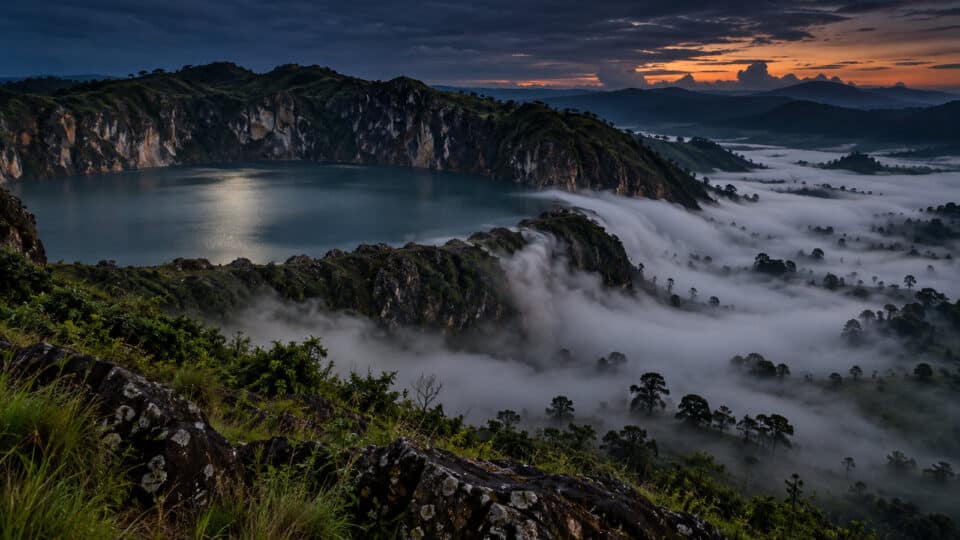
On the evening of 21 August 1986, in north-western Cameroon, the apparently tranquil Lake Nyos released an invisible cloud of carbon dioxide. About 1,700 people and thousands of animals died. There was no need for lava, a spectacular eruption or an explosion visible from afar. Understanding the phenomenon required geology, chemistry, water measurements and a troubling question: how can a lake accumulate enough gas to become deadly?
NASA Earth Observatory and research published by the U.S. Geological Survey document the Lake Nyos disaster. The death toll is sometimes reported differently depending on the source: NASA uses the wording “nearly 1,800”, while USGS reports indicate at least 1,700. What matters is the physical explanation, not a competition for a more dramatic figure.
Where did the carbon dioxide come from?
Nyos lies in an old volcanic crater. At depth, magmatic sources supplied carbon dioxide, which seeped through the Earth’s crust and reached the water, where it dissolved. The lake is deep enough for pressure and stratification to encourage gas to accumulate in its lower layers.
The phenomenon can be compared, with caution, to a carbonated drink. In a sealed container, pressure keeps a large amount of gas dissolved. When conditions change, bubbles form and the gas can escape rapidly. In a lake, the volumes, pressures and mechanisms are far more complex, but the principle of solubility helps explain what happened.
Not every volcanic lake can do this
Such an accumulation requires particular conditions: a substantial gas source, deep water, persistent stratification and insufficient exchange between the bottom and the surface. A lake whose water mixes frequently can release gas gradually, without allowing it to reach comparable concentrations. It would therefore be wrong to say that every crater lake is a natural bomb.
Researchers have also monitored Lake Monoun, also in Cameroon, to understand the accumulation and controlled release of carbon dioxide. USGS studies describe changes in concentration before and after degassing systems were installed.
What happened on the night of the tragedy?
At some point, the gas-rich water rapidly released very large quantities of CO₂. The resulting cloud moved towards nearby low-lying settlements. Carbon dioxide is colourless and, at high concentrations, can displace oxygen in the air and cause asphyxiation. NASA’s account describes a cloud moving rapidly along the valley.
The precise mechanism that initiated the process has been studied and remains a matter of scientific detail. Researchers have discussed the possibility of a landslide or an instability in the lake’s stratification. A hypothesis about the trigger should not be presented as conclusively proven fact.
Why the cloud did not rise and disperse immediately
In the conditions of the disaster, the cold, dense gas was able to travel close to the ground, following the terrain. A valley can channel the movement of a highly concentrated cloud, exposing homes in low-lying areas. Its invisibility and the speed with which it spread drastically limited people’s ability to understand the danger.
This was not a “poisonous” gas in the sense of a compound that ordinarily attacks the body at low concentrations. The main danger in this episode came from the extreme concentration of CO₂ and the lack of breathable oxygen. That distinction matters to the physical mechanism, but it does not lessen the severity of the outcome.
The science behind a rare disaster
| Question | Accepted explanation |
|---|---|
| Where did the gas come from? | Geological/magmatic sources feeding the lake water |
| Why did it remain accumulated? | Stratification and pressure in deep water |
| What released the cloud? | Rapid degassing; the precise trigger remains debated |
| Why were valleys affected? | Dense gas moved close to the ground |
| What measure reduced the risk? | Controlled release of CO₂ through specialised pipes |
The solution was surprisingly simple in principle
In 2001, researchers installed a controlled degassing system at Nyos. A pipe allows carbon-dioxide-rich water to rise, releasing the gas under managed conditions rather than allowing it to build up until a catastrophic event occurs. NASA notes that two further pipes were installed in 2011.
The simplicity of the idea does not mean the engineering is simple. The depth of the intake, flow rate, changes in concentration, equipment durability and continuous monitoring all matter for effectiveness and safety. Studies published through the USGS show that CO₂ levels fell significantly after controlled degassing began.
How researchers can tell how much gas is in the water
Temperature, pressure, physicochemical properties and gas concentrations are measured throughout the lake’s water column. Depth profiles make it possible to estimate the total amount and how it changes over time. Repeating these measurements is essential, because a lake may continue to receive carbon dioxide even after a solution has been installed.
This work is closer to monitoring a complex natural reservoir than simply observing the colour of the water. A lake that looks calm can conceal changes that cannot be detected with the naked eye.
What should not be misunderstood
- The 1986 disaster was not a lava eruption in the usual sense of the term.
- Not all lakes near volcanoes accumulate dangerous quantities of CO₂.
- The absence of bubbles at the surface is not a way to establish whether a lake is safe.
- There is no reason to apply the same label to lakes in Romania without studies.
- Degassing systems reduce a specific risk, but require maintenance and monitoring.
The broader lesson: some risks look nothing like our image of disaster
Lake Nyos remains a memorable case because it changed how geologists view gas accumulation in certain lakes. The tragedy was not caused by spectacle, but by the interaction of invisible processes that had developed over years. Good monitoring infrastructure can matter more than any alarm installed after a disaster.
Read more on InfoBuz
For another scientific explanation of natural processes that are difficult to observe, see the invisible phenomena produced by storms in the atmosphere.
Frequently asked questions
Was there a volcanic eruption at Nyos in 1986?
Geological reports indicate a catastrophic release of carbon dioxide accumulated in the lake water, without a lava eruption at the time of the tragedy. The gas source was linked to geological processes at depth.
Why did no one smell the gas?
Carbon dioxide is colourless and odourless. At very high concentrations, it can create a serious danger by reducing breathable oxygen. Smell would not have been a reliable warning method.
Can any deep lake do the same thing?
No. Dangerous accumulation requires an unusual combination of CO₂ sources, depth and persistent stratification. Researchers analyse each lake’s specific conditions, and broad analogies can be misleading.
Why did researchers install pipes in the lake?
Controlled degassing makes it possible to gradually remove part of the dissolved CO₂, reducing the build-up. The systems require monitoring and maintenance; the mere presence of pipes is not a reason to disregard long-term measurements.


Discuția cititorilor
Ai o opinie sau o întrebare despre acest articol? Spune-ne ce crezi.
Fii primul care deschide discuția.
Te rugăm să păstrezi un limbaj civilizat și să discuți la subiect. Comentariile spam sunt filtrate automat.