
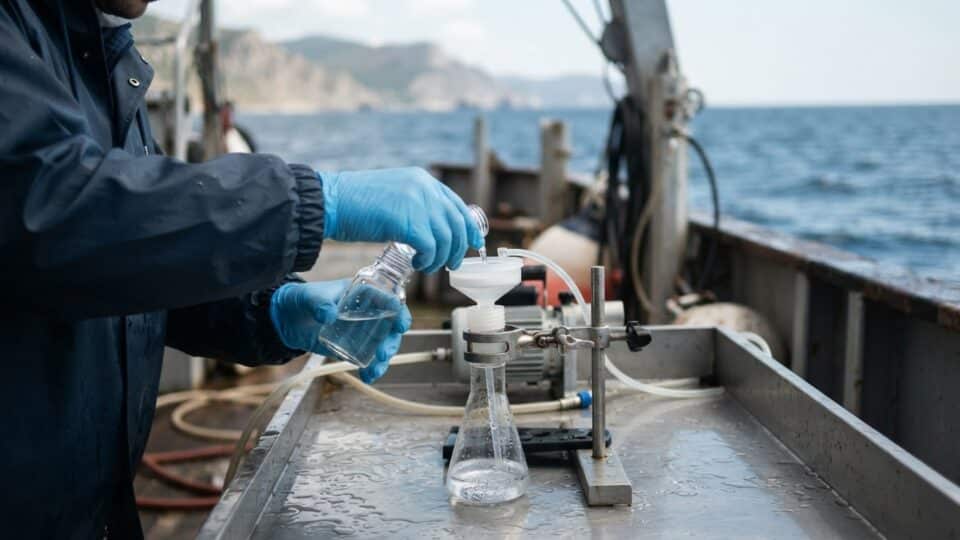
Environmental DNA in the Black Sea: sometimes, to find out which fish have passed through an area of the sea, researchers do not need to catch them. It is enough to collect water, filter its particles and analyse the genetic fragments left in the environment. A study published in November 2025, using samples collected in 2022 along Bulgaria’s coastline, identified 23 fish species in the autumn survey using an environmental-DNA method, compared with 15 species in trawl catches. In the summer survey, the comparison was 12 species versus 9.
This does not mean that every species detected genetically was swimming directly beside the research vessel when the sample was taken, or that the method can calculate the real number of fish. The result shows the potential of a technology that could change biodiversity and fisheries monitoring. InfoBuz explains the study, its limitations and what it could mean for Romania’s coast, without attributing Bulgarian data to the waters off Constanța or Tulcea.
What is environmental DNA, and why does a water sample contain information about fish?
Animals and other organisms leave genetic material in their surroundings through cells, mucus, faeces, tissue fragments and other biological sources. This material is known as environmental DNA, or eDNA. Researchers collect water, concentrate particles on a filter, extract the genetic material and analyse fragments that can be matched to species using reference databases.
The method has an unusual elegance: an animal does not have to be seen for its genetic trace to be identified. But the signal can travel with the water and may degrade depending on temperature, currents and chemical conditions. The presence of a sequence in a sample must be interpreted carefully, rather than treated as a direct observation or an automatic estimate of abundance.
The Black Sea study: who, where, when and how
The research was published on 26 November 2025 in Frontiers in Marine Science, under the title A study of feasibility and detection sensitivity of environmental DNA for fish biodiversity monitoring and stock assessment in the Black Sea. Its authors are from the Institute of Oceanology at the Bulgarian Academy of Sciences in Varna. They analysed data from two surveys, in summer and autumn 2022, at 16 locations along the Bulgarian coast, between Shabla in the north and Tsarevo in the south. Primary source: Frontiers in Marine Science, DOI 10.3389/fmars.2025.1648741.
The teams compared genetic analyses with the results of scientific trawling during the same surveys. For DNA analysis, samples were taken at several depths: about 0–5 m, 10–20 m and 30–50 m, depending on the station. From the water samples, they filtered roughly two litres at each depth through laboratory membranes, then preserved the material for extraction and sequencing. They used mitochondrial DNA regions, including 12S and 16S, for taxonomic identification.
The results came from a controlled scientific protocol, not from a bottle of water randomly collected on a beach and sent for a commercial genetic test. Sampling must limit contamination, laboratories must use controls, and analysis must compare sequences with relevant genetic libraries. If a species is poorly represented in a reference database, identification may be incomplete.
23 species versus 15: a comparison that needs explanation, not sensationalism
| 2022 survey | Species detected by eDNA (12S marker) | Species found by trawling |
|---|---|---|
| Summer | 12 | 9 |
| Autumn | 23 | 15 |
In the autumn survey, 23 species were detected genetically and 15 by trawling. The difference is eight species in the total identified by each method, but it does not mean that DNA found exactly “eight species new to science”. Most of these fish were already known, and the methods did not identify identical sets of species. Some appeared only in trawl catches. Nor does the comparison prove that eDNA is superior to every form of scientific fishing in every season or region.
In summer, the eDNA method identified 12 species, compared with nine by trawling. The finding supports the idea that analysis of genetic traces can complement conventional monitoring, particularly for species that are difficult to catch in certain conditions. The authors note that performance depends on the genetic marker, the season and environmental variables. In this study, the 12S fragment provided better sensitivity for fish diversity than the 16S-based strategy.
Why it should not be described as “23 fish” or “eight newly discovered species”
The figure of 23 refers to detected species, not 23 individual fish. A genetic trace may come from one fish or several individuals, and the amount of DNA cannot be converted directly into a count. The study did not report eight previously unknown species. It identified more taxa in eDNA samples than in a sample obtained through one trawling method, in a specific setting. That is already an important methodological finding, without adding unjustified dramatic claims.
How the method can find a fish that nets did not catch
Trawling is not equally effective for all species. Some fish swim too high in the water column or too close to the seabed; others are mobile and avoid gear, appear seasonally or occur at low density. Mesh size, trawling speed, duration and the geometry of the route all affect catches. Environmental DNA has a different observation window: it can capture traces of organisms that passed through an area, or whose genetic material was carried there by water.
That is precisely why the methods are complementary. Trawling provides direct information about the captured individuals, their size and the mass of samples, while eDNA can be highly effective for a broad search for signs of presence. Neither method perfectly describes an entire marine community.
Rare species: why a genetic trace is a clue, not a verdict
The Bulgarian study reports detections of rare or migratory species in eDNA samples, including certain species that were not caught by trawling in those surveys. The authors also discuss the limits of observation and identification: the presence of a genetic signal can depend on currents and on the DNA source, and some detections may require independent verification. It would not be correct to announce, on the basis of a single sequence, that a stable population of a rare species has recovered, or that fishing for it is possible in a particular area.
For migratory species, the sampling timetable matters greatly. A fish may occur in the study area in one season and be absent in another. Repeated monitoring at the same stations and under comparable protocols can turn a single genetic snapshot into a useful series for biologists.
Why water temperature can change the result
In their analysis, the authors found an association between higher temperatures and lower eDNA detection sensitivity, in the context of the method and variables examined. One possible explanation is degradation of genetic material, which can be influenced by temperature as well as by the dynamics of organisms and their environment. This does not mean that any warm water instantly destroys DNA or that summer research becomes useless. The finding shows that the design of sampling and the interpretation of a signal must account for the environment.
Metabarcoding: how a sample becomes a species list
- 1. Collection: the team records the sample’s position, depth, date, temperature and other conditions.
- 2. Filtration: water passes through filters that retain genetic material and biological particles.
- 3. Extraction: the laboratory isolates DNA and checks the procedure with control samples.
- 4. Amplification: target genetic regions are multiplied using molecular methods so they can be read.
- 5. Sequencing: instruments identify the order of bases in relevant DNA fragments.
- 6. Comparison: sequences are matched against reference databases to assign a taxon.
- 7. Validation: specialists assess thresholds, possible contamination, uncertain results and comparisons with other methods.
What an environmental-DNA sample cannot tell us
| Question | Can eDNA answer it on its own? | What else is needed |
|---|---|---|
| Was there a genetic signal consistent with a species? | Yes, where identification is valid | Controls and a suitable reference database |
| How many individuals were in the area? | Not directly | Species-specific calibration and independent methods |
| What was the fish’s total weight? | Not directly | Biomass estimation through validated methods |
| Were they present at the exact time of collection? | Not always | Interpretation of DNA transport and persistence |
| Is the water safe for swimming or consumption? | Not from this biodiversity test | Separate water-quality and microbiological tests |
| Has a stable population of a rare species become established? | Not from a single sample | Repeated sampling and ecological checks |
An often overlooked risk: DNA can be carried by currents
The sea is a dynamic environment. DNA may come from organisms that are no longer at that location when the water is sampled. Particles are transported, mixed and degraded, and these processes vary by depth and season. For that reason, a positive result does not automatically pinpoint an animal’s location to the metre or prove a permanent breeding area.
There is also a risk of contamination during collection or laboratory processing. Teams use controls and procedures to identify such problems. A journalistic assessment should check whether a study reports these safeguards before turning a signal into claims about a protected species.
What the technology could mean for Constanța and Romania’s coast
For Romanian research, a similar approach could complement observations of fish species, migration and biodiversity changes along specific sections of the coast. Repeated sampling in areas designated by scientific institutions could provide comparable information without catching animals at every visit. The method could also help with early checks for invasive species, if appropriate markers and genetic databases are available.
These are possible applications. The cited study was carried out in Bulgarian waters, not at Mamaia, Eforie, Mangalia or in the Danube Delta. The material presented here contains no eDNA samples collected by InfoBuz on Romania’s coast, and the figures 23, 15, 12 and 9 are not attributed to Romanian stations.
How this relates to the Black Sea’s other mysteries
The Black Sea has a distinctive physical regime, with strong separation of water masses and deep oxygen-poor or anoxic zones. These characteristics make marine-ecosystem research complex, but the 2022 eDNA–trawl comparison concerns coastal sections and explicitly investigated depths, not the basin’s deep anoxic layer. For the separate mechanism of the oxygen-free environment, see InfoBuz’s analysis of the Black Sea’s anoxic zone.
Other pressures, such as coastal erosion and pollution, can affect organisms’ habitats, but this eDNA study does not support a conclusion that a particular beach project or pollution source changed fish populations. Such causal links would require different sources and measurements. Additional context: erosion along Romania’s coast.
UNESCO expands genetic monitoring of the oceans in 2026
Technology is no longer confined to a small number of laboratories. In October 2026, UNESCO’s Intergovernmental Oceanographic Commission presented the expansion of the eDNA Expeditions 2026–2028 initiative, intended to develop biological observations in important marine areas, including through the participation of researchers and local communities. The programme indicates that genetic samples could become part of large-scale biodiversity observation. Source: UNESCO-IOC, 21 October 2026.
UNESCO also stresses that simpler sample collection does not remove the need for laboratories, bioinformatic analysis and specialist interpretation. The number of sequences does not automatically become the number of animals, and a map of genetic diversity must be checked and repeated to identify changes over time.
Three research questions for a possible InfoBuz investigation
- How does the list of genetically detected species change between seasons across repeatedly sampled sections of Romania’s coast, compared with conventional biological observations?
- Could validated eDNA monitoring identify signals of invasive or migratory species earlier than current methods?
- What costs, laboratories, quality rules and reference databases would be needed for a public monitoring programme in the Black Sea?
Frequently asked questions
Is environmental DNA the same as genetic testing of a caught fish?
No. eDNA analyses genetic fragments from the environment, without necessarily catching the organism. When a fish is tested, the material comes directly from a known individual.
Did the study discover 23 species new to science?
No. It identified 23 species in eDNA samples from the autumn survey, compared with 15 species in trawl catches in the surveyed area. It does not claim that all were unknown species.
Does Romania definitely have 23 species in every water sample?
No. The study was conducted at 16 sites in Bulgarian Black Sea waters; the results depend on season, habitat, genetic markers and the sampling method.
Can scientific fishing be replaced entirely?
Not on the basis of this study. eDNA has advantages for detecting presence, but biomass, size and other information still require complementary methods and calibration.
If DNA from a rare species appears, does a stable population definitely exist?
No. A signal requires verification and repeated monitoring; it may reflect the passage of individuals, DNA carried by currents or a detection that needs validation.
Can an ordinary person send a sea sample for analysis?
Specialised protocols and laboratories are required. Citizen-science initiatives, such as those run by UNESCO, train volunteers, but interpreting sequences remains a scientific task.
InfoBuz conclusion: the Black Sea leaves a genetic archive in every sample
The result from the Bulgarian study is notable precisely because it is verifiable and clearly limited: 23 species detected through environmental DNA, 15 by trawling, in the autumn 2022 survey. It is neither evidence of newly discovered species nor a complete census of the Black Sea. It demonstrates that a non-invasive technique can add important information to conventional methods.
The future of marine research could combine scientific nets, acoustic observations, oceanographic data and eDNA in more effective monitoring. For Romania’s coast, the genuinely new step would be to collect and publish comparable local data, so that the method’s potential is not confused with results that do not yet exist.
Primary sources and methodology
- Ivanova et al. (2025), Frontiers in Marine Science — eDNA study of Black Sea fish species; 2022 samples, 16 stations on Bulgaria’s coast, 12S and 16S, compared with trawling.
- UNESCO-IOC, 21 October 2026 — eDNA Expeditions 2026–2028.
- UNESCO — an explanation of environmental DNA and marine sampling.
- UNESCO, October 2026 — diversity monitoring in marine areas.
- InfoBuz — the Black Sea’s anoxic zone and coastal erosion.
InfoBuz editorial note, 23 November 2026: the principal study is from 2025, but samples were collected in 2022 on Bulgaria’s coast. The numerical results are not extrapolated to Romanian territorial waters. The number of detected species does not represent the number of individuals or biomass, and does not in itself prove the existence of stable populations. The featured image is an editorial illustration and does not show the study’s actual team.


Discuția cititorilor
Ai o opinie sau o întrebare despre acest articol? Spune-ne ce crezi.
Fii primul care deschide discuția.
Te rugăm să păstrezi un limbaj civilizat și să discuți la subiect. Comentariile spam sunt filtrate automat.