
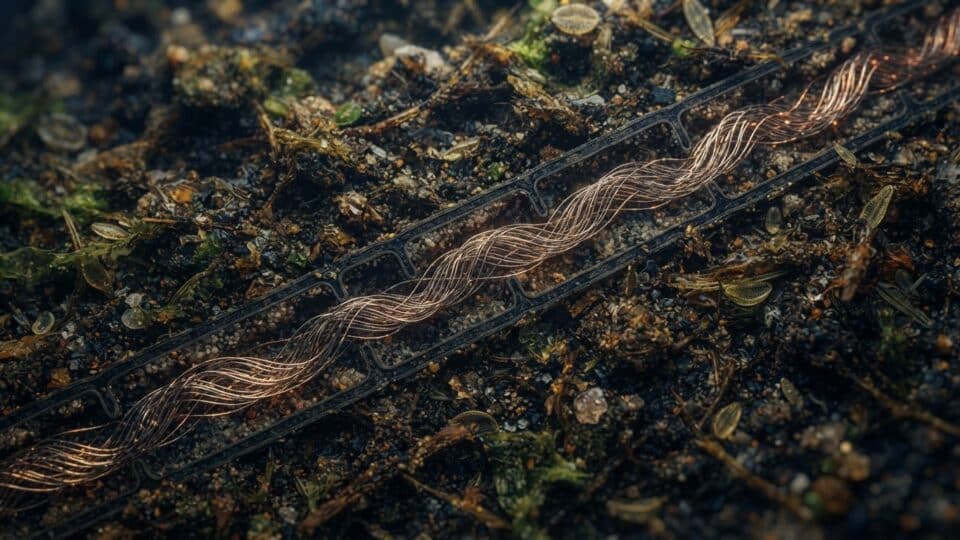
Cable bacteria are not a journalistic metaphor. They are filamentous microorganisms that live in aquatic sediments and transfer electrons over distances unusually long for a cell. A study published on 1 September 2026 in Nature Communications identified the molecular architecture of their conductive fibres: an extended structure containing nickel and organic ligands. The finding provides a more concrete explanation for a phenomenon that once seemed almost impossible in classical biology.
Cable bacteria: where the puzzle began
In sediments, oxygen available near the surface and reducing substances in deeper layers are not always found in the same place. Some bacteria can use this separation to organise their metabolism. A filament made up of connected cells enables charge transport along the structure. Crucially, this is not a natural battery capable of powering a city, but a specialised biological mechanism for electron transfer.
What researchers found in the fibres
The authors isolated bacterial filaments and combined electron microscopy, X-ray analysis, spectroscopy and molecular interpretations. They observed nanometre-scale fibres in the cell envelope, including bundles of nickel-rich ribbons. The study describes repeating units in which nickel centres are bound to sulphur-containing organic ligands within a continuous scaffold.
This architecture differs from the classical model of proteins transferring electrons through successive hops between separate metal centres. The discovery does not mean that every bacterium contains a nickel cable; it is an adaptation of the bacteria investigated, and its efficiency depends on the organisation of the filaments and environmental conditions.
Why the conductivity may be remarkable for an organism
In conventional electronic systems, copper and other metals conduct through mobile charge carriers in a solid structure. In biology, controlled transfer between molecules is far more common. A fibre with an almost continuous conductive path offers a different possibility: electrons can move along a very fine structure without the many stages involved in other cellular mechanisms.
The study refers to a biosynthesised organometallic framework, but this should not be confused with a pure metal or a superconducting conductor. The observed conductivity of the living material is not equal to that of an industrial copper cable, and researchers have not yet made a commercial wire from bacteria. The innovation lies first in understanding the structure and its design principle.
What the result means — and what it does not show
At a small scale, nature has created a flexible conductive architecture from materials available in the bacterial environment. For materials science, this is a source of inspiration: organic components, metal ions and molecular-scale organisation can be combined into a new material. But moving from a filament in sediment to a robust sensor requires reproducible synthesis, stability, service life and electrical integration.
It has not been demonstrated that the bacterium can replace wiring in a home or that such a biological cable will be manufactured at industrial scale. A headline promising “free electricity from bacteria” would confuse a transfer mechanism with energy generation. A material that conducts electrons is not automatically an energy source.
How the research could influence electronics
If researchers can reproduce the structure separately, without relying on living cells, they could investigate flexible conductive materials for microdevices, bioelectronic interfaces and sensors. The potential advantage is not magical conductivity, but control over architecture and the use of biologically inspired self-organisation principles.
A credible development stage would compare the same samples for electrical resistance, response to humidity, mechanical fatigue and degradation over time. Independent experiments would be needed, as would assessments of metal costs and environmental impact. Only then would it be possible to discuss a specific industrial advantage.
A result relevant to ecosystems, not only laboratories
Cable bacteria influence redox processes in sediments. By transferring electrons between layers, they can alter the distribution of certain substances and interact with the cycles of sulphur, iron and other elements. These effects are studied in microbial ecology; they should not be presented as an already validated method for cleaning up any water body.
For Romania, the most interesting angle would be research into coastal sediments and inland waters using appropriate microbiological methods. But this article does not claim that the 2026 study identified these fibres in Black Sea samples collected by InfoBuz. Additional context: InfoBuz’s analysis of the Black Sea’s anoxic environment.
How to check a viral claim about “living wires”
When you encounter a coloured photograph of filaments, check whether it depicts artificially coloured microscopy, a molecular reconstruction or an actual photograph. Establish the organism and species studied, whether the measurement was made on an isolated filament or in a complete circuit, and the temperature and environmental conditions. The difference between the filament’s length and the conductive fibre’s width is essential.
Another useful check is to identify the exact benchmark used for conductivity. Claims such as “better than all organic materials” or “equal to a metal” require a unit, temperature and testing method. Without them, the comparison is advertising, not a laboratory conclusion.
What to remember — facts, hypotheses and limits
| What has been verified | What does not automatically follow |
|---|---|
| Results described in a published scientific paper | A commercial product that is available or approved |
| Tests of prototypes and laboratory conditions | Guaranteed performance in every environment and at every scale |
| A new mechanism or method, reproducible under the reported conditions | Application already demonstrated for infrastructure in Romania |
One piece of the sediment puzzle: sulphur and oxygen
At the boundary between oxygenated and oxygen-free sediment layers, organisms encounter a strong chemical gradient. Normally, reactions that supply cells with energy require an electron donor and an electron acceptor to meet. Cable bacteria can spatially separate certain stages of these reactions, allowing electrons produced within the sediment to reach regions closer to oxygen. This organisation changes the local balance of sulphur compounds and, in certain contexts, metals.
The biogeochemical importance is not limited to the filament’s length. Each cell is part of a functional whole, and chemical processes in one layer may depend on conditions at a distance. A complete ecological experiment would measure the distribution of oxygen, sulphur compounds, pH and redox potential before attributing an effect exclusively to these bacteria.
Why nickel was a scientific surprise
Many biological electron-transfer systems rely on proteins and metal centres that include iron. Identifying an extended conductive structure built around nickel and sulphur-containing ligands changed hypotheses about how the mechanism is organised in the bacteria studied. The authors found that a very high proportion of cellular nickel was associated with the fibre structure, providing a clue to its central role.
Metals alone, however, are not enough to explain performance. Their relative positions, molecular ordering, bond stability and the surrounding environment all influence electron transport. An artificial material containing the same elements but lacking the same structure would not automatically reproduce the biological behaviour.
From observation to artificial material: the missing steps
To turn the principle into a material, a laboratory would need to faithfully reproduce the organisation of the nanoribbons, measure conductivity in comparable samples and test how it changes with bending, moisture and temperature. Repeatable production may be more difficult than demonstrating a property in a single sample. Material costs and the potential toxicity of certain precursors would also need to be assessed.
One possible application could be an interface between electronics and wet environments, but bioelectronic systems are exposed to corrosion, contamination and ageing. It is not enough for a wire to conduct on its first day. For a real device, what matters is how predictably it performs after hundreds of cycles and how easily it can be integrated into a circuit.
How electron transport differs from electricity generation
In a power plant, an energy source is converted into usable current, with an accounting of inputs and outputs. Cable bacteria use electron transfer as part of metabolism in an environment that already provides chemical resources. Saying that conductivity exists in an organism does not show that useful electrical power can be obtained externally without an appropriate conversion process.
A comparable article about microbial batteries would need to explain the electrodes, chemical substrate, power per unit area and stability over time. The study of nickel-containing fibres is not a complete assessment of a microbial battery and does not report the performance of a product intended for the electricity grid.
Why the study needs replication in other species
A logical next step is to analyse filaments from related organisms and environments to determine how universal the identified architecture is. In biology, variation between species can be substantial even where their forms appear similar under a microscope. The presence of nickel in a sample does not in itself prove the existence of an identical structure.
Comparisons with independently prepared samples, spectroscopic measurements and electrical determinations using the same standards would be useful. Ecological studies could also assess whether environmental changes, such as salinity or oxygen availability, influence the expression and efficiency of the fibres.
Why the research matters for Romania without inventing a local discovery
Romania has inland waters, wetlands and marine areas with chemically complex sediments. These may be subjects for microbiology and biogeochemistry, but a responsible article would require laboratory data, sampling permits and taxonomic confirmation before announcing the presence of the structure at a particular site.
In a possible local series, InfoBuz could compare scientific data on oxygen and sulphur distribution with observations of sediments. Previously published context on the Black Sea’s oxygen-free zones may offer a starting point, but it is not evidence that cable bacteria have been identified in that deep layer.
| Concept | Observation or role | Limit |
|---|---|---|
| Nickel-rich fibre | A conductive biological pathway | It is not a commercial wire |
| Redox gradient | May power metabolism | It is not equivalent to free electricity |
| Self-organisation | Inspiration for materials | It does not demonstrate industrial production |
| Marine sediment | A relevant microbial habitat | Local data are required for Romania |
Frequently asked questions
Are cable bacteria ordinary electrical cables?
No. They are filaments of microorganisms that transfer electrons through specialised biological structures; they do not operate as grid cables or as a source of household electricity.
Do they contain nickel?
The 2026 study identified a nickel-rich organometallic framework in the fibres, associated with sulphur-containing ligands.
Can they generate enough current to charge a phone?
The research discussed does not demonstrate a commercial energy-generation device or a charger based on these bacteria.
Have they been found in Romania?
This article does not present a verified local identification; samples and analyses are needed to confirm their presence in a particular sediment.
The InfoBuz conclusion
Nature offers a microscopic model of a conductor, not a ready-to-install energy solution. The research is interesting precisely because it shows a verifiable mechanism, without needing to be inflated into an unsupported technological promise. A mature assessment requires following what the authors tested, what measurements they published and what the next stage of independent validation will be.
Sources, methodology and transparency
InfoBuz editorial note, 24 November 2026: this material is a research analysis, not a test carried out by the newsroom, a commercial recommendation or evidence of local application in Romania. The representative image is an editorially generated illustration, not an original photograph of the experiment.


Discuția cititorilor
Ai o opinie sau o întrebare despre acest articol? Spune-ne ce crezi.
Fii primul care deschide discuția.
Te rugăm să păstrezi un limbaj civilizat și să discuți la subiect. Comentariile spam sunt filtrate automat.