
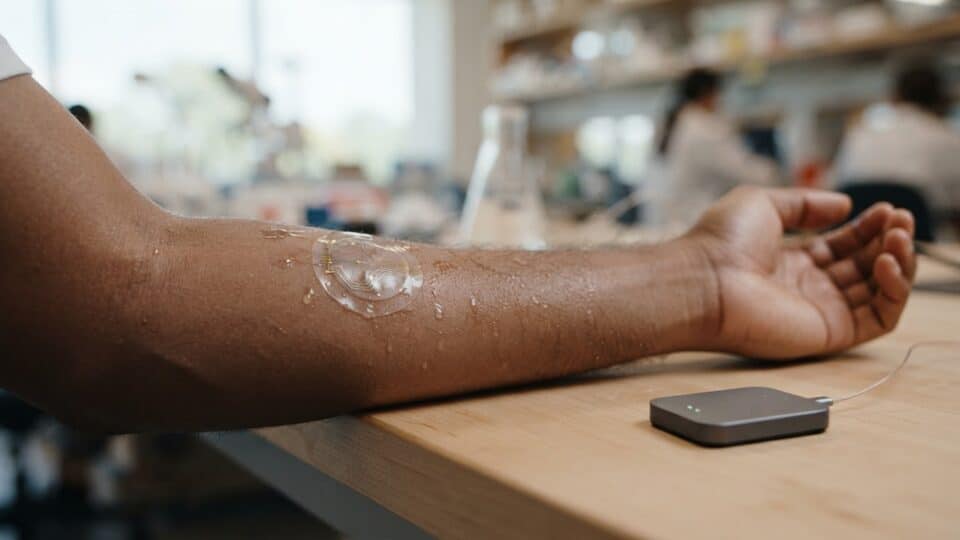
Energy from moisture does not mean that sweat becomes an inexhaustible battery. A study published in Nature Communications on 20 November 2026 describes a fully stretchable electrical generator that harnesses ambient or physiological moisture. The device uses an adaptive ionic hydrogel between two composite electrodes and was integrated into a skin-hydration monitoring demonstration.
Energy from moisture: what the 20 November 2026 study reports
The novelty lies in the combination of flexibility and output for the class of devices tested. The authors report a maximum current density of about 1.1 mA/cm² under experimental moisture-activation conditions. That figure does not represent energy permanently available to any wearable sensor in everyday use. Assessment also depends on voltage, external load, duration and conditions of use.
The hydrogel that adapts as the material stretches
A hydrogel is a polymer material that retains water and allows certain ions to move. In the device under study, the architecture promotes charge separation in response to moisture, generating an electrical signal. The researchers describe reversible changes in molecular conformation that help the network withstand mechanical deformation without immediately losing ionic transport.
The electrodes are made of elastic composites with asymmetric porosity, intended to facilitate a continuous supply of moisture and electrical contact during stretching. The device was tested under substantial deformation, including 400% strain in one set of trials, and through repeated cycles. The results indicate the resilience of laboratory samples, not certification of a product that can be worn for years.
What was actually demonstrated on skin
The team used the generator as part of a skin-hydration sensing platform, with machine-learning-assisted analysis and feedback on a phone. The authors reported classification accuracy of around 98% in one particular experimental configuration. This accuracy should not be read as an individual medical diagnosis for every person or as an authorised clinical sensor.
Classifying levels in experimental data differs from directly measuring hydration across the whole body. Skin is affected by temperature, sweating, cosmetic products, ambient conditions and sensor placement. Clinical use would require independent validation, standardisation and comparisons with medical reference methods.
A milliamp is not a milliwatt
A common pitfall in reporting this kind of research is to confuse current, voltage and energy. Current is measured in amperes, voltage in volts, and power is approximately their product under the relevant circuit conditions. A peak current density cannot automatically be converted into useful power without knowing the voltage under load. Nor does peak power guarantee a constant supply.
If a device were, purely as an illustration, to provide 0.2 V and 1 mA at a given load, their product would be 0.2 mW. This is only a mathematical example, not a measurement from the study. It is far below the requirements of an ordinary phone, but could be relevant for a low-power sensor, especially if it stores energy between readings.
Why stretchability matters more than it may seem
Sensors attached to skin are exposed to bending, twisting, stretching and moisture. A rigid device can lose contact when its wearer moves, making measurements unstable. An elastic material may improve comfort and signal quality, provided the adhesives, structure and conductivity remain sufficiently durable.
Important questions remain open, however: how does it perform after washing, during prolonged running, on sensitive skin, at very low temperatures or under heavy sweating? A laboratory study answers only for the conditions it explicitly tested.
Potential applications and barriers to industrialisation
Materials that harvest energy from moisture could help power sensors for movement, the environment or non-invasive bodily measurements. One hypothetical benefit is reducing the need for small batteries, which add thickness and require replacement. Battery-free sensors, however, do not mean cost-free infrastructure: processing electronics, energy storage, communication and encapsulation are still needed.
Before commercialisation, researchers would need to demonstrate manufacturing reproducibility, safety in contact with skin, tolerance of humidity variations and performance over many months. The source reviewed contains no announcement that a medical patch will be available in pharmacies in Romania.
What readers can take from a story about electricity from skin
Always check whether a material produces electrical energy from environmental moisture or uses power from an auxiliary battery. Consider the current value alongside voltage and the duration of the experiment. A prototype tested for a short period does not demonstrate unlimited power.
For health-related claims, look for whether human participants were involved, what the algorithm measured, the sample size and whether the method received external validation. A high classification score in a demonstration is not medical advice.
Key points: facts, hypotheses and limits
| What is established | What does not automatically follow |
|---|---|
| Results described in a published scientific paper | A commercial product that is available or authorised |
| Prototype tests and laboratory conditions | Guaranteed performance in every environment and at every scale |
| A new mechanism or method, reproducible under the reported conditions | Applicability already demonstrated for infrastructure in Romania |
How the signal is maintained when skin stretches
A sensor worn on the forearm must tolerate the bending and stretching of skin during movement. In a rigid device, contact can come loose or electrical resistance can change because of deformation, without any connection to the phenomenon being monitored. The team addressed this through a hydrogel network capable of reversible changes in molecular configuration, along with elastic electrodes.
The authors reported repeated testing under considerable deformation, including stable response after a specified number of cycles. In a future product, this kind of testing should be supplemented with trials involving variable humidity, friction beneath clothing, adhesives, temperature and washing. Durability in a mechanical test is not the same as the service life of a device worn every day.
From moisture to ion movement
Moisture changes the distribution of water in the hydrogel and the mobility of ions. The electrodes and polymer network are designed so that their transport is not identical in every direction, which can produce charge separation and a measurable electrical potential. The outcome depends on differences in conditions between the system’s surfaces and on the material’s ionic properties.
For that reason, the term “energy from moisture” should not be confused with spontaneous generation of energy. The material uses physical and chemical processes under ambient conditions, and the balance must be understood at the scale of the whole system. Power delivered to an external circuit is determined experimentally, not by the mere presence of moisture.
How much can a small device power?
Skin sensors can operate at very different levels of energy consumption. A circuit that takes an occasional measurement and sends a short message has different requirements from a continuously lit display or a radio module that transmits constantly. For a real application, the relevant factors are average power demand, current peaks and time spent idle.
One possible architecture would use a temporary energy-storage component that charges slowly and delivers power briefly at each reading. The published study demonstrates a generator and a sensing platform, but commercial performance would require a complete energy budget that includes conversion losses and realistic wearing conditions.
What the skin-hydration classification actually measures
An algorithm that distinguishes particular categories defined by researchers can achieve good scores when its test data resemble its training data. To assess the result of around 98%, the protocol, test population, conditions and separation between training and evaluation data would need to be examined. The accuracy of a laboratory classification is not a perfect measure of body water.
Skin hydration can differ between anatomical regions and according to creams, sweating, temperature or recent activity. A commercial health device would need validation across diverse people and comparison with reference measurements appropriate to its intended purpose.
Material, adhesive and skin: the safety triad
Beyond electrical performance, a patch must meet skin-compatibility requirements. Materials can cause irritation or work differently in the presence of sweat and salts. The adhesive must hold the device in place without causing damage after repeated removal, while conductive elements need protection from deterioration and leakage.
A prototype presented in a scientific publication does not mean that all of these stages have been completed. Relevant testing, authorisations and clear instructions for use would be needed before medical use.
Its connection to continuous health monitoring
Wearable sensors are one research direction for repeated observations without bulky equipment. A small power source integrated into the sensor material may be attractive, particularly where frequent battery replacement becomes inconvenient. But continuous data collection also raises questions about consent, privacy and the proper interpretation of signals.
InfoBuz has separately examined continuous AI monitoring and control of medical data. A moisture-powered sensor does not, by itself, provide privacy, a diagnosis or a treatment plan.
| Measure | What it describes | What it does NOT mean |
|---|---|---|
| mA/cm² | Current density in a test | Continuous power in watts |
| 400% strain | A laboratory mechanical condition | Unlimited service life |
| 98% accuracy | Classification in one protocol | Universal medical diagnosis |
| Ionic hydrogel | Moisture and ion transport | A battery for every device |
Frequently asked questions
Is it available to buy?
The article describes a research prototype, not a confirmed commercial product.
Can it replace a phone battery now?
No. The device is aimed at low-power sensors, and its performance under real-world conditions still needs to be demonstrated.
Can it diagnose dehydration?
The skin-hydration classification demonstration is not equivalent to a validated medical diagnosis of whole-body dehydration.
Can it stretch without breaking?
The authors reported stretching tests and mechanical cycles, but these do not guarantee the same durability in every use case.
InfoBuz conclusion
The elastic hydrogel may open a path towards very small sensors, but it does not turn skin into a high-power battery. The research is notable precisely because it shows a verifiable mechanism, without needing to be inflated into an unsupported technological promise. A mature assessment requires attention to what the authors tested, which measurements they published and what the next step in independent validation will be.
Sources, methodology and transparency
InfoBuz editorial note, 24 November 2026: this article is an analysis of research, not a test conducted by the editorial team, a commercial recommendation or evidence of local application in Romania. The representative image is an editorially generated illustration, not an original photograph of the experiment.


Discuția cititorilor
Ai o opinie sau o întrebare despre acest articol? Spune-ne ce crezi.
Fii primul care deschide discuția.
Te rugăm să păstrezi un limbaj civilizat și să discuți la subiect. Comentariile spam sunt filtrate automat.