
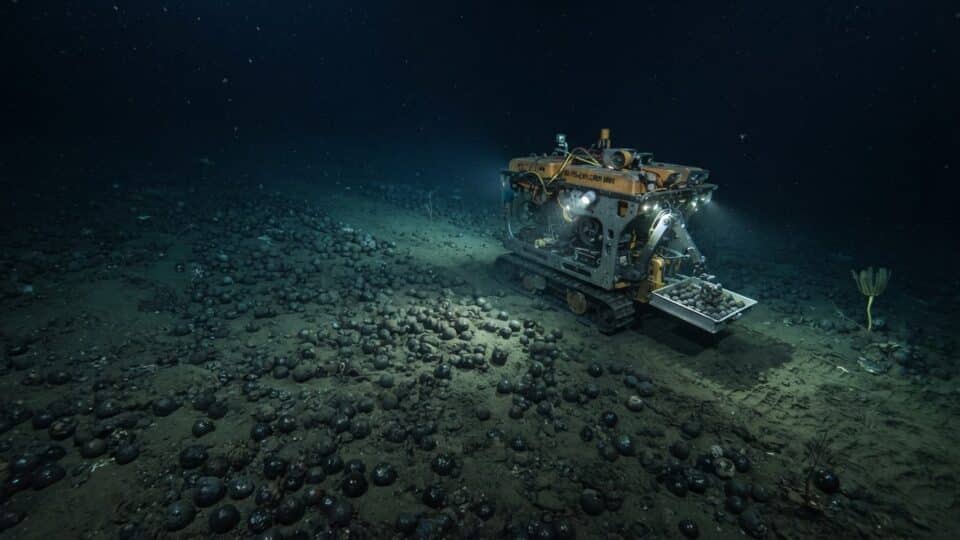
Dark oxygen is the popular name for a hypothesis that oxygen may be produced locally on the ocean floor without sunlight. In 2024, a team reported unexpected rises in oxygen concentrations in experimental chambers placed on the Pacific seafloor, in an area covered with polymetallic nodules. The researchers proposed that electrochemical reactions associated with the nodules might contribute to the phenomenon. But a 2026 reanalysis challenged the causal link.
Dark oxygen: a surprising observation, not definitive proof
This makes for a more interesting story than a simple report about “oxygen made by rocks”: how an unexpected finding is tested, the role of experimental error, and why a striking result does not automatically become a confirmed new chapter in biology textbooks. The journal also published an editorial note in April 2026 warning about aspects of the original study that were still under review.
Where the story emerged: the Clarion–Clipperton Zone
The Clarion–Clipperton Zone lies in the deep Pacific and is known for polymetallic nodules containing metals including manganese, nickel and cobalt. These nodules form extremely slowly and provide a substrate for distinctive biological communities. Mining them could disrupt habitats, which is why researchers are closely examining the ecological consequences.
The 2024 experiments used benthic chambers, which isolate an area of sediment in order to monitor chemical exchanges. Rather than the expected decline in oxygen, some chambers showed increases. The authors investigated surface electrical potentials and suggested possible electrolysis. The observation and the proposed explanation are two separate things.
Are nodules “natural batteries”? Why the comparison is fragile
Water electrolysis requires energy and suitable electrochemical conditions. The mere fact that two electrodes show a potential difference does not demonstrate sustained production of molecular oxygen from water. The potentials measured on nodules, mineral distribution and surface reactions must be considered in a complete physicochemical balance.
Nodules are complex mineral formations, not commercial batteries with terminals and a designed external circuit. An electrochemical hypothesis must explain where the free energy comes from, which by-products are formed, and why a control experiment without nodules would—or would not—produce the same signal.
What the 2026 reanalysis changed
A critical study published in 2026 re-examined the correlation between nodule surface area and oxygen increases in experimental chambers. After expanding the number of images and tests, its authors found no significant correlation between nodule area or mass and oxygen variation. They also noted oxygen increases in experiments where nodules were absent.
The reanalysis concluded that a causal relationship between polymetallic nodules and rising oxygen is not demonstrated in the dataset examined. That does not mean that every mechanism for producing oxygen without light is physically impossible; it means that the specific explanation popularised in 2024 cannot be treated as certain. A rigorous assessment should give space to both papers, including their methodologies and limitations.
Contamination and equipment: when the sensor becomes part of the story
Oceanographic instruments operate under difficult conditions: high pressure, transport through the water column, temperature changes and mechanical intervention to secure a chamber. A closed system may contain traces of air or water with a composition different from that of the target environment. Alternative hypotheses therefore include oxygen accidentally introduced during descent or measurements affected by procedures.
A robust result should appear in repeated experiments, with control chambers, calibrated sensors, measurements using independent methods and complete documentation of installation. Confidence rises when two different techniques support the same variation. If only one instrument shows it, the interpretation remains open.
Why the dispute matters for deep-sea mining
Polymetallic nodules are mineral resources, but they are also part of the habitat. There are sound ecological reasons to assess their removal carefully, whether or not the “dark oxygen” hypothesis is confirmed. Benthic communities may depend on the nodules’ hard surfaces, while sediment stirred up by machinery may affect other organisms.
It is inaccurate both to claim that mining would remove a proven “new lung of the planet” and to suggest that all environmental concerns disappear following a critical result. Assessing mining risk relies on many kinds of evidence: biodiversity, sediment, noise, ecosystem recovery and the legal regime governing international areas.
What future confirmation would mean
If an abiotic mechanism of local oxygen production were independently demonstrated, it would raise new questions about chemical cycles in lightless environments, the oxygen balance and conditions that may support microorganisms. It would also have implications for astrobiology, but would not prove the existence of life on other celestial bodies.
Until then, the most serious approach is to follow replication expeditions, direct measurements and the journal’s editorial decisions. The publication date of a paper is not the final stage of research. Corrections and methodological disputes are part of the scientific process.
What has been demonstrated, and what still needs investigation
- Demonstrated: observations, experiments or official outputs recorded in primary sources.
- Not yet demonstrated: commercial operation, identical applicability everywhere, or local impact without data.
- Future verification: independent replication, comparative results and publication of the full methodology.
Why benthic-chamber experiments are difficult
A benthic chamber isolates a small volume of water in contact with sediment, allowing instruments to record the consumption or production of particular substances. Organisms and chemical reactions in sediment normally consume oxygen. If a sensor indicates an increase, researchers must rule out exchange with external water, initial contamination and calibration problems before proposing an unknown reaction.
At great depth, deploying a chamber with a vehicle or specialised equipment adds further complications. The water may have different properties along the descent route, and a small air bubble or a change in configuration may affect the measurement. Good methodological control documents the precise manoeuvres and the sensors’ response before, during and after the experiment.
Why correlation does not demonstrate electrolysis
The initial research associated certain oxygen increases with nodule surface area and proposed a possible electrochemical process. The 2026 reanalysis increased the number of observations and showed that the association was no longer statistically significant in the expanded dataset. A statistical test sensitive to a handful of observations should be interpreted cautiously, particularly when the sample is small.
Even a robust correlation would only be an indication. Demonstrating electrolysis requires measurement of energy balances, the chemical species produced and electrode conditions. Without those data, the phrase “nodules make oxygen” skips essential stages of scientific verification.
What the next expedition should do
A credible replication would combine chambers in areas with nodules, control chambers without nodules, and independent oxygen samples analysed with different methods. Teams could record temperatures, electrical potentials, currents, equipment position and water composition before deployment. Raw data and all measurements—including those that do not support the hypothesis—should be published.
A result repeated at several sites and by several teams would carry far more weight than a single campaign. If the phenomenon also occurs without nodules, researchers should look for another mechanism or an experimental explanation. This is how a controversy can produce solid knowledge.
Do not confuse deep-sea oxygen with the Black Sea’s anoxic zone
The Black Sea has its own stratification regime, including deep zones without dissolved oxygen and distinct chemical processes. That is a different oceanographic issue from the hypothesis in the Pacific’s Clarion–Clipperton Zone. The two subjects can be compared to explain oxygen’s role in ecosystems, but neither is evidence for the other.
Any regional research would require direct measurements and analyses of minerals on the basin floor. This article contains no new data from the Black Sea demonstrating oxygen production by nodules. For context, see InfoBuz’s article on the anoxic zone.
Why a scientific dispute can affect economic decisions
Polymetallic nodules attract interest because they contain elements used in industrial technologies. Policies on deep-sea exploration and extraction involve environmental assessments, international law and economic scenarios. A hypothesis about oxygen production could influence public debate, but it cannot be the sole argument for or against an activity.
A responsible assessment must include the habitat of species dependent on nodules, sediment disturbance and long-term ecological recovery. These questions remain relevant regardless of how the oxygen controversy is resolved.
How to spot headlines that go beyond the evidence
A headline such as “researchers have found the planet’s unknown source of oxygen” is not justified by a set of ocean-floor experimental chambers. For a discovery of that kind, researchers must first establish that the phenomenon is real, then identify the mechanism and only finally assess its global importance. A local experimental signal is not the chemical balance of all the oceans.
Readers can consult the editorial note associated with the original study and the subsequent critical paper. In science journalism, a revision or challenge should not be concealed to preserve an appealing headline. On the contrary, it is the most relevant part of the story.
| Claim | Scientific status | How it can be tested |
|---|---|---|
| Oxygen increases in some chambers | Reported in 2024 | Replication and independent instruments |
| Electrolysis caused by nodules | Disputed hypothesis | Electrochemical balance and controls |
| Link between nodule area and oxygen | Challenged by the 2026 reanalysis | Larger data series |
| Impact on the entire ocean | Not demonstrated | Spatial and temporal measurements |
Frequently asked questions
Has dark oxygen been definitively demonstrated?
No. The hypothesis linking nodules to oxygen increases is disputed, and the 2026 editorial note calls for caution.
Is this about the Black Sea?
No. The studies discussed concern the Pacific Ocean floor, in the Clarion–Clipperton Zone.
Do the nodules work like batteries?
Electrochemical mechanisms have been proposed, but oxygen production through electrolysis has not been confirmed as the explanation for the experiments.
Does this mean seabed mining is safe?
No. The ecological risks of extraction must be assessed independently of this specific hypothesis.
InfoBuz conclusion
The dark-oxygen story illustrates the value of a well-designed control experiment. The distinction between an observation, a proposed mechanism and a demonstrated conclusion is the most important safeguard against sensationalism. A discovery can remain remarkable even when the next experiment narrows its significance.
Primary sources and article methodology
- Nature Geoscience, the original 2024 study
- Critical reanalysis published in 2026, PubMed
- Report on marine mining, April 2026
InfoBuz editorial note — 24 November 2026: This article is documented using scientific and institutional publications, not experiments conducted by the editorial team. The representative illustration is generated and is not a photograph of the site or the original equipment. We do not extrapolate findings to Romania without local measurements.


Discuția cititorilor
Ai o opinie sau o întrebare despre acest articol? Spune-ne ce crezi.
Fii primul care deschide discuția.
Te rugăm să păstrezi un limbaj civilizat și să discuți la subiect. Comentariile spam sunt filtrate automat.