
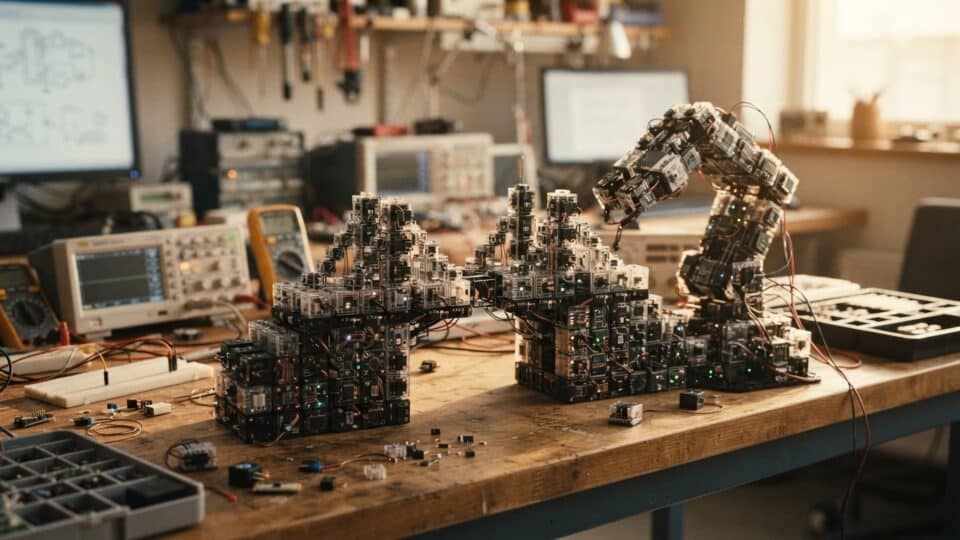
The “smart bricks” discussed by researchers are electronic cubic modules, not ceramic blocks ready to be installed in a flat. In a 2026 study published in Nature Communications, nearly 200 physical modules each ran the same local algorithm, inspired by neural cellular automata. Without a central computer telling them the shape of the whole assembly, the modules were able to classify three-dimensional structures and detect certain missing pieces.
Smart bricks are not ordinary masonry
The notable idea is not that a cube “thinks” like a human. Information from neighbouring modules spreads through the network of connections, and repeated local rules produce a collective result. The same principle appears in biology: cells that respond to their neighbours can help organise a complex form without each holding a complete map of the organism.
How the algorithm works: the same rule in every block
In the experimental demonstration, each cube can communicate with its neighbours through connections on its faces. The modules run a shared local neural network trained to infer the overall shape category from received signals. This means that each unit does not need an absolute address in space or a complete copy of the model.
The authors report classifying configurations resembling an aeroplane, tables or vehicles, converging in fewer than 60 update cycles in the hardware demonstrations. A cycle is an algorithmic iteration, not a second of human thought. Such results depend on the size of the structure and on the distribution of data used in training.
How a structure can “sense” that a piece is missing
When a module no longer communicates or is removed, its neighbours receive a different pattern of signals. The network can use the change in message distribution to locate an anomaly. The researchers also demonstrated resilience to communication losses and inactive modules. But this is not the same as detecting a microscopic crack in a concrete block or assessing a building’s structural integrity.
More importantly, the system does not necessarily carry out a physical repair. It may identify a discrepancy and guide a recovery process, but genuine self-repair would require actuators, available replacement parts, power and reconnection mechanisms. A collective detector of missing components is one step, not a self-regenerating building.
How it differs from a sensor connected to a central controller
In a conventional system, each sensor sends data to a controller that builds an overall picture. Here, information is processed in a distributed way. An isolated failure may have a limited effect on overall operation if the network retains sufficient connectivity. This principle could be of interest for very large or reconfigurable structures.
There are costs as well: many small modules mean more connections, electrical power, maintenance, cybersecurity requirements and potential failure points. The fact that an algorithm is decentralised does not automatically demonstrate lower energy use or greater reliability than every centralised architecture.
What the team demonstrated, and what remains a hypothesis
The hardware demonstration with nearly 200 cubes and the published results represent verifiable progress in modular robotics. The authors tested shape classification, identification of certain discontinuities and tolerance of certain faults. These tests are not equivalent to operating for decades in a bridge exposed to moisture, temperature variation and vibration.
Construction applications would require assessment of real loads, mechanical strength, fire behaviour, electrical connections, service life and certification methods. For this reason, the subject remains one of research and experimental engineering, not a recommendation to buy “smart bricks” online.
Where it could have practical uses
Modules with distributed intelligence could be used in reconfigurable equipment, platforms for work in difficult areas, space research or adaptable educational structures. An assembly able to determine its own shape or the location of a missing piece could simplify diagnosis where there is no GPS or external camera viewing the entire system.
A separate MIT example from August 2026 presents other reconfigurable blocks, called bifur-circuits, which maintain electrical connections while changing shape. The two research projects are distinct. Their similarity lies in their focus on modularity, not in technological identity.
What Romanian industry could learn from this result
Romania has sectors where inspection of structures and modular equipment matters, including industrial manufacturing, robotics, logistics and prototyping. The principle of assemblies identifying themselves could inspire local research, although this article does not identify a Romanian company that has implemented the exact system.
A credible pilot would need clear conditions: the number of modules, types of faults, the correct detection rate, cost per module, and behaviour after a large number of connections and disconnections. Without such data, the promise of a house that repairs itself remains science fiction.
Key points: facts, hypotheses and limits
| What is verified | What does not follow automatically |
|---|---|
| Results described in a published scientific paper | A commercially available or approved product |
| Prototype tests and laboratory conditions | Guaranteed performance in every environment and at every scale |
| A new mechanism or method reproducible under the reported conditions | Applicability already demonstrated for infrastructure in Romania |
From cube to assembly: how information moves
In a decentralised system, each module exchanges data only with nearby neighbours, while information about the global state emerges after several rounds of communication. This may be advantageous in an assembly with many units, where a connection to a central processor would be difficult. Each module runs the same logic without holding a complete map of the structure.
This way of working resembles local information propagation in certain biological systems, but it does not mean that the modules develop collective consciousness. The algorithm remains a set of operations designed and trained by researchers, and the result depends on the topology of the connections.
What it means to recognise a three-dimensional shape
The researchers used categories such as an aeroplane, table or demonstration vehicle to test whether the network could classify overall geometry. The distinction between classification and exact reconstruction matters: a system can recognise that a structure belongs to a class without knowing the precise spatial coordinates of every piece.
The authors also tested altered forms, such as table legs of different lengths or objects with certain variations. This shows some degree of generalisation, but it does not confirm recognition of every entirely new structure, of any size or material.
A communication fault differs from a mechanical fault
A module may physically disappear, lose power, or remain installed while no longer transmitting data. These situations produce different anomalies. A decentralised system that observes a change in incoming messages may identify a problematic area, but determining the exact cause may require additional sensors.
In engineering applications, a crack, a loose bolt and a failed controller are not the same thing. The shape self-identification algorithm is only one component of a complete diagnostic process and does not replace visual or non-destructive inspection methods.
How the performance of a distributed system is measured
To assess an architecture with many modules, useful measures include time to classification, correct identification rate, tolerance of lost messages and total energy consumption. In the paper, convergence in fewer than 60 rounds for certain shapes and tolerance of inactive modules refer to the conditions tested.
As the size of the assembly increases, the number of connections, signal propagation and synchronisation may become more difficult. An experiment involving nearly 200 cubes is an important step, but it is not a demonstration for millions of modules.
From the laboratory to adaptable structures
One possible application is a reconfigurable robotic platform, in which modules can be assembled into different structures and verify their form without an external camera. Another direction is identifying errors after assembly, which could be useful in technical education or prototyping. However, actuators and additional control are needed for components to move independently.
Not every modular device needs to be fully decentralised. In some products, a simple central controller may be cheaper, easier to maintain and more efficient. The choice of architecture must be justified by the real application.
What an independent test for Romania could look like
A robotics team could reproduce the principle with locally built modules, prepare sets of shapes not seen during training, and introduce faults in a controlled manner. The results should be compared with a centralised method using the same criteria and the same energy resources.
Such a study would be relevant to industry, but it would not amount to a building-strengthening solution. For structural safety, see also InfoBuz’s guide to assessing real seismic risk.
| Problem | What the prototype can do | What requires further research |
|---|---|---|
| Shape identification | Distributed classification | New shapes and scales |
| Missing piece | Anomaly signal | The exact mechanical cause |
| Communication failure | Tolerance in some tests | Very large networks |
| Repair | Guiding a response | Actual actuation and reconnection |
Frequently asked questions
Are these bricks for building a house?
No. The study concerns electronic research modules used in robotics and demonstrative modular structures.
Can they detect a missing piece?
In the configurations tested, the distributed algorithm identified anomalies and missing pieces through local communication.
Can they repair themselves?
Not in the sense of complete physical autonomy. Detecting or locating a fault does not automatically mean rebuilding the structure.
Is there a product on the market?
The study does not demonstrate the availability of a commercial system for ordinary construction.
InfoBuz conclusion
A structure that recognises its own shape is closer to a network of cooperating cells than to a brick from a building-supplies yard. The research is of interest precisely because it shows a verifiable mechanism, without needing to be inflated into an unsupported technological promise. A mature assessment requires following what the authors tested, which measurements they published and what the next stage of independent validation will be.
Sources, methodology and transparency
InfoBuz editorial note, 24 November 2026: This article is an analysis of research, not a test conducted by the editorial team, a commercial recommendation or evidence of local implementation in Romania. The featured image is a generated editorial illustration, not an original photograph of the experiment.


Discuția cititorilor
Ai o opinie sau o întrebare despre acest articol? Spune-ne ce crezi.
Fii primul care deschide discuția.
Te rugăm să păstrezi un limbaj civilizat și să discuți la subiect. Comentariile spam sunt filtrate automat.