
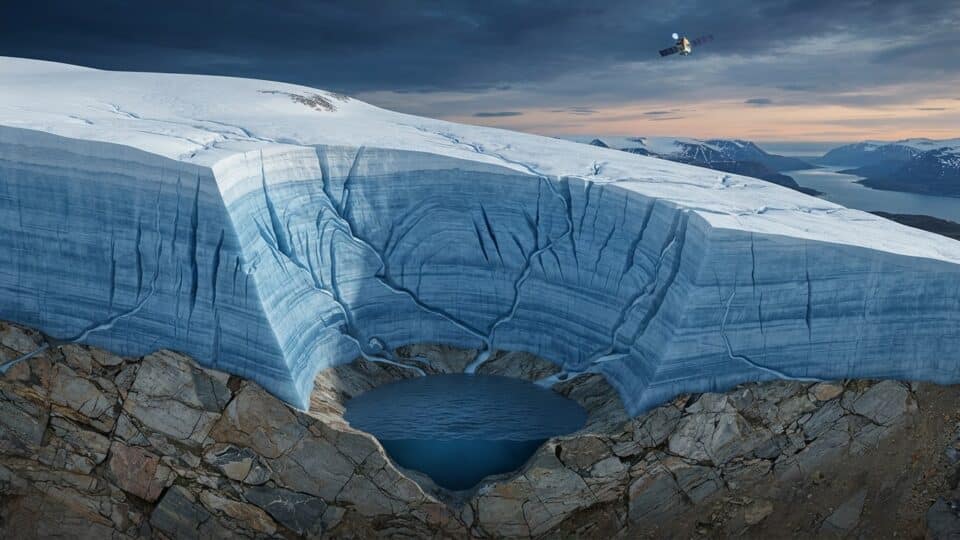
A previously unknown subglacial lake has been identified beneath the Flade Isblink ice cap in northeast Greenland. An ESA announcement of 15 October 2026 says it acts as a temporary reservoir for some of the water produced by surface melting. That water may remain trapped beneath the ice before being released into downstream hydrological systems.
A subglacial lake hidden beneath the ice sheet
The discovery challenges an overly simple picture of ice melt. Water does not always flow directly from the surface to the ocean. Some of it moves through cracks and channels, may be stored beneath the ice, and is released later, altering water flows and the interaction between ice and the ground beneath it.
How researchers detected the water without drilling through the ice
The research combined satellite observations and climate models to infer hydrological behaviour beneath the ice cap. Satellites can track changes in the elevation and shape of the surface, while models connect them to the movement and accumulation of water within and beneath the ice mass. In some cases, the filling and draining of lakes leave subtle surface signals that can be detected.
This is not a direct image of the lake bed. The findings depend on the quality of the observations, modelling of ice deformation, and assumptions about drainage pathways. ESA does not say it physically visited the lake with a robot or mapped every metre of its shoreline.
Flade Isblink: a system more complex than it appears at the surface
The ice cap lies in northeast Greenland, where seasonal melt, snow accumulation and ice dynamics combine in a hydrological regime that is difficult to track. A subglacial lake can alter water pressure at the base of the ice, with implications for friction at the bed and for drainage towards valleys or the coast.
It cannot automatically be said that the lake will cause an ice cap to collapse or trigger major flooding. Such conclusions would require time series, discharge measurements, basin characterisation and further observations. The study discusses mechanisms, not a catastrophic event forecast for a specific date.
What “temporary reservoir” means in numbers
In hydrology, a reservoir can store part of a flow and release it later. As an illustrative exercise, if a hypothetical volume of 1 million cubic metres accumulated over one period and drained over ten days, the additional average discharge would be about 1.16 cubic metres per second. The calculation illustrates the relationship between volume and time; it is not a measured value for the Flade Isblink lake.
Actual discharge can vary greatly, and the lake may receive new water at the same time. A large volume does not automatically translate into hazardous flow: the route, duration, drainage-system capacity, and the location of communities or infrastructure all matter.
Why a local discovery can help improve global models
How ice responds to higher temperatures depends not only on the melt balance, but also on how water is transported and stored. If models assume immediate drainage while some water is retained beneath the ice cap, they may misjudge discharge and the pace of the response.
For researchers, the value lies in testing mechanisms that may also occur in other glacial regions. But not all ice caps have the same geometry, geological bed or drainage network. The Greenland finding should not be mechanically extrapolated to Antarctica.
Not a new ocean with exotic life
A lake beneath ice inevitably raises questions about microbiology and isolated environments. But the ESA material reviewed here is primarily concerned with hydrology and ice dynamics. It contains no evidence of a newly discovered species, a complex ecosystem or a connection to a lost civilisation.
Nor does the discovery identify a drinking-water resource for exploitation. The environment, location and ecosystem protection make such lakes subjects of research rather than conventional commercial projects.
Why the discovery is worth following
Future data may show whether the basin fills and drains repeatedly, what fraction of meltwater is temporarily retained, and how drainage changes in warmer years. Continued monitoring would link satellite imagery, models and, where possible, ground-based measurements.
For a Romanian publication, the lesson is methodological: not all unseen water can be mapped directly, and a regional estimate must be accompanied by uncertainty. A useful parallel is this InfoBuz article on groundwater measured through gravity, a different technology that also examines difficult-to-observe reserves.
How to read a scientific discovery correctly
- Identify the date of the measurement or experiment, which may differ from the publication date.
- Check the laboratory conditions and the location where the observation was made.
- Separate what was observed from the interpretive mechanism proposed by the authors.
- Do not generalise to other regions or organisms without additional data.
How a lake can fill without being seen at the surface
Water produced by melting snow and ice can enter through fractures, channels and subglacial networks. Where bed geometry and pressure allow accumulation, water can collect in a depression. The ice surface above may respond to the filling basin through subtle changes in elevation, detectable through repeated observations from space.
Not every depression observed by satellite conceals water. Variations in snow, ice dynamics and other processes can also change elevation. Before identifying a subglacial lake, researchers must combine independent clues and compare the data with a physically plausible model.
Why water release is not continuous
In certain glacial systems, a lake can store water until pressure or the configuration of drainage pathways permits accelerated discharge. Downstream flow can then differ from the rate of surface melting. A year with extensive melt does not necessarily produce the same discharge every day of the season.
This kind of delay matters for understanding ice-cap dynamics. But without observations demonstrating that pattern at the specific site, it cannot be inferred that the lake identified at Flade Isblink drains through a precise mechanism or on a repeatable schedule.
What satellites measure, and what remains hidden
Remote sensing can capture changes in elevation, ice movement and surface conditions. Some radar missions can provide observations in low-light conditions. Climate and glaciological models help turn these observations into hypotheses about water circulation beneath the ice.
Such a reconstruction does not necessarily provide a directly measured volume or a complete map of the lake bed. The results are sensitive to the resolution of the datasets, measurement error and the properties of the ice. These constraints should be made clear in any article presenting a lake “discovered by satellite”.
The possible link to the speed of ice movement
Water at the base of a glacier can influence pressure and contact between the ice and the underlying bed. Under some conditions, pressure changes can alter friction and the speed of ice flow. The relationship depends on how efficiently the drainage system works and on the structure of the contact surface.
It does not follow that every lake beneath ice automatically accelerates an ice cap or contributes a fixed share to sea-level rise. Such an attribution would require independent time series of movement, pressure, melting and discharge.
Why a dramatic image of ice is not enough
Satellite images and artistic reconstructions work well in news coverage, but they can wrongly suggest that there is a direct photograph of the lake beneath thousands of tonnes of ice. In reality, the evidence is a combination of measurements and interpretation. An accurate illustration should be labelled as a conceptual reconstruction.
In this article, the featured image is not an observed image of the lake. Neither its position, geometry nor the dimensions visible in it should be interpreted as a scientific result of the ESA team.
How a long-term trend could be confirmed
Repeated monitoring could show whether the reservoir fills seasonally or whether longer storage periods occur. Comparing years requires the same elevation reference framework and corrections for changes in snow accumulation. Otherwise, surface signals may be confused.
It would also be useful to integrate climate data with measurements of downstream discharge where infrastructure and observing conditions are available. Only such an analysis could turn the discovery into a robust estimate of the lake’s role in regional hydrology.
| Element | What can be observed | What requires modelling |
|---|---|---|
| Ice surface | Changes in elevation | Volume of water beneath it |
| Drainage channels | Indirect evidence | Flow through each route |
| Seasonal melt | Climate and satellite products | Fraction retained in the lake |
| Hydrological risk | Regional indicators | Specific local events |
Frequently asked questions
Was a lake found beneath Greenland in 2026?
ESA presented a previously unknown subglacial lake beneath Flade Isblink in October 2026.
Is it a surface lake?
No. The lake lies beneath the ice cap and is inferred from observations and models.
Has the lake’s exact discharge been measured?
This material does not assign a specific numerical discharge; the mathematical example in the article is explicitly hypothetical.
Will it definitely cause flooding?
No. Identifying a temporary reservoir is not a flood forecast for a particular time and place.
InfoBuz conclusion
The subglacial lake shows that ice hydrology is not a direct pipe to the ocean, but a system involving storage and delays. The information becomes valuable when every limitation of the method is explained as clearly as the attention-grabbing finding itself.
Sources and research transparency
Editorial note — 24 November 2026: This article is based on scientific sources and does not present original research by InfoBuz. The featured image is illustrative, not a photograph of the original observation or experiment. We do not assign certainty where studies report only hypotheses or conditional findings.


Discuția cititorilor
Ai o opinie sau o întrebare despre acest articol? Spune-ne ce crezi.
Fii primul care deschide discuția.
Te rugăm să păstrezi un limbaj civilizat și să discuți la subiect. Comentariile spam sunt filtrate automat.