
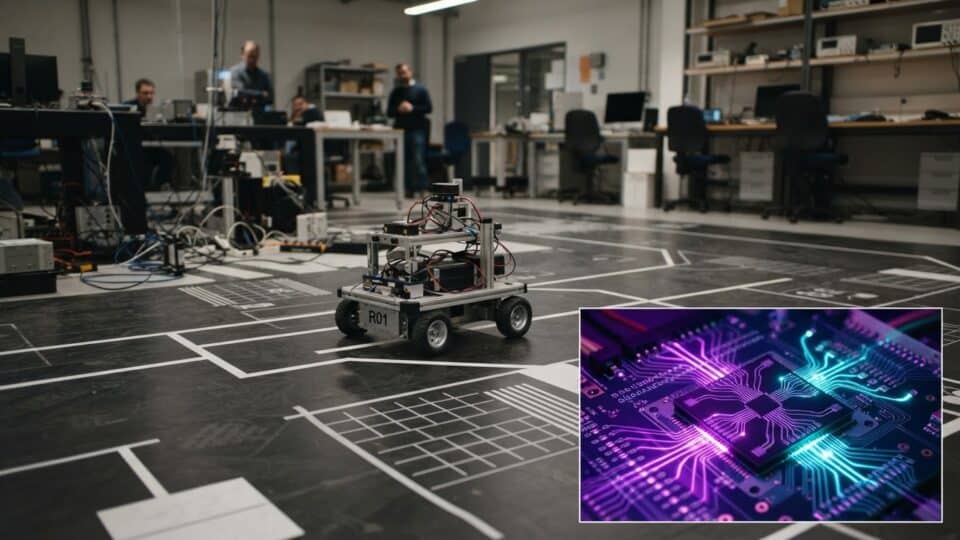
Neuromorphic robotics, broadly speaking, uses computing architectures inspired by the principles of nervous systems. A study published in Nature Communications on 10 September 2026 describes the autonomous operation of a robot using a neuromorphic device based on wave propagation. It is a demonstration of physical hardware in the control chain, rather than simply an algorithm running on a conventional computer.
Neuromorphic robotics: why a robot might compute differently
The point of interest is that, for certain tasks, part of the signal transformation can be carried out directly by the dynamics of a material or physical circuit. This may offer alternatives to conventional digital processing, but it does not mean that a robot has thoughts or consciousness.
What wave-based computing is
Waves can carry and combine information through interference, phase, amplitude and propagation. In a suitably designed device, the physical response to a signal can implement certain operations useful for control. Rather than simulating every step numerically on a general-purpose processor, part of the computation takes place in the physical system.
This approach requires careful calibration and interpretation of the response. Variations in materials, temperature, noise and frequency shifts can affect the result. It is not a magical technology that eliminates the need for software or electrical power.
How the system can control movement
A robot receives information about its position, obstacles or test environment. The computing device turns those signals into commands for actuators. When the neuromorphic circuit is part of the control loop, researchers can test whether its response enables autonomous operations under defined conditions.
The prototype described by the authors demonstrates a principle, not a universal robot capable of driving on public roads without restrictions. Autonomy is always relative to the task, environment and safety rules for which a system was designed.
Why energy use could matter
Artificial intelligence and robotic control can consume energy in acquiring data, processing it and actuating a system. Analogue or physical computing may offer advantages for certain transformations, but any comparison must also include the energy needed to generate signals, amplify them, perform conversions and power motors.
A sound comparison would measure energy use on an identical task, control error, response speed and robustness. Without a shared protocol, it is not possible to declare that the new architecture is “100 times more efficient” than all existing robots.
How it differs from AI on a conventional processor
A neural network can be implemented in software on a CPU or GPU, on specialised chips, or in an analogue neuromorphic system. All may use principles inspired by biology, but their behaviour and limitations differ. In wave-based hardware, physical dynamics take a direct part in computation.
Possible advantages include fast operations for certain types of signals, but there are also limits involving precision, parameter tuning and reconfiguration. Digital systems remain highly flexible and have mature development infrastructure.
What would need to be demonstrated for industrial robots
In a factory, a controller must provide stability, predictable behaviour, safe shutdown and resistance to interference. A prototype tested in a laboratory does not demonstrate compliance with industrial standards or requirements for working alongside people.
Validation steps include reproducing the result in other laboratories, testing under temperature variations and vibration, failure analysis, and comparison with a conventional controller on the same task. Only then can potential savings and integration costs be discussed.
The connection to research in Romania
Romanian robotics institutions and companies could examine the principle for sensors, navigation in controlled spaces or industrial interfaces. But there is no evidence here of the study being implemented in Romanian factories. Future applications require research partnerships, funding and technical assessment.
For readers, the most important distinction is between a robot responding autonomously in a test and a general-intelligence system. Neuromorphism is a computing architecture, not a claim that machines possess consciousness.
How to interpret the results without exaggeration
- Verify the instruments, source, date and measurement conditions.
- Compare the same unit and methodology across areas or periods.
- Separate hypotheses and future projects from applications demonstrated today.
Why waves can perform mathematical operations
When several waves propagate through a medium, their amplitudes and phases combine. A device designed so that its response to inputs corresponds to a useful transformation can use this process in place of equivalent digital operations. The geometry and material properties become part of the algorithm.
For robot control, however, the output must still be converted into a signal that actuators can interpret. This chain includes sensors, conversion, power and safety mechanisms. Physical computing does not remove the need for the rest of the engineering.
Autonomous control is less spectacular than it sounds
In robotics research, autonomy can mean carrying out a task without continuous human commands in a tightly defined experimental environment. The robot does not need to understand every situation in the real world. Success is assessed against the selected route, obstacles or objective.
That is why any comparison between robots must specify the task and conditions. Performance on a test course does not automatically tell us about safety in traffic, hospitals or around children.
Limits posed by temperature and frequency variation
Devices based on wave propagation may be affected by material properties that change with temperature and mechanical stress. In an industrial setting, vibration and interference can alter the signal. Stability must be tested under conditions far more varied than those of an initial demonstration.
A periodic calibration method may compensate for some changes, but it adds complexity. If the physical processor requires frequent intervention, its energy-use or speed advantage may be reduced.
How to compare it fairly with a digital controller
A comparison should use the same task, the same input signals and the same error metric. Alongside response time, total energy use, cost, failure rate and noise tolerance should be measured. Only then can it be said whether an architecture is efficient in a specific application.
Digital systems are flexible and well standardised, while certain analogue processors can perform narrowly defined transformations very efficiently. There is no universal winner. A hybrid solution could combine the advantages of both.
Can a neuromorphic robot learn anything on its own?
The term “neuromorphic” does not guarantee online learning, general reasoning or consciousness. Some devices implement only fixed or adjustable transformations within a narrow domain. A research paper should clearly identify which parameters are adjusted, when training takes place and how robust the system is with new data.
A headline claiming that a “robot was given a human brain” would be inaccurate. Biological inspiration is an architectural principle, not equivalence with a nervous system.
Where the technology could be tested in Romania
Automation and robotics laboratories could investigate such systems on small mobile platforms or experimental manipulators. A credible project would include reference controllers, energy analysis and safety assessment. In a research setting, the value lies in validating a technical hypothesis, not in immediate market launch.
For a different type of microscopic mechanical system, see also InfoBuz’s article on microrobots with artificial cilia. It uses a different principle and should not be confused with wave-based neuromorphic hardware.
| Feature | Conventional digital control | Physical neuromorphic control |
|---|---|---|
| Processing | Operations in a processor | Physical dynamics of the device |
| Reconfiguration | High software flexibility | Hardware-dependent |
| Validation | Mature industrial methods | Specific experimental testing |
| Efficiency | Depends on the task | Potential in narrow tasks |
Frequently asked questions
Does the robot have a biological brain?
No. It uses hardware designed according to computing principles inspired by neural systems.
Does it work without software?
No. It does not eliminate all software; part of the computation is performed physically by the wave-based device.
Is it ready for autonomous cars?
The paper describes a research demonstration, not certification for public-road traffic.
Is it the same as AI running on a GPU?
No. Physical neuromorphic architecture differs from implementing a neural network on a conventional digital processor.
InfoBuz conclusion
Wave-based neuromorphic hardware points to a different route for robotic control, but its industrial usefulness must be demonstrated through comparative testing. Before a practical recommendation can be made, the observation needs to be supplemented by methodology and an assessment of uncertainty.
Sources and methodology
Editorial note — 24 November 2026: This analysis uses research and institutional materials available at the time of writing. It does not claim that the editorial team conducted its own experiments or local measurements. The representative image is illustrative, generated, and does not show an actual photograph from the study.


Discuția cititorilor
Ai o opinie sau o întrebare despre acest articol? Spune-ne ce crezi.
Fii primul care deschide discuția.
Te rugăm să păstrezi un limbaj civilizat și să discuți la subiect. Comentariile spam sunt filtrate automat.