
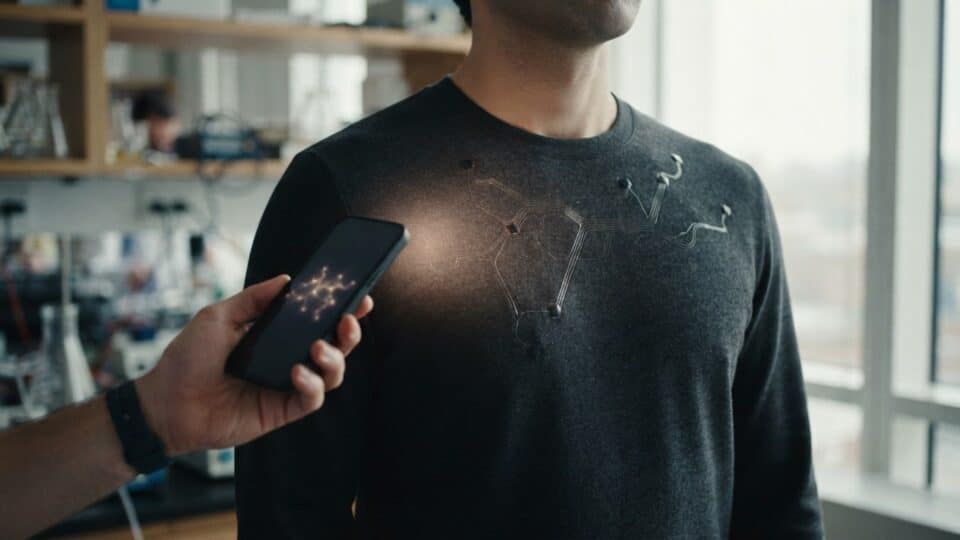
Battery-free wireless sensors are the central idea of research published in Nature Communications on 14 September 2026. The team built a network of wearable sensors that receives power from an NFC-compatible phone and transmits data through a textile structure with special electromagnetic properties. A material embroidered with conductive liquid-metal fibres guides signals along the body.
Battery-free wireless sensors: from smartwatches to signal-carrying textiles
This is not a shirt that generates energy from nothing. The sensors do not each contain a battery, but they need an external power source, such as the phone used in the demonstration. The system seeks to eliminate distributed batteries, not electronics’ need for energy.
What is a textile metamaterial?
A metamaterial is an engineered structure whose geometry and arrangement of components give it useful electromagnetic properties. In the 2026 research, conductive paths are integrated into textiles through digital embroidery using liquid-metal fibres. They support the propagation of the signals used for power delivery and communication.
Being a fabric does not mean that any ordinary T-shirt has the same properties. The materials, path orientation, contacts and geometry are all part of the device. Signal quality may depend on movement, position and the connection of textile elements.
Two signal types in one system
The paper describes near-field power transfer at about 13.56 MHz, in the range used by NFC, and Bluetooth communication around the 2.4 GHz band. This separation makes it possible, in the demonstrated configuration, to power the sensors and transmit their readings through a shared textile network.
NFC does not become a universal charger for every electrical device. The transferred energy is constrained by coupling, distance, efficiency and operating restrictions. The sensors are designed for low power consumption, not to directly run powerful motors.
Laboratory results: relative comparisons, not universal promises
The authors reported an approximately 37.8-fold improvement in data throughput and a doubling of power-transfer efficiency compared with a reference configuration used in the research. These are experimental findings dependent on the chosen comparison, frequencies, geometry and protocol. They do not mean that clothing transmits internet data 37.8 times faster than every Wi-Fi network.
The paper includes demonstrations of robotic-hand control, virtual-reality interaction and body-motion representation. They show possible integrations, but do not constitute clinical testing of a medical product.
A phone in the pocket as the network hub
In the configuration studied, the NFC-compatible phone acts as a power and communications hub. Sensors on the hands, torso or legs can send movement information for central processing. A body-tracking system could therefore be less bulky than one with a battery in every node.
However, phone position, textile coverage, interrupted contacts and device compatibility remain limitations. Everyday use would require testing for washing, sweat, abrasion and the lifespan of conductive paths.
Future applications: robotics, accessibility and VR
A system of gloves and body-worn sensors could be useful for robotic control, clinically researched rehabilitation exercises, virtual experiences or interfaces for people with limited mobility. In all such cases, overpromising should be avoided: an interface prototype is not a medical treatment.
Assistive devices intended for the market require ergonomic testing, electromagnetic compatibility, information-security validation and compliance with applicable requirements. Some uses may involve sensitive biometric data that need protection.
The overlooked privacy issue
A network that tracks gestures and movement can generate detailed information about a user’s habits. Data on posture, activity and interaction should be collected only for clear purposes, stored securely and controlled by the person wearing the device.
The metamaterial is a physical solution for transferring signals, not an automatic guarantee of privacy. That depends on how the connection, phone and app are secured.
How to check information before sharing it
- Check the scientific publication, date and research method.
- Distinguish laboratory measurements from possible future commercial applications.
- Note the units, reference values and conditions under which the authors obtained the result.
- Do not attribute results to a different city or device without local research.
How the textile can guide energy and data
The embroidered conductive paths are designed to guide electromagnetic fields in a configuration useful for a body-area network. At 13.56 MHz, the system can transfer power through a near-field mechanism, while at about 2.4 GHz it facilitates Bluetooth data transmission. Operation depends on the sensor’s position relative to the textiles and the phone.
This clothing-integrated infrastructure differs from simply connecting a watch via Bluetooth. The aim is to reduce the size and number of distributed batteries, but the system still contains electronic circuits and an external power source.
Why a battery-free sensor still uses energy
A sensor that measures movement needs energy for sensing, processing and communication. If it has no battery of its own, it receives energy from the electromagnetic field of a nearby source. Efficiency depends on coupling, losses and distance. The energy does not disappear from the equation; it is supplied elsewhere.
For continuous use, the total power consumption of the phone, textile elements and sensors would need to be calculated. An architecture without distributed batteries may improve ergonomics, but it does not guarantee lower total electricity use in every configuration.
What 37.8 times better data throughput means
The result reported by the study’s authors compares the textile architecture with a reference configuration used in the research. It indicates a relative improvement under defined conditions. It should not be confused with a 37.8-fold increase in the internet speed of a phone, mobile network or Wi-Fi connection.
In a real-world application, performance may be affected by movement, contact, clothing and interference. A transparent comparison would require the exact equipment, distances, frequencies and measurement protocol to be known.
The glove that can control a robotic hand
In the research demonstration, a glove with finger-bending sensors supplied information to control a robotic hand. The sensors collect movement signals, and software turns them into commands. The textile network helps transfer power and data to the phone.
This demonstration does not mean the glove can automatically be used in a clinical prosthesis or an industrial robot. Separate testing is needed for accuracy, latency, safety and resilience under real conditions of use.
How smart clothing is tested after washing
Textiles are exposed to washing, sweat, bending, friction and temperature changes. Conductive connections can be affected by these processes, and a prototype that works well in the laboratory may require additional protection for daily use.
A commercial product should be tested after many washing and drying cycles, with electrical performance measured before and after. Comfort, flexibility, added weight and the ability to repair faulty modules should also be assessed.
Body movements are data that need protection
A system that tracks gestures and posture can reveal information about a user’s behaviour. If the data are sent to a phone or online service, storage, authentication, third-party access and retention periods need to be clarified. A network without batteries is not immune to cyberattacks.
For a broader discussion of what wearables can reveal, see InfoBuz’s analysis of continuous health monitoring and personal data. Technology and privacy are two issues that need to be addressed together.
| Component | Role in the prototype | Limitation |
|---|---|---|
| NFC / 13.56 MHz | Wireless power delivery | Coupling and distance |
| Bluetooth / 2.4 GHz | Data transmission | Interference and power consumption |
| Textile metamaterial | Signal guidance | Wear and washing |
| Battery-free sensor | Movement measurement | Depends on external power |
| Phone | Power and processing hub | Battery life and security |
Frequently asked questions
Do the clothes generate electricity themselves?
No. The battery-free sensors receive external power—through an NFC phone and textile metamaterial in the demonstration analysed.
Are they available in shops?
The research describes prototypes, not a universal commercial product.
Do they use NFC and Bluetooth?
Yes, for different functions: power transfer and data communication, through engineered textile paths.
Can they be used for medical diagnosis?
The interface demonstrations alone do not provide general clinical validation of this system.
InfoBuz conclusion
A smart material can carry energy and data across the body, but a battery-free sensor is not a sensor without a power source. The technology’s promise can only be assessed responsibly alongside repeatability testing, costs and the study’s real limitations.
Primary sources and methodology
Editorial note — 24 November 2026: This article analyses the authors’ data and does not present experiments conducted by the editorial team. The lead image is an illustrative editorial image, not an authentic photograph of the device or researchers. We do not promise commercial availability or local impact without further documentation.


Discuția cititorilor
Ai o opinie sau o întrebare despre acest articol? Spune-ne ce crezi.
Fii primul care deschide discuția.
Te rugăm să păstrezi un limbaj civilizat și să discuți la subiect. Comentariile spam sunt filtrate automat.