
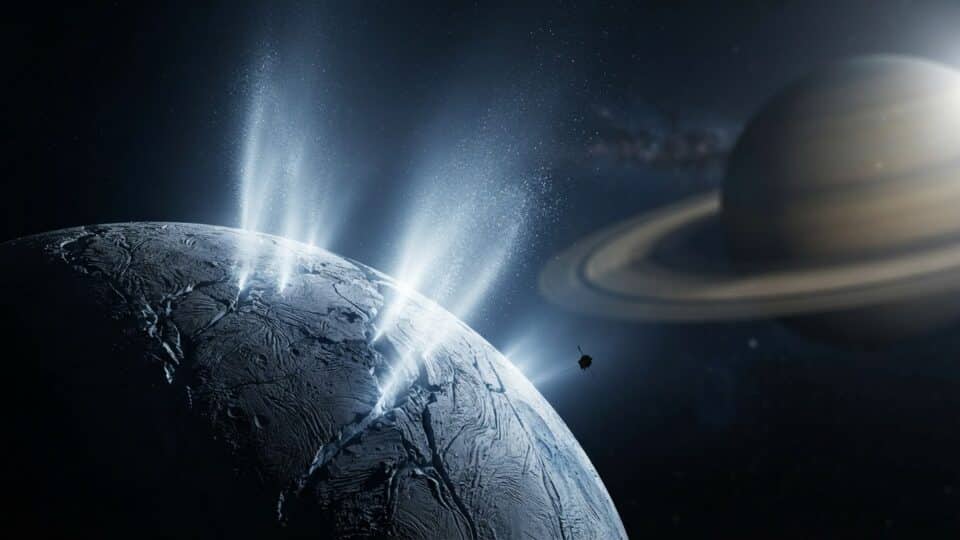
Enceladus’s ocean, hidden beneath the icy crust of one of Saturn’s moons, can be investigated indirectly through ice particles expelled by geysers at its south pole. In September 2026, two lines of research offered intriguing clues: one on how ice particles preserve chemical signatures from the water, and another on the tolerance of terrestrial microorganisms under simulated conditions.
Enceladus’s ocean: a world that ejects samples into space
Neither study demonstrates that life exists on Enceladus. Instead, they refine the question: what signal might a future mission detect, and how faithfully do particles in the plumes represent the composition of the ocean below?
What the Cassini spacecraft measured
The Cassini spacecraft passed through regions containing particles from Enceladus’s plumes and used its Cosmic Dust Analyzer (CDA) to investigate their composition. Depending on their type, the particles contain differing amounts of salts and organic substances. Researchers are seeking to determine to what extent these differences arise during freezing, fragmentation and transport from the ocean into space.
A Science Advances study published on 25 September 2026 proposes an interpretation in which the freezing and fragmentation of ocean droplets compositionally separates different types of ice grains. This may help reconstruct the ocean’s properties, but it relies on physical models of the formation process.
Why two ice grains can tell different stories
When salty water freezes gradually, dissolved substances are not distributed evenly among all ice fragments. Some areas may concentrate salts and organic molecules, while others remain more depleted. If a spacecraft detects particles selected according to particular properties, that distribution may affect conclusions about the ocean.
For that reason, a chemical signal observed in space should not automatically be interpreted as a fully representative sample of the entire body of water. Researchers are examining processes of selection, fragmentation and transport in order to distinguish the ocean’s signature from that of an individual particle.
Microorganisms that tolerate simulated conditions
Research presented by LMU Munich on 28 September 2026 investigated microorganisms that consume hydrogen and produce methane, under laboratory conditions chosen to approximate certain characteristics of the environment on the floor of Enceladus’s ocean. The result suggests that some archaea can withstand an environment previously considered highly challenging.
The experiment tests the survival or adaptation of Earth organisms in a simulation, not their existence on Saturn’s moon. The distinction is essential: a condition that may be compatible with life is not a detection of extraterrestrial life.
The three ingredients discussed in astrobiology
For life as we know it, liquid water, the necessary chemical elements and a usable source of energy are important. Enceladus has an ocean beneath its ice, compounds of interest and evidence of interactions between water and materials in its interior. That is why it is a major target for astrobiology.
Yet the mere coexistence of water, chemistry and energy does not guarantee that life emerged. Science must distinguish potentially habitable environments from credible biosignatures, and rule out abiotic explanations for detected molecules.
How the next mission should be designed
A future spacecraft could fly through the ice plumes with instruments able to analyse complex molecules, isotopic ratios and particle distributions. Calibration should account for the way samples are transformed during ejection, travel through space and collection.
If particles have been selected or altered, a negative result does not automatically rule out life in the ocean. Conversely, an interesting organic molecule is not necessarily biological. Instrument capability and chemical interpretation need to advance together.
Why the findings matter to us
Studies of this kind combine spectrometry, laboratory simulations, ice physics and biology. These techniques are also useful in research on extreme terrestrial ecosystems, although analogies have limits. A terrestrial microorganism resistant to alkaline water is not a perfect model for any possible ecosystem on Enceladus.
For InfoBuz readers, the key point is understanding the difference between “a world could support life” and “we found life”. The first claim can be tested with experiments and models; the second would require extraordinary, reproducible evidence and rigorous elimination of alternative explanations.
How to read a scientific discovery correctly
- Identify the date of the measurement or experiment, which may differ from the publication date.
- Check the laboratory conditions and the location where the observation was made.
- Separate what was observed from the interpretive mechanism proposed by the authors.
- Do not generalise to other regions or organisms without additional data.
How material from an ocean reaches space
Enceladus has a fractured ice crust, and plumes of particles and vapour have been observed in its south-polar region. Understanding the path of these particles requires models of pressure, freezing, droplet formation and transport through fractures. Material from the ocean may be altered along the way.
As a result, analysing a particle remotely is not the same as lowering an instrument into the ocean. It provides access to a potentially representative sample, but a correct interpretation depends on the processes that produced and selected that particle.
Why salt-rich particles are distinctive
Particles enriched in salts may retain clues to the composition of the water from which they originate. During freezing, salts and some molecules may become concentrated in particular areas, while relatively pure ice forms elsewhere. Subsequent fragmentation can produce several classes of particles.
The 2026 study contributes to interpreting this compositional separation. However, the composition of one particle should not automatically be generalised to the entire ocean, particularly if selection by size or formation process is involved.
What a mass spectrometer can reveal
A cosmic dust analyser investigates particles through signals associated with their composition. Such data can be used to propose compounds or classes of substances, subject to limits of resolution, calibration and detectability. It is not an instrument that directly reads the DNA of a hypothetical organism in the ocean.
Robust biosignatures would require several lines of evidence: complex molecules, isotopic ratios or chemical distributions that are difficult to explain abiotically, assessed against simulations and geochemical models. A single peak in a spectrum should not be presented as evidence of life.
What terrestrial archaea showed in simulations
The LMU Munich team studied anaerobic microorganisms able to use hydrogen and produce methane. Under laboratory conditions selected to approximate certain properties of Enceladus’s ocean, some organisms showed the potential for adaptation and survival. This is information about the limits of biological tolerance.
But these microorganisms come from Earth. They were not found on Enceladus, and the simulation does not reproduce every factor in the actual environment. Without direct observations, the responsible conclusion is that certain conditions may be compatible with known forms of life—not that life exists there.
Why life may be difficult to detect even if it exists
An ocean beneath ice may contain chemically distinct regions and low concentrations of biological compounds. Plumes may select particles or alter molecules during their formation and ejection. An instrument that does not detect a particular compound cannot rule out all possible forms of life in the entire ocean.
An optimal mission would need to combine complementary instruments, repeated sampling and contamination controls. Earth-based laboratories are useful for estimating which compounds survive the sampling process and for setting realistic detection limits.
Why the difference between “habitable” and “inhabited” matters
A habitable environment is one in which certain conditions necessary for life may exist. An inhabited environment is one for which there is evidence of organisms. The presence of water and organic compounds may support the first proposition, but does not automatically validate the second. This distinction is fundamental in astrobiology.
Headlines such as “NASA discovered aliens in Saturn’s ocean” are inaccurate in relation to the research from 2026. The real development is an improved ability to interpret ice particles and test the viability of environmental conditions.
| Evidence or method | What it tells us | What it cannot confirm on its own |
|---|---|---|
| Cassini ice particles | Chemical composition and variation | Extraterrestrial life |
| Salts and organics | A clue about the ocean | A necessarily biological origin |
| Terrestrial archaea in the laboratory | Tolerance of simulated conditions | Organisms on Enceladus |
| Plume models | How samples form | The ocean’s full composition |
To understand how complex environments hidden beneath ice can be even on Earth, see InfoBuz’s analysis of Antarctica’s subglacial lakes. This comparison does not demonstrate that life exists on Enceladus.
Frequently asked questions
Was life discovered on Enceladus in 2026?
No. The studies discuss the composition of ice particles and the viability of terrestrial organisms in simulations.
Does Enceladus have an ocean beneath its ice?
Scientific data support the existence of an ocean below the frozen surface, investigated indirectly through plumes.
What did Cassini do?
It analysed ice particles and other data from the Saturn system, helping researchers interpret the ocean’s chemistry.
Why are salts and organic molecules of interest?
They can inform researchers about water composition and chemical reactions without automatically constituting biosignatures.
InfoBuz conclusion
Enceladus remains promising because it offers fragments from its hidden ocean, not because life has already been found. The information becomes valuable when every limitation of the method is explained as clearly as the attention-grabbing result.
Sources and research transparency
- Science Advances, September 2026, Cassini CDA
- Freie Universität Berlin, 25 September 2026
- LMU Munich, 28 September 2026, microbiological simulations
Editorial note — 24 November 2026: This article is documented from scientific sources and does not present InfoBuz’s own research. The featured image is illustrative, not a photograph of the original observation or experiment. We do not assign certainty where studies report only hypotheses or conditional results.


Discuția cititorilor
Ai o opinie sau o întrebare despre acest articol? Spune-ne ce crezi.
Fii primul care deschide discuția.
Te rugăm să păstrezi un limbaj civilizat și să discuți la subiect. Comentariile spam sunt filtrate automat.