
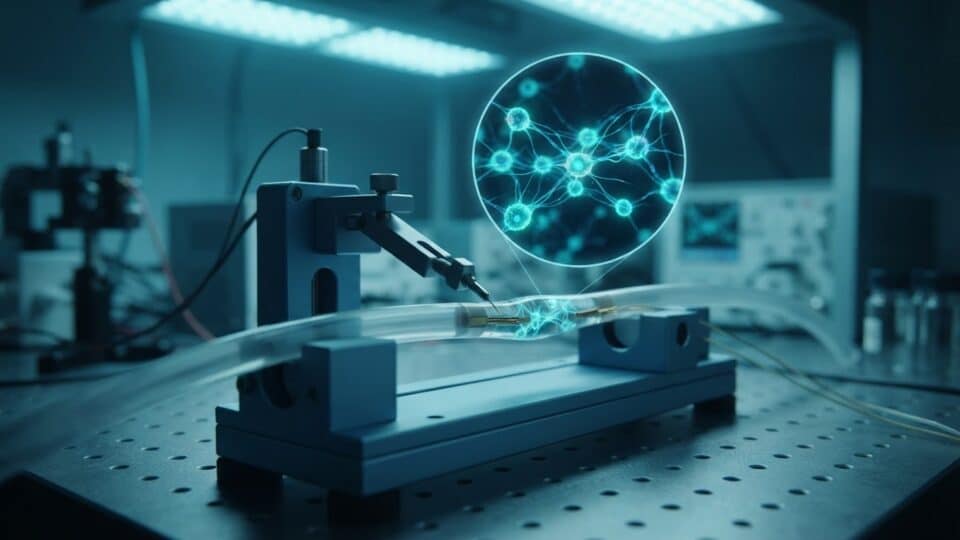
The living sensor described in a Nature Communications study published on 23 July 2026 uses a network of genetically engineered bacteria to detect mechanical forces. The cells are designed to connect to one another through pairs of surface-recognition molecules. The resulting network is placed within an elastic structure, becoming part of the layer that responds to stress.
The living sensor: a network of microorganisms in an elastic material
This is an example of bioelectronics in which organisms are not merely a decorative addition. Cellular organisation is used to create a flexible material architecture. The study does not, however, announce a “conscious artificial organism” or a medical sensor approved for patients.
How microorganisms assemble into a larger structure
The team used laboratory cells from the Escherichia coli MG1655 strain, engineered to display pairs of proteins on their surfaces that recognise and bind to each other. By mixing cell populations, the network develops connections between microorganisms. The material is then integrated into a flexible tube that supports and protects the sensing layer.
The research should not be mistaken for an invitation to grow bacteria at home for electronics projects. Working with genetically modified microorganisms and building such a prototype require specialised infrastructure and controls. The paper explains the principle; it does not provide a laboratory protocol.
What the researchers measured: deformation, resistance and recovery
The authors describe a sensor with a configurable measurement range, rapid recovery after the network is ruptured, and relative insensitivity to overall stretching of its support. In some tests, they reported functional recovery in around 39 milliseconds and an electrical-resistance increase of only around 30% at 800% elongation.
These are specific experimental conditions. A material tested in a laboratory at eight times its original length is not automatically suitable for skin, medical equipment or permanent outdoor use. The figures must be read alongside the preparation method, sample geometry and test duration.
Why a living network may differ from a metal wire
A conventional metal conductor may have a predictable mechanical response, but some configurations break under large deformations. A network made of cellular units with reversible bonds may redistribute stress and reconnect parts of its structure. This explains the authors’ interest in programmable, resilient materials.
That does not mean the system is better than all existing conductive elastomers or nanocomposites. Standardised testing of sensitivity, noise, repeatability, service life, biological stability and unit cost would be needed.
What “living” means in a technological device
The term raises practical questions: how long do the cells remain viable, how are they supplied, what happens if the environment dries out, and how is user exposure limited? A living material may have interesting capacities for reorganisation, but it also introduces biological requirements beyond those of an ordinary electronic sensor.
For wearable devices, microbiological safety and sealing would be essential. This research does not demonstrate a product intended for unrestricted contact with the skin of the general public.
Possible applications: robotics and human-machine interfaces
A force sensor that tolerates stretching may be attractive for deformable robotic elements, experimental prostheses or interfaces that need to distinguish pressing from stretching of the support material. The researchers demonstrated a measurement platform, not a complete range of clinical products.
Real-world use would require a signal-processing chain, electrical power, biological protection and validation in repeatable environments. For medical applications, an additional stage would involve comparison with certified instruments and long-term safety testing.
What still needs to be verified before talking about “self-healing materials”
The term “self-healing” may describe the restoration of a connection after rupture in a specific protocol, rather than regeneration from any damage. A device can regain its response in one test while still degrading during very long cycling, heat exposure or contamination.
For assessment, useful data would include complete force-signal curves, control of variation between samples, storage stability and results from other laboratories. Such evidence will determine whether the bacterial network is a broadly useful engineering advantage or an extraordinary demonstration that is difficult to translate to industry.
How to read a scientific discovery correctly
- Identify the date of the measurement or experiment, which can differ from the publication date.
- Check the laboratory conditions and where the observation was made.
- Separate what was observed from the interpretive mechanism proposed by the authors.
- Do not generalise to other regions or organisms without further data.
Why the bonds between cells are decisive
The researchers did not simply use bacteria mixed into a liquid. They engineered molecular surface-recognition systems so that some cells formed non-covalent or covalent connections with others. This organisation contributes to the network’s cohesion and to how it responds to mechanical stress.
The bonds may have different properties: some come apart and reform more easily, while others are more stable. The balance between them may affect the material’s strength and recovery, but this performance must be confirmed in the actual sensor configuration.
What recovery in 39 milliseconds represents
In the 2026 study, the authors describe rapid signal recovery after a stress event that affects the network. A value of 39 ms characterises a precise test, not the instantaneous “healing” of every crack anywhere in the material. The electrical signal may recover without all mechanical properties being restored in exactly the same way.
A full assessment requires several types of tests: resistance before and after stress, changes in sensitivity, repeated cycles and resistance to ageing. In a real application, stability after extended use is precisely what matters.
Why insensitivity to stretching is useful
A force sensor mounted on a flexible surface can confuse the pressure it is meant to measure with accidental stretching of its support. If electrical resistance changes strongly during stretching, the measurements become difficult to interpret. The bacterial network studied was designed to tolerate substantial deformation.
Still, a relatively modest resistance increase in one test does not mean that the signal is never affected by bending, temperature or humidity. Calibration across a matrix of conditions and reference instruments would be needed.
Why “living” is a challenge for industry
Living materials may require water, nutrients and suitable conditions to maintain cell viability. If those conditions are not maintained, their properties may change over time. Conversely, some bio-inspired materials may retain a function without permanently depending on organism growth. These alternatives must be assessed separately.
Devices intended for public use also bring requirements for sealing, sterility or biosafety, depending on the application. It would be inaccurate to infer that a laboratory demonstration can be placed directly against skin or incorporated into a product for children.
How sensor sensitivity would be verified
A complete technical report would include the curve between applied force and signal change, the useful measurement range, noise, repeatability and response time. Differences between samples produced on separate days and stability after storage should also be checked.
Comparison with existing stretchable sensors must be made under the same conditions. The network’s resilience may be an important advantage, but it does not prove lower cost, greater sensitivity or superior durability in every situation.
Which applications should be tested before promotion
In a human-machine interface, a device could detect pressure exerted on a flexible component. In robotics, measuring a small force may help control a deformable element. But each use requires readout electronics and a sensor-maintenance strategy.
For medical or assistive applications, the study cannot replace validation with users and safety assessment. The technology is promising, but a bioelectronic prototype is not automatically an authorised medical device.
| Indicator | What the research examined | What it does not demonstrate |
|---|---|---|
| Response to force | Measurable electrical signal | Medical diagnosis |
| Rapid recovery | Recovery test | Unlimited self-healing |
| Large stretching | Mechanical tolerance | Commercial service life |
| Bacterial network | A material with a living structure | Automatic safety in skin contact |
For another experimental application involving sensors and miniature systems, read InfoBuz’s article on microrobots with artificial cilia. The two studies use different mechanisms and should not be conflated.
Frequently asked questions
Does the sensor contain real bacteria?
Yes. The study describes a network made of genetically engineered bacterial cells encapsulated in an elastic structure.
Can it be used in a commercial prosthesis today?
The work is experimental and does not validate a clinical application available to the public.
Does it repair itself?
The authors report rapid recovery in certain tests, but not an ability to remedy every type of damage.
Is it safe for direct contact with skin?
The safety of specific products must be demonstrated separately; the study does not provide clinical authorisation.
The InfoBuz conclusion
The living sensor shows that biology can become a functional architecture, but engineering, control and validation are still needed. Information becomes valuable when every limitation of a method is explained as clearly as the attention-grabbing result.
Sources and research transparency
Editorial note — 24 November 2026: This article is documented from scientific sources and does not present original research by InfoBuz. The featured image is illustrative, not a photograph of the original observation or experiment. We do not assign certainty where studies report only hypotheses or conditional results.


Discuția cititorilor
Ai o opinie sau o întrebare despre acest articol? Spune-ne ce crezi.
Fii primul care deschide discuția.
Te rugăm să păstrezi un limbaj civilizat și să discuți la subiect. Comentariile spam sunt filtrate automat.