
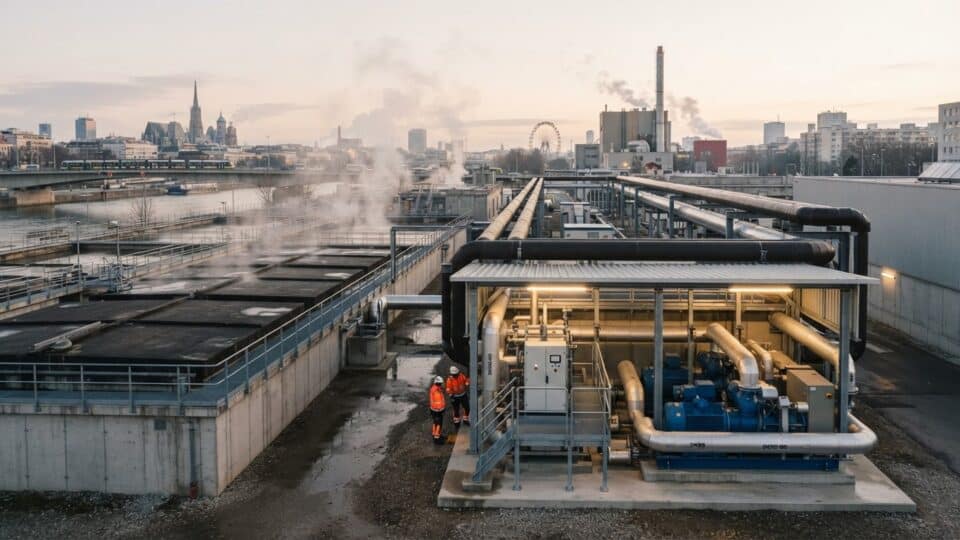
Heat from wastewater is not merely a laboratory idea. At the end of 2023, Vienna brought online a system of large heat pumps that capture thermal energy from treated wastewater and feed it into the district-heating network. In its first stage, the Simmering facility has a stated thermal capacity of 55 MW and is associated with the heating needs of around 56,000 households.
Heat from wastewater: an energy source cities discard
Treated water at the ebswien plant remains relatively warm even in winter. The city administration cites temperatures of roughly 12°C to 23°C, depending on the season. Rather than discharge this energy into the Danube, the city uses industrial equipment to raise it to a temperature useful for district heating.
How the facility works: it does not turn sewage into drinking water
Treated wastewater transfers heat through heat exchangers and a process circuit. The heat pump uses electricity to raise the temperature of a separate heat-transfer medium. The water circulating through radiators is not dirty sewage water. Separate circuits, filtration and the monitoring of heat exchangers are essential to operation and service safety.
Vienna’s city administration describes extracting around 6°C from treated wastewater and producing hot water at more than 90°C for the heating network. These figures refer to the facility described and do not amount to a model that can automatically be replicated in an apartment building.
55 MW does not mean 55 MWh a year
Capacity in megawatts expresses the thermal power available under a given operating condition. The energy produced depends on time and utilisation. If a hypothetical 55 MW facility operated at its nominal capacity for exactly 1,000 hours, it would deliver 55,000 MWh of heat. This is an illustrative calculation only, not Simmering’s actual annual output.
The cost of heat also depends on the electricity used by the pumps, expressed through efficiency or the coefficient of performance. If a pump delivered 4 kWh of heat from 1 kWh of electricity under defined conditions, its COP would be 4. That value should not, however, be attributed to the Vienna installation without the relevant operating documentation.
Why wastewater temperature is valuable in winter
A relatively stable heat source allows a heat pump to operate across a temperature difference that may be more favourable than that of very cold outdoor air. The high flows at a wastewater-treatment plant create potential for recovery at urban scale. But not every sewer system has suitable flow, temperature and water quality.
Proper sizing requires data on hourly temperature, minimum winter flow, contaminant concentrations, fouling risk, electricity requirements and the connection point to a district-heating network. The facility also has maintenance, resilience and electricity-supply requirements.
Vienna’s model: planned expansion to 110 MW
Vienna’s administration describes a plan to add three more heat pumps by 2027, bringing the system to around 110 MW and, according to the municipal communication, the equivalent of 112,000 households. These figures represent planned capacity and a household equivalent; they are not evidence that every future stage had already been completed by November 2026.
A project of this scale requires investment, specialised equipment, connections and an electricity-supply strategy. The city administration mentions electricity associated with the Freudenau hydropower plant within the system. Any emissions assessment must nevertheless account for the full electricity mix and real operating conditions.
Could it be applied in Romania?
In theory, large cities with wastewater-treatment plants and district-heating systems could investigate such solutions. But the mere existence of a treatment plant is not enough to make a project viable. It requires nearby heat consumers, an available network, a reliable minimum flow and comparison with other energy sources.
For Bucharest, Constanța, Iași or other cities, a pre-feasibility study setting out flows, temperatures, electricity costs, investment, payback period, cost per MWh delivered and emissions would be useful. This article does not claim that a Romanian administration has already built a system identical to Vienna’s.
Five questions for a serious public tender
How much heat can be extracted in the coldest month, when flows and temperatures may differ from the average? What electrical power is needed at peak demand? What happens if the wastewater-treatment plant shuts down temporarily? Who finances the installation, and what final tariff does the consumer pay? How can costs and emissions be verified each year?
The answers should be published in the project documentation before the investment decision. A fair comparison uses total lifetime cost, not simply a striking chart of households heated. For context, InfoBuz also has an analysis of the cost of hot water and recirculation, a matter on a different scale.
Three checks before repeating the story
- Confirm the institution, date and research method in the original source.
- Do not confuse a controlled experiment with a measurement carried out in Romania.
- Do not turn a possible mechanism into certainty about effects or future applications.
Why wastewater-treatment plants retain substantial thermal energy
Water leaving a household after showering, washing or other uses carries thermal energy. After treatment, a city’s combined flow may remain warmer than the outdoor environment for much of the year. At a large plant, the relatively steady flow is the main advantage: energy is available in quantities that can justify industrial equipment.
Recovery takes place after assessing its effect on treatment and discharge conditions. Lowering the temperature must not disrupt biological processes or environmental obligations. Projects should therefore be assessed jointly with the plant operator, not only with the heat-pump supplier.
How the theoretical amount of heat in water is calculated
The thermal energy associated with cooling a flow of water can be approximated from its mass, specific heat capacity and temperature change. For a hypothetical 1,000 m³ of water, cooling by 5°C corresponds to around 5.8 MWh of extracted thermal energy, using a density of about 1,000 kg/m³ and a specific heat capacity of 4.18 kJ/(kg·K).
This is a physical illustration, not a measurement of the Vienna facility or the thermal energy delivered to the network. The heat pump also receives electrical energy, so useful output energy, losses and operating conditions must be assessed across the full system.
What the coefficient of performance means
COP is the ratio between heat delivered and electricity consumed under a specified condition. If a system delivers 4 MW of thermal output while consuming 1 MW of electricity at a given operating moment, its COP is 4. But that figure can vary with source temperature, the temperature of the heat-transfer medium, load and the demand from auxiliary pumps.
It is not appropriate to compare a heat pump’s catalogue COP with the total cost of district heating without including the network, circulation pumps, maintenance and backup sources. An economic decision requires the total cost per MWh delivered, not only an efficiency figure.
Why district-heating network temperature matters
Heat pumps operate more efficiently when the difference between the source temperature and required output temperature is relatively small. A network requiring very high temperatures may have different energy requirements from one modernised to use a cooler heat-transfer medium. In Vienna, the stated facility produces heating water at more than 90°C for an existing network.
In Romania, a wastewater-heat recovery project would need to be coordinated with pipe upgrades, system balancing and loss analysis. A new source does not automatically compensate for a network with high losses or inefficient distribution.
What an economic assessment of a Romanian project would look like
The first step would be an hourly balance of flows and temperatures for at least one representative season, together with the heating demand of nearby consumers. The assessment would then estimate investment, electricity costs, operations, equipment replacement, financing costs and savings compared with existing sources.
A fair comparison would include scenarios with different electricity prices, because heat pumps depend on them. The source of electricity should also be specified if the project aims to reduce emissions. A lower final tariff does not follow automatically from recovering a resource regarded as “free”.
What is missing from the public debate on “green” heat
Discussion often focuses on installed capacity and the number of equivalent households, and less on how many hours the system runs, annual maintenance costs and the actual emissions balance. For a publicly funded project, these indicators should be reported after every year of operation.
Data would also be useful on periods when the system is shut down, performance in extreme temperatures and backup sources. A durable district-heating investment must be assessed over its full lifetime, not only at its inauguration.
| Indicator | What should be published | Why it matters |
|---|---|---|
| Water flow and temperature | Hourly or monthly series | Estimate of the real resource |
| Seasonal COP | Heat delivered / electricity consumed | Operating cost |
| Capacity in MW | Nominal and maximum power | Facility sizing |
| MWh per year | Energy actually delivered | Real-world performance |
| Cost/MWh | Investment and operation | Economic comparison |
Frequently asked questions
Does the heat come directly from sewage dirt?
No. It is the thermal energy carried by treated wastewater, recovered through equipment and heat exchangers.
Is 55 MW annual energy?
No. MW measures power, while annual energy depends on operating hours and the actual load.
Is it an operational system?
Vienna’s city administration says the first stage entered service at the end of 2023.
Can it be installed anywhere?
No. Suitable conditions of flow, temperature, infrastructure, demand and financing are required.
InfoBuz conclusion
Vienna shows that energy from an apparently ordinary municipal flow can become a heating resource if a project is properly sized and operated. The important next step is not to amplify the headline, but to verify the methods, uncertainty and whether the result can be reproduced.
Sources and transparency
Editorial note — 24 November 2026: This analysis is based on primary sources and institutional documentation. We do not present the mathematical examples as local measurements. The featured image is a generated illustration, not a documentary image of the original research.


Discuția cititorilor
Ai o opinie sau o întrebare despre acest articol? Spune-ne ce crezi.
Fii primul care deschide discuția.
Te rugăm să păstrezi un limbaj civilizat și să discuți la subiect. Comentariile spam sunt filtrate automat.