
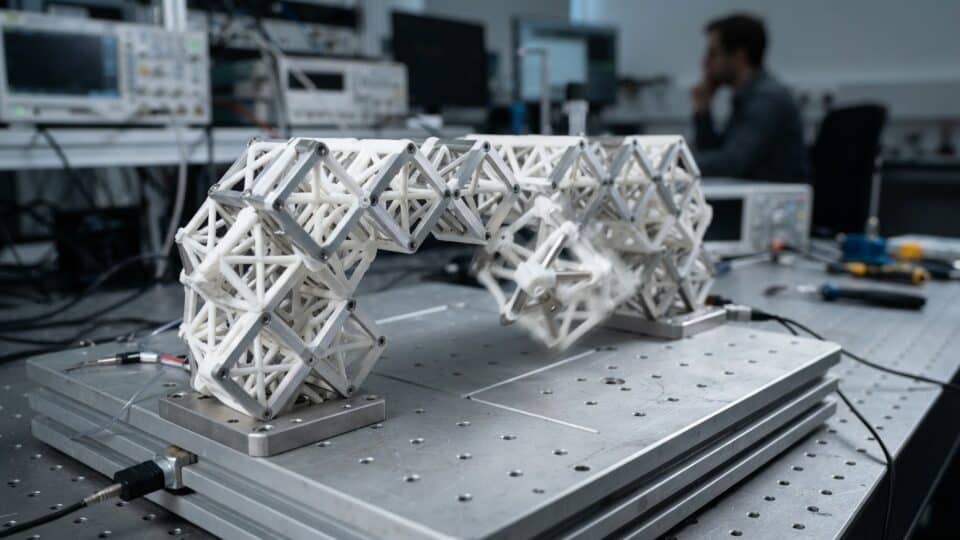
Vibration-driven disassembly is the principle behind an experimental modular structure presented in Nature Communications in May 2026. Researchers designed mechanical modules with joints whose geometry allows selective release at particular vibrations. The entire assembly can be controlled externally by a vibration source, without electronic controllers installed in every component.
Vibration-driven disassembly is not uncontrolled demolition
The innovation is not a real bridge that could collapse when a truck passes over it, or a commercial wall that comes apart to the sound of music. The prototypes are experimental structures with specific locking and release mechanisms, tested under controlled conditions.
How the mechanical connections are designed
The authors describe cuboctahedral units, with internal joints strong enough to withstand the expected loads and external joints that respond to vibrations. The geometry and mechanical thresholds influence the order in which parts can detach.
This is a form of programming through physical structure: information about future behaviour is embedded in the connector geometry. Rather than placing a small processor in every module, mechanical parameters are selected to respond to a particular external stimulus.
Why one source can produce different results
If modules have joints with different mechanical responses, a shared excitation can cause only certain areas to release. The researchers explored staged disassembly sequences, including demonstrations underwater and on modular research platforms.
The results depend on shape, amplitude, frequency and mounting conditions. In a real-world application, mechanisms to prevent accidental activation and limit the effects of external vibrations would be essential.
What was demonstrated in the laboratory
The paper presents an architecture that is scalable at the level of the prototypes investigated, as well as mechanical validation of controlled separation triggers. The researchers used models and tests to estimate connector response and design sequences.
Saying that a structure can be selectively disassembled does not mean it can operate indefinitely without wear. Joint materials are subject to fatigue, friction and manufacturing tolerances, all of which affect repeatability.
Potential applications: reuse, not destruction
Industry could examine this principle for assemblies that need to be taken apart without direct access to every screw: structures for robotics, experimental equipment or components that must be recovered in difficult environments. Selective disassembly could reduce some manual operations, but only if the system can be built and verified at a competitive cost.
Another potential application is the design of products that are easier to disassemble at the end of their life. For the circular economy, controlled separation of materials may be of interest, but it must be compared with conventional disassembly methods.
Safety: the most important question
A load-bearing structure cannot be used in a building without demonstrating that operational vibrations, earthquakes and dynamic loads cannot trigger unwanted releases. Engineers must assess resonance risk and safety factors, test tolerances and design a safe failure state.
The article therefore does not recommend using connections of this type in homes or public infrastructure. The laboratory demonstrator shows a design possibility, not compliance with construction standards.
What Romanian industry could explore
Manufacturers of modular equipment and mechanics laboratories could examine the principle for prototyping, resonance testing and joint design. A credible local project would include a test bench, fatigue criteria and a plan for identifying accidental activations.
We have no data on commercial use of this exact system in Romania. Application must be assessed separately for each material, scale and environment, without generalising a striking experiment to the scale of a building.
How to check the information before sharing it
- Check the scientific publication, date and research method.
- Distinguish laboratory measurements from future commercial applications.
- Note the units, reference values and conditions under which the authors obtained the result.
- Do not attribute the findings to a different city or device without local research.
How a connector can be “programmed” without a processor
A mechanical connector can be designed with geometry that makes it stable under some loads and easier to release under others. In the 2026 system, differences between connectors make it possible to select disassembly sequences when the entire assembly is excited by controlled vibrations.
This approach moves part of the operational logic into the material’s form. It is not programming in the same sense as a computer program, but it enables behaviour designed before assembly. Reconfiguration also requires an understanding of the limits imposed by manufacturing tolerances.
What cuboctahedral units are
A cuboctahedron is a polyhedron with square and triangular faces. A structure made of such units can form modular lattices whose mechanical properties are influenced by geometry. The researchers used this architecture to integrate two types of connections: some structural, others intended for selective separation.
One advantage of modular systems is the possibility of changing the configuration without designing an entirely new object. But modularity can increase the number of connection points and tolerances that must be controlled, which can complicate industrial production.
Controlled vibration is not the same as random vibration
A mechanical system’s response depends on frequency, amplitude, direction and mounting method. In the research, the stimulus is applied with controlled parameters so that certain joints disengage before others. Real-world environments also contain unwanted vibrations caused by transport, machinery or natural phenomena.
Safety tests should therefore show a clear separation between normal operating ranges and those for intentional activation. Without this margin, a product cannot be considered reliable simply because it works in a demonstrator.
Potential benefits for product recycling
Many objects are difficult to disassemble because they use adhesives, hidden connectors or combinations of materials that are hard to separate. A system designed for selective disassembly could make it easier to recover components at the end of their life and reduce manual labour.
However, a product that is easier to take apart is not automatically more environmentally friendly. The materials used, manufacturing energy, durability during use and logistical cost must be compared. The full impact is determined through life-cycle assessment.
Why it should not be installed experimentally in a building
Load-bearing structures are designed under rigorous standards for strength and earthquake performance. Any connection that can be released by vibrations would require validation in extreme scenarios and control of accidental activations. A laboratory prototype does not provide that assurance.
For a practical understanding of structural risk, see InfoBuz’s guide to apartment-block earthquake safety. Buildings are not assessed by the spectacle of a technical demonstration.
What the next experiment should include
A testing programme would compare several connector types under load cycles, different temperatures and humidity levels. It should track wear, fatigue and degradation after repeated assembly. It is also important to establish how precisely the disassembly area can be selected without affecting adjacent modules.
Industry must also consider disassembly time, energy consumption and the number of parts that can be reused after the operation. These data would allow comparisons with screws, clips or conventional joints, rather than visual demonstrations alone.
| Feature | What the prototype demonstrates | What remains to be validated |
|---|---|---|
| Mechanical connector | Separation under defined stimuli | Industrial durability |
| One vibration source | Global control of disassembly | Safety under accidental stimuli |
| Reusable modules | Potential for reconfiguration | Life-cycle cost |
| Load-bearing structures | Controlled demonstrations | Compliance with standards |
Frequently asked questions
Can a house be dismantled with a speaker that produces vibrations?
No such application has been demonstrated; the study concerns specially designed mechanical modules and joints.
Does every module have a chip?
No. The architecture discussed is designed for selective disassembly without electronics in every component.
Could it be dangerous in an earthquake?
Any load-bearing application would need to demonstrate safety under vibration and seismic loading before use.
Does this mean materials are recycled automatically?
No. Easier disassembly can support reuse, but separation and recycling depend on materials and logistics.
InfoBuz conclusion
Connectors programmed through geometry could change how disassembly is designed; they do not replace structural safety rules. The technology’s potential can be assessed responsibly only alongside tests of repeatability, costs and the study’s real limitations.
Primary sources and methodology
Editorial note — 24 November 2026: This article analyses the authors’ data and does not present experiments conducted by the editorial team. The opening image is an illustrative editorial image, not an authentic photograph of the device or the researchers. We do not promise commercial availability or local impact without further documentation.


Discuția cititorilor
Ai o opinie sau o întrebare despre acest articol? Spune-ne ce crezi.
Fii primul care deschide discuția.
Te rugăm să păstrezi un limbaj civilizat și să discuți la subiect. Comentariile spam sunt filtrate automat.