
Updated: 22 November 2026 la 11:05. Articolul a fost revizuit pentru a reflecta informațiile disponibile la această dată.
Online classes intended to save energy costs: the case of Aurel Vlaicu University of Arad raises questions about institutional funding, the quality of laboratory teaching and students’ rights. This article considers separately the local decision, the additional funding announced by the Ministry of Education, and ways to cut costs without academic compromises.
Universities and online classes in 2026: the Arad controversy
Aurel Vlaicu University of Arad announced the temporary transfer of some teaching activities online in order to reduce utility costs. The case raises questions about education funding, university autonomy and the quality of students’ training. The sources reviewed contain no national measure requiring all universities to proceed in the same way.
What happened and what the ministry announced
Following the public controversy in November 2026, the Ministry of Education said it would provide the university with an additional 1,261,534 lei in funding. The announced sum is not equivalent to the institution’s entire annual budget and does not automatically show that every online class was cancelled. The precise timetable must be checked against the university’s decisions.
Where energy spending comes from
Campuses use energy for classrooms, laboratories, libraries, dormitories, offices, heating and digital infrastructure. Costs depend on floor space, insulation, contracts, prices and timetables. Genuine savings can be demonstrated only by comparing consumption adjusted for weather and occupancy with the additional costs of online teaching.
Theoretical courses and laboratories are not equivalent
Synchronous theoretical teaching can work online when materials, digital access and transparent assessment are available. Laboratory work, medical practice, experiments and technical activities often require physical attendance. Moving them online without making up the work may affect the development of skills.
Students’ rights
Students should be informed about timetables, examinations, arrangements for making up practical work, and access to libraries and dormitories. Those without a stable internet connection or suitable equipment may be disadvantaged. University autonomy does not remove the obligation to comply with academic standards and regulations.
Reducing costs without suspending in-person teaching
Alternatives include concentrating classes in efficient buildings, smarter room scheduling, automated heating controls, LED lighting and thermal renovation. Some require up-front investment, but may produce lasting savings. Decisions should be based on an energy audit and consultation with students.
What data should be published
For transparency, useful information would include comparable bills, consumption in kWh, the floor space closed, the number of online teaching hours, platform costs and the plan for making up missed work. Without these, an exact amount saved cannot be verified. It is also important to track how the additional budget funding is used.
Frequently asked questions
Did all universities move online? No. Was additional funding announced for the Arad case? Yes: 1,261,534 lei. Are online classes illegal? Not in themselves; what matters is the rules that apply to the programme and the quality of practical activities.
Sources and context
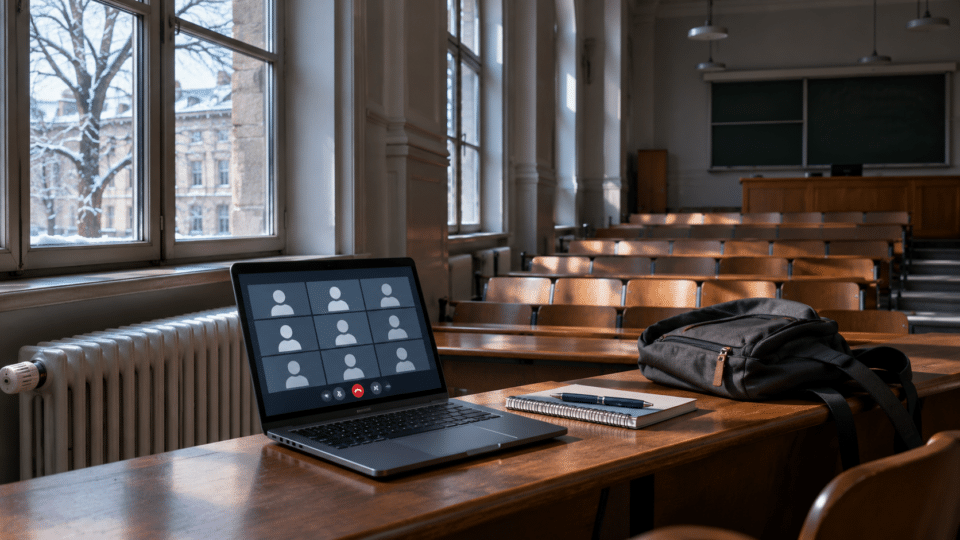
Sources for verification: Aurel Vlaicu University of Arad, the Ministry of Education and public communications from November 2026. For energy context, see InfoBuz’s analysis of energy in Romania in the winter of 2026–2027. The image is illustrative and was not taken on campus. Updated 21 November 2026.
Laboratories versus theoretical courses
Practical activities cannot be assumed to be equivalent to a video conference. Institutions must meet standards and explain how missed work will be made up.
Calculating savings
Lower bills must be verified using comparable consumption data, taking account of weather, floor space and the costs of digital platforms.
Accessibility
Students without a laptop, internet access or an appropriate space may be disadvantaged. Decisions must include support measures.
Sources
The Ministry of Education and Aurel Vlaicu University are the primary sources for the timetable and funding.
Why savings must be measured, not assumed
A university may reduce consumption if it genuinely closes spaces and adjusts heating. But if only classes are moved online while buildings remain heated for laboratories, libraries and staff, the saving may be modest. A proper comparison takes account of outdoor temperatures and the number of users.
Useful data include kWh consumed, the unit cost of energy, floor space closed, the duration of the measure and additional spending on digital infrastructure. Without these elements, an exact savings figure cannot be verified.
What happens to laboratories and practical training
Theoretical teaching can be adapted through live sessions and recorded materials, but laboratories involving equipment, clinical activities and technical work are designed to build practical skills. Make-up sessions must be scheduled transparently, without unrealistically compressing teaching hours.
Quality can be assessed through participation, examination results, student satisfaction and demonstrated skills. The number of online meetings alone is not a sufficient indicator.
Equity among students
Access to stable internet, devices, a quiet space and suitable learning conditions is not uniform. Students living in dormitories or commuting may be affected differently by a sudden timetable change.
Institutions can provide study spaces, equipment loans and technical assistance. Any measure should be communicated before it takes effect and accompanied by clear examination rules.
Structural solutions
Energy audits, building insulation, zone-based temperature control, efficient lighting and smarter room scheduling can reduce spending without moving all classes online. These investments have up-front costs but may generate savings over several years.
A serious public debate should compare the total cost and educational effects of the alternatives, rather than focusing only on one month’s bill.
Online classes: what is confirmed and what remains to be clarified
Aurel Vlaicu University of Arad announced the temporary transfer of some activities online in the context of utility costs. The Ministry of Education later announced an additional 1,261,534 lei. These two facts alone do not show that all classes were moved online, that practical activities were cancelled, or that the additional funding fully covered the institution’s expenses.
A complete chronology requires consultation of decisions by the university senate and management, the precise timetable for affected activities, and ministry communications. There is no basis for automatically extrapolating the Arad case to all Romanian universities.
How a university budget works
A higher-education institution has relatively fixed expenses: staff, maintenance, utilities, security, laboratories, software licences and IT infrastructure. Some costs fall if a building is temporarily closed; others remain even when students attend from home. Energy contracts, floor space and the technical condition of buildings make comparisons between campuses difficult.
A one-off funding addition should not be confused with reform of core funding. A serious assessment should track structural investment needs and how operating costs affect the quality of educational services.
Illustration: when moving online produces savings
Assume, purely for illustration, that a building uses energy and heating worth 100,000 lei in one month. If a reduced timetable enables a genuine saving of 20%, expenditure falls by 20,000 lei. But if the building remains heated for laboratories and offices and the actual saving is only 5%, the reduction would be 5,000 lei. Neither percentage is a figure reported for Arad.
The calculation must include any digital spending, such as licences, technical support, equipment and additional use of infrastructure. More importantly, a lower accounting cost does not automatically justify the loss of essential practical hours.
Which activities can be adapted and which are not easily replaced
Theoretical lectures can be delivered synchronously online if stable platforms, access to materials and opportunities to ask questions are available. Interactive seminars need adapted methods of assessment and participation. By contrast, experiments involving equipment, clinical work, field placements and many engineering activities require physical attendance or verifiable make-up arrangements.
A well-designed hybrid programme should specify before the module begins what will take place online, what will remain on campus, and how skills will be assessed. Simply ticking off hours on a platform does not demonstrate that learning outcomes have been achieved.
Who bears the hidden costs of remote teaching
Moving activities into the home may shift some costs to students and teachers: electricity, heating, internet connections, webcams and devices. These costs are unevenly distributed. A student sharing a room with others may face far more difficult conditions for participation than one with a dedicated workspace.
Support policies may include access to computer laboratories at controlled times, equipment loans, materials accessible on a phone and alternative procedures for people with disabilities. These measures should be assessed before a reduction in institutional spending is presented as a net saving for society.
How learning quality is measured
Useful indicators include actual attendance, pass rates, demonstrated practical skills, anonymous student evaluations and compliance with the timetable. For laboratory subjects, the number of hours actually completed and the arrangements for making them up should be documented, rather than simply the number of virtual meetings.
A fair comparison must account for differences between subjects and years of study. If a cohort performs less well, the cause cannot automatically be attributed to the online format without examining other variables, including changes to assessment and the difficulty of the subjects.
Alternatives to closing buildings
Concentrating groups in efficiently used rooms, zone-based temperature adjustments, building-level consumption monitoring, repairs to installations and thermal renovation can reduce costs without eliminating face-to-face activities. An energy audit may identify losses that are not visible in an aggregated bill.
Efficiency investments should be prioritised according to estimated savings, up-front cost, payback period and their effect on comfort. For example, lowering temperatures below levels appropriate for study is not equivalent to improving insulation or automated controls.
What students and the media should request
Relevant documents include the official decision on the format of classes, the list of affected activities, the laboratory plan, the status of dormitories and libraries, the amount of the funding addition and the intended use of the money. A public-information request can seek aggregated consumption and spending data without disclosing personal information.
Transparency would allow estimated savings to be compared with actual savings and would help prevent hasty conclusions. In the absence of complete data, the article should clearly distinguish between general explanations, institutional claims and measured results.
Frequently asked questions about online classes
Were all universities moved online? The information reviewed contains no such national measure. Is the 1,261,534 lei sum the university’s total budget? No; it is an additional allocation communicated publicly. Can laboratories be held entirely online? It depends on the subject and the applicable standards; practical skills must be provided and assessed.
What happens to examinations? Their arrangements must be set by the institution’s decisions and regulations. How are savings verified? Through consumption and cost comparisons adjusted for temperature, occupancy and digital expenditure.
Institutional sources and verification criteria
For updates, readers should consult the Ministry of Education, Aurel Vlaicu University of Arad and ARACIS for quality-assurance standards. The specific documents from November 2026 should be checked against the institution’s decisions before publication.
This analysis does not attribute specific savings to the university without bills and comparable consumption data. The numerical illustrations in this article are hypothetical and are used solely to explain the methodology.



Discuția cititorilor
Ai o opinie sau o întrebare despre acest articol? Spune-ne ce crezi.
Fii primul care deschide discuția.
Te rugăm să păstrezi un limbaj civilizat și să discuți la subiect. Comentariile spam sunt filtrate automat.