
Updated: 22 November 2026 la 11:26. Articolul a fost revizuit pentru a reflecta informațiile disponibile la această dată.
Romania’s 2026 Nations League campaign: the national team finished bottom of Group B4 with three points, one win and five defeats. Following the draw on 20 November 2026, Romania will face Estonia in a relegation play-off in March 2027. Here is what the official UEFA standings, the goal record and the two-legged tie mean for Romania’s place in League B.
Romania’s Group B4 record
Romania completed UEFA Nations League 2026/27 Group B4 in fourth place, with three points. Its six-match record was one win, no draws and five defeats, with six goals scored and 16 conceded: a goal difference of minus 10. The only victory was a 2-1 win against Poland.
According to UEFA, Sweden won Group B4 with 14 points and were promoted to League A. Bosnia and Herzegovina finished second on 11 points and entered the League A play-offs. Poland were third on five points and remain in League B. Romania, fourth on three points, must play a relegation play-off.
These figures describe the results, but do not by themselves establish the reasons for any tactical difficulties. This Nations League campaign should also be considered separately from qualifying campaigns for other competitions.
Why Romania have not been relegated yet
The 2026/27 format requires teams finishing fourth in League B groups to play a play-off against teams that finished second in League C groups. Romania have therefore not yet lost their League B place; the sporting outcome will be decided over two matches against Estonia.
The winner of the tie will play in League B in the next edition, while the losing side will play in League C, under the promotion and relegation mechanism announced for this stage. It would therefore be inaccurate to say that Romania have already been relegated.
Estonia–Romania play-off
The draw held in Nyon on 20 November 2026 paired Estonia with Romania. The first leg is due to be played in Estonia on 25 or 27 March 2027, with the return in Romania on 28 or 30 March. Exact dates, kick-off times and venues must be confirmed through announcements by UEFA and the national associations.
Before the final fixture list is announced, supporters should not book non-refundable travel or accommodation based on an assumed date. Ticket information and squad announcements should likewise not be treated as official until communicated by the organisers.
Estonia finished second in League C Group C4 with 12 points, behind Iceland on 14. According to the record published after the group stage, Estonia registered three wins and three draws, scored five goals and conceded only two.
The difference between the leagues does not guarantee a result. A side that concedes few goals may be difficult to break down, particularly in a two-legged tie in which every goal changes the calculation. Any assessment of Estonia should take account of match footage and the squad available in March.
What the goal record does — and does not — show
Romania’s six goals in six matches equal an average of one per game. The 16 conceded amount to approximately 2.67 per match. A minus-10 goal difference points to poor results at both ends of the pitch, but it cannot show whether the principal factor was positional defending, transitions or the quality of the opposition.
A more precise tactical assessment would require match-by-match analysis of chances created and conceded, the locations of recoveries, individual errors and set pieces. Possession, shot and expected-goals figures have not been cited here because they have not been verified from comparable sources.
Areas for tactical assessment
Three broad areas merit examination ahead of the tie: limiting the space allowed immediately after losing possession through shorter distances between the lines and a collective reaction; controlled progression towards the opposition penalty area rather than exclusive reliance on long balls; and preparation for set pieces in both attack and defence.
These are analytical directions, not conclusions attributed to Romania’s coaching staff. A specific plan will depend on the players who are fit, their club form, and the way Estonia organise their pressing and defending.
When possession is lost, the distances between units, midfielders’ reactions and cover in wide areas are all relevant. An effective attack also requires ball progression, support between the lines and entries into the penalty area that offer a genuine chance of a finish. Set pieces can decide even matches, but their effectiveness should be measured from confirmed events rather than assumed.
Managing a two-legged tie
A home-and-away contest requires management of the aggregate score as well as the time remaining. A narrow first-leg win does not make the return leg a formality, and an away draw does not guarantee progression.
The staff will need scenarios for an early concession, injuries, cards, substitutions and the closing stages. The applicable rules on extra time and penalties should be checked in the competition regulations rather than inferred from previous competitions. Adapting to the opponent and weather conditions can be as important as the tactical system.
Squad selection before March
Call-ups for March 2027 should be assessed according to club minutes, fitness, health, tactical compatibility and roles. Club form and injuries may alter the squad before the matches. It is not possible to predict the selected players or starting line-up, which may differ from the November group.
What the play-off means beyond March
The Nations League affects the competitive level of the next edition and may influence allocations, depending on the applicable regulations. It should not, however, be automatically confused with qualification for, or elimination from, European Championship or World Cup qualifying.
Romania’s wider international calendar must be checked separately against the UEFA fixture list, the qualifying regulations and Romanian Football Federation announcements. A report on this play-off cannot replace those documents.
What supporters should follow
The official schedule, stadium, entry rules, tickets and selected squad should be checked through UEFA and the Romanian Football Federation (FRF). Unofficial resale websites may involve different terms and risks. For sporting context, supporters can follow players’ club performances and how their roles fit together, rather than relying only on the profile of individual names.
Possible measures of progress include reducing clear chances conceded, creating opportunities from positional play and improving organisation at set pieces. Such indicators need to be defined and compared across matches against relevant opponents. The play-off result will provide a sporting verdict, but any rebuilding process should be assessed beyond two matches.
Questions and answers
How many points did Romania earn? Three in Group B4.
Who won the group? Sweden, with 14 points.
Who will Romania play? Estonia, over two legs.
Where will the first match be played? In Estonia.
Is Romania already in League C? No. The play-off result will decide that.
When are the matches? In the 25/27 March and 28/30 March 2027 windows, with the precise dates still to be confirmed.
Which league do Estonia come from? League C, where they finished second in Group C4.
Sources and editorial context
The standings and play-off mechanism are documented by UEFA Nations League standings and fixtures, UEFA’s update on promotion and relegation arrangements, and the official procedure for the 20 November 2026 draw. For the Estonia–Romania pairing and match windows, see AGERPRES, 20 November 2026. Further announcements can be found through the Romanian Football Federation.
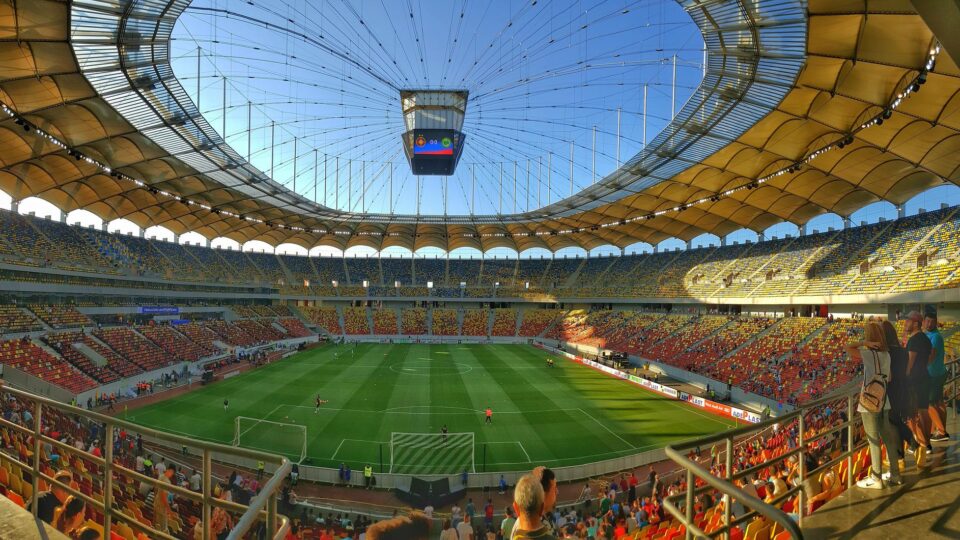
For additional context on sports policy and international competitions, see the InfoBuz editorial archive. The Arena Națională photograph is an archive image and not from the 2026 matches; the article image is illustrative and does not necessarily show an incident from the 2026 campaign. Sources were checked on 21 November 2026. Editorially updated on 22 November 2026.



Discuția cititorilor
Ai o opinie sau o întrebare despre acest articol? Spune-ne ce crezi.
Fii primul care deschide discuția.
Te rugăm să păstrezi un limbaj civilizat și să discuți la subiect. Comentariile spam sunt filtrate automat.