
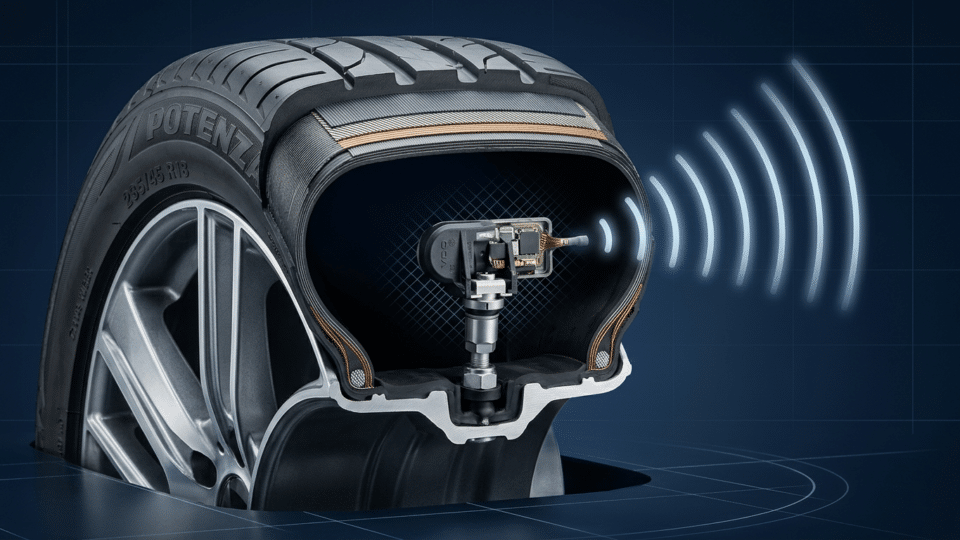
TPMS does not work the same way in every car. Some models measure the actual pressure in each tyre and can display readings such as 2.3 or 2.5 bar. Others have no pressure sensors in their valve stems at all: they use ABS/ESP sensors and only detect that one wheel is behaving differently.
This is the source of a common misunderstanding: a car may have a TPMS warning light and alert you that a tyre is losing air, yet show no reading in bar in the instrument-panel menu. That is not necessarily a fault, nor does it mean the system is incomplete. It is often an indirect TPMS.
What is TPMS?
TPMS stands for Tire Pressure Monitoring System. Its role is to warn the driver when the pressure in a tyre falls below a threshold considered safe.
The NHTSA describes two main system types: direct systems, which measure the actual pressure inside the tyre, and indirect systems, which use wheel speed and other vehicle data to infer a loss of pressure.
Direct TPMS: pressure is physically measured in every wheel
A direct system has a sensor installed in each wheel, usually integrated into the valve stem or fitted to the rim. It measures air pressure and, in many systems, temperature.
The data are sent wirelessly to a receiver in the vehicle, and the control unit determines whether the deviation is large enough to trigger the warning light.
- It measures actual pressure.
- It can display individual readings for each wheel.
- It can detect slow leaks more precisely.
- It may also provide temperature data, depending on the system.
- It requires battery-powered sensors in every wheel.
Indirect TPMS: there is no pressure sensor in the valve stem
Indirect TPMS uses the wheel-speed sensors already used by ABS and ESP. A tyre that is losing pressure changes its effective rolling radius slightly and, under certain conditions, starts rotating differently from the other tyres.
The car’s electronics analyse these differences and may conclude that there is a loss of pressure, even though they never directly measure pressure in bar.
Continental also explains that modern indirect systems can analyse not only rotational speed, but also changes in a tyre’s vibration behaviour.
Why do some cars not show 2.3 or 2.5 bar?
The simplest reason is that the car has no value to display. An indirect TPMS does not measure absolute pressure; it only detects a deviation from a reference condition.
As a result, such a system may have only:
- a yellow dashboard warning light;
- a “Check tyre pressure” message;
- a SET / STORE / CALIBRATE function;
- a menu for saving the correct tyre pressures after inflation.
How does indirect TPMS know what the correct pressure is?
In fact, it does not. The system starts from a reference condition confirmed by the driver after the tyres have been inflated correctly.
When you press SET or save the pressures in the vehicle menu, the electronic control unit learns how the wheels behave at that point. It subsequently compares new data with that reference.
Why is it important to set the correct pressure before resetting the system?
If you save the setting while the tyres are already underinflated, indirect TPMS will treat that condition as normal. This can delay or undermine the warning.
The correct sequence is as follows:
For more information on car maintenance, see Windscreen covered in tiny pits and scratches: what can be repaired and when it needs replacing, which provides additional details relevant to this subject.
- check the pressure when the tyres are cold;
- adjust it to the manufacturer’s recommended values;
- then perform the TPMS SET / RESET / STORE procedure;
- drive the car so the system can establish its reference again.
Direct vs indirect TPMS: a quick comparison
| Feature | Direct TPMS | Indirect TPMS |
|---|---|---|
| Measures actual pressure? | Yes | No |
| Sensor in every wheel? | Yes | No |
| Uses ABS/ESP? | Not as its main method | Yes |
| Can display pressure in bar? | Yes, if the manufacturer allows it | No |
| Requires batteries in sensors? | Yes | No |
| Needs recalibration after inflation? | Sometimes | Usually yes |
| Maintenance cost | Higher | Lower |
Which system is more accurate?
Direct TPMS is more accurate because it measures the physical pressure inside the tyre. The NHTSA says direct systems have the advantage of better sensitivity to small pressure losses and can monitor each wheel independently.
Indirect TPMS is simpler and less expensive, but it cannot tell you the actual pressure and depends on algorithms interpreting wheel behaviour.
Can indirect TPMS detect that all four tyres are underinflated?
This is one of the limitations of indirect systems. If all four tyres lose pressure at roughly the same rate, the differences between wheels may be smaller, making detection more difficult.
The NHTSA discussed this limitation in early TPMS standards: indirect systems based solely on comparisons of wheel speeds have difficulty when several tyres lose pressure at the same time.
Why does the TPMS warning light come on in the morning, then go out after a few kilometres?
Tyre pressure falls as temperature drops. On a cold morning, a tyre that was already close to the threshold may fall far enough to trigger the warning.
As the tyre warms up while driving, its pressure rises and the warning light may go out. The NHTSA nevertheless recommends checking the pressure if the warning appears repeatedly.
Steady TPMS warning light vs a flashing warning light
In many cars, a continuously illuminated warning light indicates low pressure. If the light flashes for a period and then stays on, the system may be reporting a TPMS malfunction.
With direct systems, common causes include:
- a sensor battery has run down;
- a sensor was damaged during tyre fitting;
- a new sensor has not been learned by the car;
- the sensor frequency or protocol is incompatible;
- wheel positions were not correctly recognised after tyre rotation.
How long does a direct TPMS sensor battery last?
Direct sensors use internal batteries that are generally not replaced separately. Once the battery is depleted, the entire sensor is replaced.
Exact lifespan depends on the model, temperature and frequency of transmission. In practice, many sensors last several years, but on older cars it is normal for them to begin failing one after another.
What happens when you change from summer to winter wheels?
With indirect TPMS, there are usually no special sensors in the rims. Fit the wheels, set the correct pressure and recalibrate the system.
With direct TPMS, the second set of wheels must have compatible sensors or the system will report an error. Some cars recognise new sensors automatically; others require a relearn procedure or programming.
Why can the car show the wrong wheel position after tyre rotation?
In some direct systems, sensors are associated with a position: front left, front right, rear left and rear right.
After tyre rotation, the system may need a relearn procedure to learn the new positions. The NHTSA notes that many systems can be retrained after tyre rotation.
Can you enable pressure readings in bar through coding alone?
Not in every case. If a car has indirect TPMS, coding alone cannot create a pressure value that is not measured by any sensor.
Displaying actual readings in bar requires, in principle, hardware capable of measuring pressure: direct sensors, a compatible receiver module, and software integration in the instrument cluster or infotainment system.
Some vehicle platforms support complete retrofits, but simply enabling a menu does not turn an indirect system into a direct one.
Why do some premium cars have direct TPMS and others indirect TPMS?
The choice is a trade-off between cost, accuracy, complexity and maintenance. Indirect TPMS makes use of existing ABS sensors and needs no batteries in the wheels. Direct TPMS provides more data, but adds sensors, receivers and servicing costs.
Does TPMS replace manual checks with a pressure gauge?
No. The NHTSA explicitly says TPMS is not a substitute for regular pressure checks. The warning light is a safety net, not a preventive maintenance tool.
Continental recommends checking tyre pressure manually at regular intervals, even in cars fitted with TPMS.
How to check tyre pressure correctly
- Measure it when tyres are cold, before a long journey.
- Use the values on the vehicle’s label, not the maximum pressure marked on the tyre.
- Take the vehicle load into account.
- Check all four wheels.
- After adjustment, reset indirect TPMS if the manufacturer requires it.
Why correct pressure matters
An underinflated tyre heats up more, changes its contact patch and can increase fuel consumption. Continental notes that underinflation affects handling, wear and efficiency.
Excessive pressure is not ideal either: it can reduce comfort, alter wear and affect grip.
What to remember
If your car has indirect TPMS, it is normal not to see readings in bar on the dashboard. The system does not measure pressure; it monitors wheel behaviour through ABS/ESP.
If your car has direct TPMS, the sensors physically measure pressure. However, the presence of direct sensors does not automatically guarantee that the manufacturer displays the readings on the dashboard; some systems use the data only to issue a warning.
Frequently asked questions about direct and indirect TPMS
How can I tell whether I have direct or indirect TPMS?
If you can see an individual pressure reading in bar for each wheel, you almost certainly have a direct system. If you only have a SET/RESET function and a warning light, it is very likely to be an indirect system.
Why does it not show the exact pressure?
Because indirect TPMS does not measure absolute pressure; it detects differences in behaviour between wheels.
Do I need to reset TPMS after inflating the tyres?
With indirect systems, usually yes. The pressures must be set correctly before resetting it.
Can I fit TPMS sensors to a car with an indirect system?
Only through a complete retrofit, if the vehicle platform permits it. Sensors alone are not enough; reception hardware, electronic integration and compatible software are also needed.
Does a TPMS warning light necessarily mean a puncture?
No. It may indicate a slow loss of pressure, low ambient temperature or a system malfunction. Pressure should be checked with a gauge.





Discuția cititorilor
Ai o opinie sau o întrebare despre acest articol? Spune-ne ce crezi.
Fii primul care deschide discuția.
Te rugăm să păstrezi un limbaj civilizat și să discuți la subiect. Comentariile spam sunt filtrate automat.