
Rare diseases are among the most difficult areas of modern medicine: they are numerous, often hard to diagnose and require collaboration across several specialties. In Romania, the direction announced in November 2026 is more ambitious than before: expanded newborn screening, faster access to genetic diagnosis, integrated centres with multidisciplinary teams, and continuity of care when patients move from paediatric to adult medicine.
For more information on rare diseases, see Expanded newborn screening: what is tested now and what remains a promise for 2027, which provides complementary details on the subject.
On 4 November 2026, the Ministry of Health announced a new Memorandum of Understanding with the Carol Davila University of Medicine and Pharmacy, ARPIM and patient associations. The document sets out specific directions for faster diagnosis, modern treatment, integrated services and better coordination of care for patients with rare diseases.
What exactly is a rare disease?
In Europe, a disease is considered rare when it affects a very small number of people in the general population. Taken together, however, rare diseases affect a significant number of patients and families.
There are thousands of rare conditions, many of them genetic, and symptoms may emerge in childhood or, in some cases, only in adulthood. Diagnosis can therefore require complex investigations, genetic testing and assessments at centres with specific expertise.
Why rare diseases are so difficult to diagnose
A patient with a rare disease may see several doctors and specialists before the clinical picture is recognised. Some symptoms are non-specific, while family doctors or specialists who encounter very few such cases may find it difficult to identify a rare pattern quickly.
- Symptoms may be common to other diseases.
- Not all hospitals have rapid access to medical genetics.
- Investigations across several specialties may be needed.
- Some conditions are so rare that there is very little local experience.
- The patient’s route between specialties may be fragmented.
The first major priority: expanding newborn screening
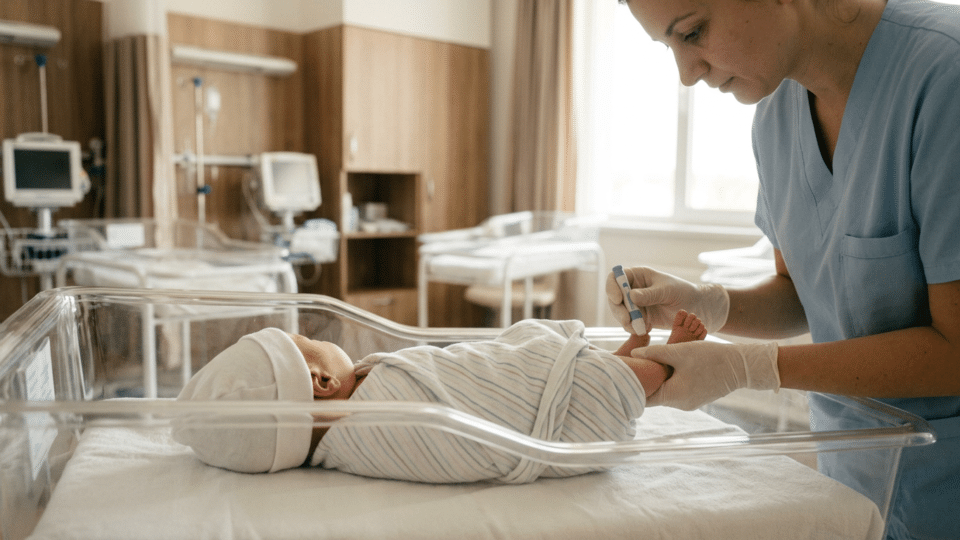
Health Minister Alexandru Rogobete identified expansion of the National Newborn Screening Programme as one of the central priorities. The principle is straightforward: certain diseases must be detected as early as possible, sometimes in the first days of life, before severe symptoms or irreversible complications emerge.
Newborn screening does not mean that every child automatically receives a complete diagnosis. It identifies newborns at sufficiently high risk to require further investigation.
Why early screening can change the course of a rare disease
For some rare diseases, the difference between a diagnosis in the first days or months of life and a late diagnosis can be the difference between a controlled course and neurological, metabolic or organ damage that can no longer be fully reversed.
The Ministry of Health’s official message is therefore that effective treatment begins with a timely diagnosis.
Expanded newborn screening: what it should mean in practice
Expanding screening is not simply a matter of adding diseases to a list. For the programme to work, a complete chain is needed:
- standardised sample collection;
- laboratories with sufficient capacity;
- a short turnaround time for results;
- confirmatory testing;
- rapid referral to an expert centre;
- treatment and monitoring without delay.
The second major priority: integrated centres and multidisciplinary teams
Rare diseases generally cannot be managed by a single doctor. A patient may simultaneously need genetics, neurology, cardiology, pulmonology, gastroenterology, endocrinology, rehabilitation, psychology and social services.
The Ministry of Health said it would open discussions with the National Health Insurance House (CNAS) to create reimbursement mechanisms that would allow genuine funding of multidisciplinary care in integrated centres.
Why multidisciplinary funding matters
Under conventional reimbursement systems, consultations are paid separately by specialty. For rare diseases, this model can fragment care and force patients to repeat consultations, investigations and administrative processes.
A multidisciplinary services package could allow several specialists to assess a patient in a coordinated manner at the same centre and establish a shared treatment plan.
The third priority: continuity from childhood to adulthood
One of the most sensitive periods for patients with rare diseases is the transition from paediatric to adult medical services. Without a clear pathway, a patient may lose continuity of monitoring or enter a system that does not have the same experience with the condition concerned.
The Memorandum explicitly provides for the development of medical pathways intended to reduce this gap and allow treatment and monitoring to continue without interruption.
Genetic and genomic diagnosis is becoming increasingly important
The Memorandum’s partners identified access to genetic and genomic investigations as one of the essential components of faster, more precise diagnosis.
For some rare diseases, diagnosis cannot be confirmed through symptoms and routine tests alone. Genetic tests can identify the mutation or molecular mechanism responsible and may guide treatment, family counselling and assessment of risk for other family members.
Family doctors could have a larger role
One proposed measure is to develop criteria for suspicion that can be used by family doctors. The aim is not for family doctors to make the final diagnosis of a rare disease, but to recognise certain warning signs and refer patients more quickly to an expert centre.
Romania also needs a better national rare-disease registry
The Memorandum explicitly mentions developing a national registry and record-keeping systems aligned with European standards.
Without good data, it is difficult to estimate how many patients there are, which therapies are needed, where the largest gaps lie and how resources should be allocated.
Why registries also matter for access to therapies
Many rare-disease treatments are expensive and intended for a small number of patients. A well-designed registry can help assess eligibility, monitor treatment response and plan budgets.
Access to innovative treatments remains a major issue
The Ministry of Health announced its intention to speed up access to modern therapies and develop sustainable funding mechanisms.
For patients, the challenge is not only whether a medicine exists at European level, but whether it is authorised, assessed, included in programmes and actually available in Romania.
A national treatment programme for rare diseases already exists
CNAS has a national programme covering treatment for several rare diseases through designated centres and medical units. CNAS documents include, among others, conditions such as cystic fibrosis, epidermolysis bullosa, pulmonary arterial hypertension, Prader-Willi syndrome and transthyretin amyloidosis.
Some medicines are dispensed through hospital pharmacies and others through community pharmacies, depending on the disease and programme.
The issue is not only whether the programme exists, but the patient’s route through it
Even when treatment is available, patients may lose time between the onset of symptoms, referral to a specialist, genetic investigations, diagnostic confirmation and enrolment in the programme.
That is why the reform proposed in 2026 focuses on clear clinical pathways and coordination between centres.
European Reference Networks could reduce the isolation of Romanian centres
The Memorandum proposes expanding Romania’s participation in the European Reference Networks. These networks connect expert centres in several countries and enable the exchange of experience in very rare or highly complex cases.
For patients, this could mean access to specialist opinions without requiring every national centre to have comprehensive experience in every rare disease that exists.
What could change for patients — and what has yet to change
| Area | What has been announced | What still needs to be done |
|---|---|---|
| Newborn screening | Expansion of the programme | The list of diseases, laboratory capacity and effective implementation |
| Multidisciplinary teams | Recognition and funding | Concrete reimbursement mechanisms with CNAS |
| Child-to-adult transition | Clear medical pathways | Functional centres and protocols |
| Genetics and genomics | Better access | Testing capacity and funding |
| National registry | Development and standardisation | Interoperable implementation |
| Innovative treatments | Faster access | Assessment, reimbursement and actual availability |
Why rare diseases are also a social issue
A rare disease affects more than the patient. It can alter the life of an entire family through the need for permanent care, travel to specialist centres, additional costs, absence from work or school, and difficulties with educational or professional integration.
This is why the Memorandum also refers to coordinating medical and social services and to case management, rather than medication alone.
What a patient should do when a rare disease is suspected
- Document the history of symptoms and investigations.
- Discuss a referral to the relevant specialty with their family doctor.
- Ask whether an assessment in medical genetics is indicated.
- Request a referral to a centre experienced in the suspected disease.
- Keep all reports and results in a complete medical file.
This article is for information only and does not replace an individual medical assessment.
What to watch in 2027
The announcements made in November 2026 are important, but their real impact will depend on implementation. The main points to watch are:
- which diseases will actually be added to newborn screening;
- how multidisciplinary work will be funded;
- how the national registry will operate;
- how quickly genetic tests and new therapies will be reimbursed;
- how many Romanian centres will be better connected to European networks;
- whether the child-to-adult transition will have clear national protocols.
Conclusion
Romania is seeking to shift its approach to rare diseases from the isolated treatment of individual cases towards an integrated system: screening, diagnosis, genetics, multidisciplinary teams, registries and continuity of care.
For patients, the change will matter only if these objectives are translated into procedures, funding and effective access. The Memorandum of 4 November 2026 is a relevant step, but the real measure of success will be how much it shortens the time to diagnosis and how easily patients can reach the appropriate treatment.
Frequently asked questions about rare diseases in Romania
What changes have been announced for rare diseases?
Expansion of newborn screening, funding for multidisciplinary teams, continuity between child and adult care, better access to genetics and genomics, improved registries, and faster access to innovative therapies.
What is newborn screening?
It is testing of newborns to identify certain serious conditions early, before symptoms cause major complications.
Is reimbursed treatment available for rare diseases in Romania?
Yes. CNAS has national programmes for several rare diseases, although access depends on the diagnosis, indication, centre and reimbursement rules for each condition.
Why is a national registry important?
It makes it possible to estimate patient numbers accurately, track treatments and plan services and budgets.
What is the role of expert centres?
They bring together experienced specialists and can coordinate investigations, diagnosis and treatment for very rare or complex conditions.




Discuția cititorilor
Ai o opinie sau o întrebare despre acest articol? Spune-ne ce crezi.
Fii primul care deschide discuția.
Te rugăm să păstrezi un limbaj civilizat și să discuți la subiect. Comentariile spam sunt filtrate automat.