
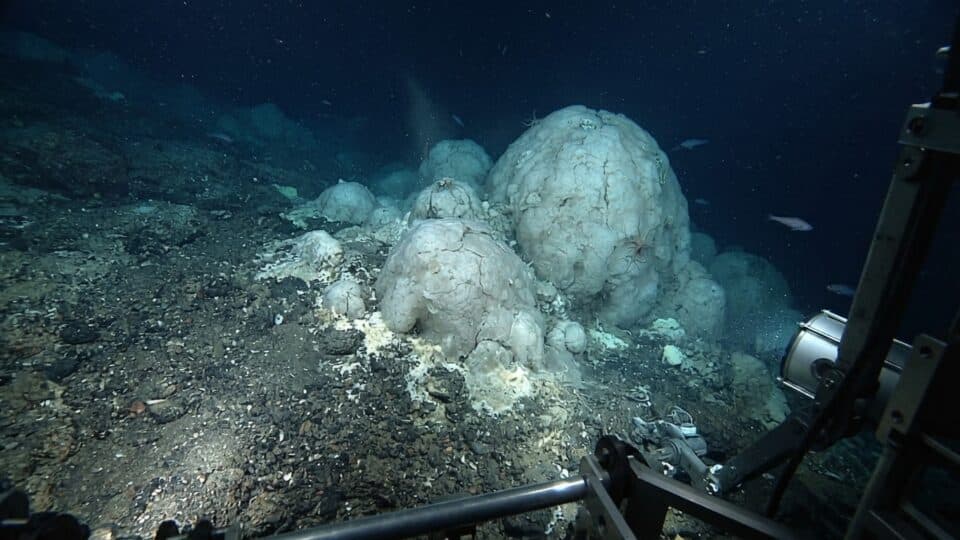
Carbon dioxide hydrate is a solid material in which water molecules form structures capable of enclosing CO₂ molecules under particular temperature and pressure conditions. In 2026, researchers documented an unusual field of such deposits near the Indian Ocean island of Mayotte, including formations resembling white domes. Some are about five metres high.
Carbon dioxide hydrate: structures that look like ice, but are not ordinary ice
This is not a viral story about a sunken city. It is a real geochemical site studied by oceanographers and geologists, where carbon dioxide from an active geological system reaches the seafloor and forms solid materials on contact with cold water under pressure.
Mayotte: why this region is so unusual
Mayotte lies in the Indian Ocean, in an active and complex volcanic setting. The 2021 GEOFLAMME campaign investigated several submarine sites. The team used underwater vehicles and oceanographic instruments to observe fluid seepage and associated formations. The paper published on 12 June 2026 describes a field of CO₂ hydrates near the island.
The Paris Institute of Earth Physics (IPGP) reports more than 120 hydrate deposits at the Fer à Cheval site, with observations at depths of about 1,367 metres at some locations. This depth is neither a measurement of all formations nor a universal limit at which hydrates can exist. Local pressure, temperature and chemical composition are critical.
How an underwater dome forms
A flow of CO₂ can migrate through sediments and through a hydrothermal or volcanic system before reaching the ocean floor. At suitable pressures and temperatures, solid hydrate shells may form around flows or accumulations. Researchers also observed liquid CO₂ droplets associated with the formations.
The solid material is not ordinary “dry ice” — pure solid carbon dioxide at atmospheric pressure. The hydrate contains water arranged in a crystalline lattice. Its formation and breakdown depend on the balance between fluids, pressure, temperature and seawater movement.
Why it matters for the carbon cycle
Some of the carbon released by the Earth enters the atmosphere, some remains dissolved in water, and in certain environments it may temporarily take a solid form. Hydrate fields may constitute transient geochemical reservoirs. However, the Mayotte study does not demonstrate that such domes will solve industrial CO₂ emissions.
Assessing quantities requires evaluation of flows, rates of formation and dissolution, distribution across the seabed, and exchange with ocean water. A photograph of a five-metre dome alone does not provide either a carbon mass or an annual capture rate.
What researchers can learn from released liquids
Droplets rising from the deposits offer clues about the physical state of carbon and fluid transport. Underwater vehicles can film the site, collect water, and measure turbidity and redox potential, while geological samples help interpret the reactions taking place.
Researchers use multiple tools precisely because a single signal is ambiguous. A turbidity anomaly may reflect particles or other processes, not CO₂ alone. A valid model links imaging, chemical composition, physical conditions and repeated observations.
Is there a risk to marine organisms?
Local CO₂ concentrations and changes in pH can affect organisms near seeps, but the scale of the effect depends on mixing, currents, exposure and species tolerance. Researchers also use such sites to investigate the effects of acidification on marine communities.
It would be inaccurate to say that these domes automatically cause a regional ocean disaster. The opposite claim — that hydrates “permanently lock away” carbon — is not demonstrated either. The formations can evolve and become destabilised as environmental conditions change.
The connection with Romania and the Black Sea: methodological comparison only
The Black Sea has geochemical characteristics and submarine phenomena studied by geologists, but the precise formations at Mayotte should not be transferred by analogy to the seabed of Romania’s basin. This article does not report the discovery of a comparable field of domes in Romanian territorial waters.
A local report would require bathymetric maps, observations of submarine seepage and published studies of fluid composition. A sensational headline such as “carbon dioxide mountains near Constanța” would be unjustified without evidence.
What has been shown, and what remains to be studied
- Shown: observations, experiments or official findings recorded in primary sources.
- Not yet shown: commercial operation, identical applicability everywhere, or local impacts without data.
- Future verification: independent replication, comparative results and publication of the full methodology.
Why hydrate is stable at great depth
Gas hydrates can exist within a particular window of pressure, temperature and composition. On the ocean floor, high pressure and low temperatures can favour the stability of solid structures that would be unstable at the surface. This explains why a sample recovered without controlled conditions could change before analysis.
Not all gases form hydrates under the same conditions, and CO₂ behaves differently from methane and other fluids. Inferring stability requires phase diagrams, measurements and models. The whitish appearance of a formation is not chemical identification without instruments.
What an underwater robot can reveal
Remotely operated vehicles make it possible to film formations, approach jets, collect fluids and position sensors in environments inaccessible to divers. At Mayotte, the scientific documentation includes observations of domes, CO₂ droplets and water characteristics. Video recordings provide geometric context, but quantities and composition must be measured separately.
Footage of a gas droplet alone does not show the total flow rate or the dissolved concentration hundreds of metres away. Such estimates require image calibration, data on currents and densities, and series of observations.
What more than 120 deposits means
The Paris Institute of Earth Physics announced the identification of more than 120 hydrate deposits in the area investigated at Fer à Cheval. The figure refers to objects identified during the stated campaign and within the stated perimeter, not to every formation on the floor of the Indian Ocean. Each deposit may also differ in size and lifespan.
To calculate the total carbon mass, researchers would need to know the three-dimensional geometry, density and composition of each deposit. Even an exact number of formations cannot be converted into a single volume using the maximum height observed in one of them.
Carbon dioxide: storage or a source of acidification?
When CO₂ dissolves in water, it takes part in chemical equilibria that can alter pH. Near a seep, the concentration may be high locally, while mixing with ocean water reduces or redistributes the signal. Hydrate formation may temporarily retain some carbon, while dissolution may release it.
This does not mean the ocean is a safe industrial repository for emissions in all conditions. Designing anthropogenic storage would require stability studies, monitoring, environmental assessments and a specific legal framework. The Mayotte site is a natural laboratory, not a demonstration of a commercial solution.
Volcanic geology and fluid circulation
In a tectonic and volcanic setting, gases and fluids can rise through fractures or permeable structures. Geologists investigate the relationship between such pathways, magmatic activity and the composition of emitted fluids. At Mayotte, recent phenomena have drawn attention to submarine volcanic processes.
Causation must nevertheless be documented at each site. A hydrate deposit alone does not indicate an imminent eruption and cannot be used as a seismic warning system. Monitoring combines independent geophysical and geochemical methods.
What an article about the Black Sea should explain
If future research reported CO₂ hydrates in an area of the Black Sea, the coordinates, depth, composition, identification method and assessment of flows would be essential. Without these, a visual resemblance between two underwater images does not justify a geological attribution.
InfoBuz discusses the particular features of the deep Black Sea environment separately in its analysis of the anoxic layer. That phenomenon should not be confused with the deposits observed near Mayotte.
| Observation | What it confirms | What it does not demonstrate |
|---|---|---|
| Hydrate domes | The presence of a solid under pressure | Permanent storage |
| Liquid CO₂ droplets | Local carbon flows | The concentration across the entire ocean |
| More than 120 deposits | A documented geological field | Total mass without measurements |
| Volcanic conditions | A particular geological context | An imminent eruption |
Frequently asked questions
Are the domes made of ordinary ice?
No. They are CO₂ hydrate deposits, a solid structure formed under particular submarine conditions.
How tall are they?
Some formations described by researchers are several metres high, reaching about five metres.
Do they store carbon dioxide permanently?
Permanent storage has not been demonstrated; the chemical equilibrium can change.
Have they also been found near Romania?
The cited study concerns Mayotte in the Indian Ocean; there is no verified equivalent observation for Romania’s coast.
InfoBuz conclusion
The hydrate field at Mayotte illustrates the complexity of the forms in which carbon moves between rock and ocean. Distinguishing between an observation, a proposed mechanism and a demonstrated conclusion is the strongest safeguard against sensationalism. A discovery can be striking even when the next experiment narrows its significance.
Primary sources and article methodology
InfoBuz editorial note — 24 November 2026: This article is documented from scientific and institutional publications, not from experiments conducted by the editorial team. The representative illustration is generated, not a photograph of the site or the original equipment. We do not extrapolate results to Romania without local measurements.


Discuția cititorilor
Ai o opinie sau o întrebare despre acest articol? Spune-ne ce crezi.
Fii primul care deschide discuția.
Te rugăm să păstrezi un limbaj civilizat și să discuți la subiect. Comentariile spam sunt filtrate automat.