
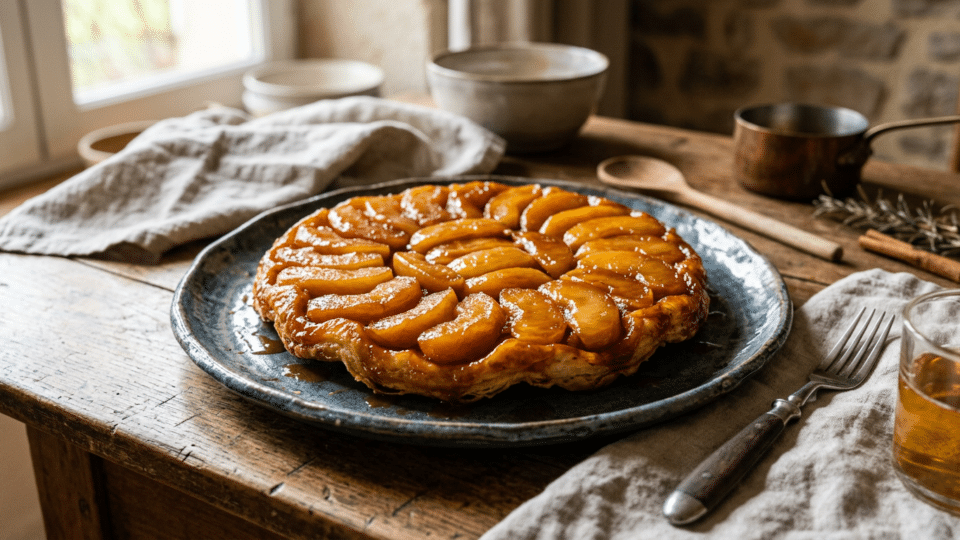
Apple Tarte Tatin looks celebratory precisely because the usual order of a tart is reversed: the apples cook in caramel, the pastry covers them, and the dessert is turned out only at the end. For a 20–22 cm tart, the key is not a “mandatory” apple variety or an exact timing, but control of three things: firm fruit, reduced liquid and a very short rest before turning it out.
The recipe below uses puff pastry for a dramatic, quick crust. If you prefer a shorter, less airy base, you can use shortcrust pastry; this version also appears in the 1921 historical recipe mentioned by Villa Rabelais – Institut Européen d’Histoire et des Cultures de l’Alimentation.
In the same context, see also Oven-baked pike-perch with crisp skin: the method that keeps it tender, not dry, which provides additional relevant information.
Apple Tarte Tatin: quantities, timing and equipment
- Servings: 6–8 slices
- Preparation: about 25 minutes
- Cooking and baking: about 45–55 minutes
- Oven: 190°C conventional, or 180°C fan-assisted
- Pan: a 20–22 cm skillet or pan suitable for the hob and oven; alternatively, a shallow saucepan and a tart tin
Ingredients
- 1 kg firm apples, weighed before peeling
- 140 g granulated sugar
- 70 g butter with at least 80% fat
- 1 generous pinch of fine salt
- 1 tsp vanilla extract or the seeds from 1/2 vanilla pod, optional
- 230–250 g cold puff pastry, preferably rectangular
- 1 tsp lemon juice, optional, especially for very sweet apples
Choose apples that feel firm, with dense flesh and a balance of sweetness and acidity. Romanian shops do not offer one variety guaranteed to be available all year round, and the variety name matters less than the condition of the fruit: apples that are very mealy, bruised or already soft will break apart before the tart reaches the oven.
Method: apples and caramel first, pastry afterwards
- Prepare the pastry and oven. Heat the oven to 190°C conventional. Take the puff pastry out of the fridge only long enough for it to become workable. Cut out a circle around 2 cm wider than the diameter of the pan. Place it on baking paper and keep it chilled. Cold pastry goes into the oven better and retains its layers.
- Cut the apples into large pieces. Peel and core the apples, then cut them into large halves or quarters, depending on their size. Do not slice them thinly: after cooking and turning out, large pieces remain visible and create that compact patisserie-style pattern.
- Make a golden-amber caramel. Put the sugar in a heavy-based skillet or pan over medium heat. Let it melt without stirring vigorously; you may gently swirl the pan once the sugar starts to colour. Stop when the caramel is golden to coppery and smells pleasant rather than sharp. A very dark caramel may turn bitter after baking.
- Add the butter carefully. Take the pan briefly off the heat and add the butter, salt and vanilla. The caramel will bubble vigorously. Stir carefully with a heatproof spatula until the sauce is smooth. If using, add the lemon juice now.
- Cook the apples and reduce the liquid. Arrange the apples very tightly in the caramel, rounded side down for an even pattern once the tart is turned out. Return the pan to medium-low heat and cook for 15–20 minutes. Carefully turn the pieces once or twice. The apples should soften on the outside but still offer resistance to the tip of a knife.
- Check the level of caramel. Towards the end, the sauce should be glossy and thicker, rather than forming a watery pool between the apples. If the apples have released a great deal of juice, leave the pan over the heat for a few more minutes, uncovered. Arrange the apples tightly again; they shrink during cooking, and large gaps will be visible after turning out.
- Cover with puff pastry. Place the cold pastry circle over the apples. Using a spoon or spatula, tuck the edges inside the pan without touching the caramel. Prick the pastry 5–6 times with a fork to allow steam to escape.
- Bake until the pastry is browned. Transfer the pan to the oven and bake for 30–35 minutes. The tart is ready when the puff pastry is well risen and golden brown, including around the edges. If the pastry is pale, it needs a few more minutes even if the apples are already tender.
- Rest the tart for 5–10 minutes, then turn it out. Place the pan on a heatproof surface. After a short rest, set a large plate with a slightly raised rim on top. Use oven gloves, hold the pan and plate firmly together, and invert them in one decisive movement. The caramel is extremely hot: do not turn the tart out onto a flat or undersized plate.
Serve Tarte Tatin warm or at room temperature, plain or with sour cream, crème fraîche or vanilla ice cream. For another autumn dessert built on the contrast between soft fruit and a crisp element, you can also try baked apples with oats and walnuts.
Shortcrust or puff pastry: what changes in Tarte Tatin
| Option | What it offers | What to watch for |
|---|---|---|
| Puff pastry | Airy layers, high edges and a more dramatic appearance | It must be used cold and baked until fully browned; steam from the apples can make it soggy if the liquid is not reduced. |
| Shortcrust pastry | A denser, crumbly and stable crust | Roll it thinly, chill it before use and prick it. It will not have the volume of puff pastry. |
There is not enough evidence to treat puff pastry as the only “authentic” option. A 1921 historical source cited by Villa Rabelais specifies shortcrust pastry and a copper pan, while many modern recipes use puff pastry. A modern technical recipe from King Arthur Baking likewise stresses firm apples, tight arrangement and reduced caramel before baking.
Control matrix: where the tart succeeds or fails
| Variable | The positive sign | What happens if you miss the point | Useful correction |
|---|---|---|---|
| Apples | The pieces are tender at the edges but hold their shape. | Overly soft apples fall apart; overly firm ones remain crisp and separate from the caramel. | Use firm fruit and large pieces; cook until a knife enters with slight resistance. |
| Caramel | It is glossy, coppery and coats the apples in a thin layer. | Too pale and too runny: soggy pastry. Too dark: a bitter taste. | Continue reducing over moderate heat, without aiming for a very dark brown colour. |
| Pastry | It is golden brown right to the edges. | Pale pastry remains raw or soft after turning out. | Bake until visibly browned; protect only the edges if they colour too quickly. |
| Turning out | The apples remain arranged and the caramel flows over them in a controlled way. | Too early: the tart may slip. Too late: the caramel may stick to the pan. | Wait 5–10 minutes and use a plate larger than the tin. |
The important point is counterintuitive: turning out does not “save” a Tarte Tatin. It only reveals the result of the earlier stages. Broken apples usually indicate fruit that was too soft or overcooked; watery caramel shows that the liquid was not reduced; and pale puff pastry means that the tart came out of the oven too early.
What we know about the Tatin sisters legend
Tarte Tatin is associated with Stéphanie and Caroline Tatin and their hotel in Lamotte-Beuvron, in the Sologne region. Its basic culinary definition is clear: an upside-down tart in which apples are cooked, covered with pastry, baked and turned out for serving.
Less clear is the episode often repeated as its origin: one sister is said to have forgotten apples with sugar and butter on the heat, then placed pastry over them to remedy the situation. The historical documents consulted do not prove this event. They do, however, show that the dessert was already known: a public mention from 18 December 1899 refers to “Miss Tatin’s tart”, while an account from 1903 describes the apple tart at the Hôtel Tatin as the house speciality.
The analysis published by the Université de Liège notes that the principle of a tart baked with the pastry on top was known in Sologne before the Tatin name became established. The cautious conclusion, then, is that the Tatin sisters are documentarily linked to the popularisation of a local speciality, while the accident remains a culinary legend rather than a proven fact.
Frequently asked questions
Which apples are suitable for Tarte Tatin?
Choose firm, dense apples with a slightly tart or balanced flavour. More important than the variety label is that the fruit should not be mealy or very ripe. If you have apples of different sizes, cut them into comparable pieces so that they cook evenly.
Why does the pastry go soggy in Tarte Tatin?
Usually, the apples have released too much liquid and the caramel was not reduced enough before the tart went into the oven. Pastry that is warm when used or not pricked can worsen the problem because it traps more steam.
Can you make Tarte Tatin without an ovenproof skillet?
Yes. Cook the caramel and apples in a saucepan, then carefully transfer them to a metal tart tin or heatproof ceramic dish. Work quickly, as the caramel begins to set as it cools.
How long does the tart keep?
It is best on the day it is made, when the pastry remains crisp. Keep it covered in the refrigerator for up to 2 days and reheat individual slices in the oven for a few minutes, not in the microwave, if you want to partly restore the crust.
Frequently asked questions
Which apples are suitable for Tarte Tatin?
Firm, dense apples that are slightly tart or balanced. Avoid mealy, very ripe or bruised fruit, as it breaks apart easily in the caramel.
Why does the pastry go soggy in Tarte Tatin?
Most often, the apples have released too much liquid and the caramel was not reduced before baking. Use cold pastry and prick it with a fork.
How long should the tart rest before turning out?
Generally, 5–10 minutes are sufficient: too early, and the apples may shift; too late, and the caramel may set in the pan.
Sources consulted
- La Tarte Tatin, un dessert renversant — Villa Rabelais / IEHCA
- Les grands mythes de la gastronomie : La tarte des demoiselles Tatin — Université de Liège
- Classic Apple Tarte Tatin Recipe — King Arthur Baking
- Tarte Tatin — BBC Three Counties Radio recipe sheet
- La Tarte Tatin : histoire et légendes — Bibliothèque nationale de France


Discuția cititorilor
Ai o opinie sau o întrebare despre acest articol? Spune-ne ce crezi.
Fii primul care deschide discuția.
Te rugăm să păstrezi un limbaj civilizat și să discuți la subiect. Comentariile spam sunt filtrate automat.