
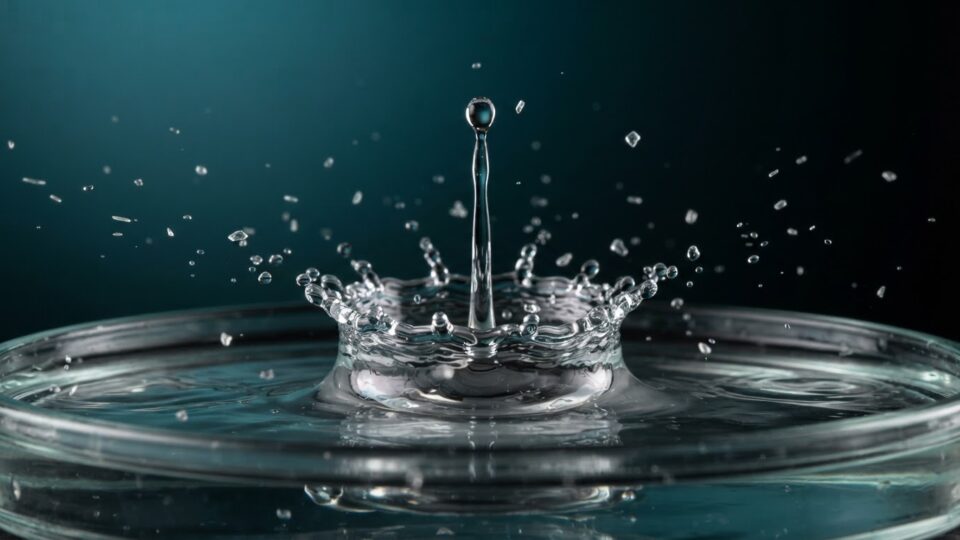
Microplastics in rain is shorthand for a more precise experimental process: a raindrop striking a contaminated water surface can propel plastic particles at the interface into the air. Researchers associated with Oxford, UCL and UNAM presented the results of high-speed-camera experiments on 2 November 2026.
Microplastics in rain: a mechanism observed at small scale
They observed two mechanisms: the initial splash after impact and the thin jet of water that rises when the crater formed by the drop closes. In some tests, one ejected droplet carried around 100 microplastic particles. This figure comes from a controlled experiment; it is not an average measured in the Black Sea on a rainy day.
What is a Worthington jet, and why does it matter?
When a drop falls onto water, it can form a crater, then a crown and, in some cases, a very fine vertical jet. These forms are studied in fluid mechanics and depend on speed, surface tension, viscosity and droplet size. The jet can detach secondary droplets and carry particles located at the water’s surface.
The researchers tracked the process with high-speed cameras because the stages of impact last only a very short time. An ordinary photograph may capture only one shape of the splash and miss the point at which particles actually enter the air.
Hydrophobic particles: not all microplastics behave alike
The study showed that the properties of a particle’s surface influence how likely it is to be ejected. Water-repellent materials may behave differently from particles that are more readily wetted. In some tests, the researchers observed so-called “liquid marbles”: droplets coated with a layer of particles that limits coalescence.
This mechanism matters because two particles of similar size can behave differently because of their composition or surface condition. The findings cannot be reduced to the claim that “all microplastics jump into the air at the first rain”.
In the laboratory versus in the ocean: the crucial difference
The experiments used controlled conditions, including particle types and concentrations set by the researchers. At sea, waves, foam, salinity, wind, currents and changes in rainfall intensity alter the process. There are also other mechanisms through which particles can be transferred to the atmosphere.
The authors have not yet quantified what proportion of global atmospheric microplastics comes from raindrop splashes. A process demonstrated at microscopic scale may be real, but its contribution to regional pollution must be measured independently.
What this could mean for Romania’s coast
In ports, coastal lakes and areas affected by microplastic pollution, the water-air interface is worth investigating. But for Constanța, local water and air samples would be needed before, during and after rainfall events, using a clear method for identifying polymers and controlling contamination.
The article does not claim that rainfall in Romania has been measured ejecting a particular number of particles. For another source of plastic pollution, see InfoBuz’s report on microplastics from tyre wear.
Health risks: what this experiment does not demonstrate
The demonstration describes one possible route for particles through the environment; it does not quantify the inhaled dose for people or the clinical effects of a particular rainfall event. Assessing health implications would require information on airborne concentration, particle size, duration of exposure and chemical properties.
It is important not to turn this result into a claim that going out in the rain is dangerous because of microplastics. Such a conclusion cannot be drawn from the experiments described.
What the next study should measure
Researchers could test simulated rainfall at different intensities, salinities, temperatures and surface tensions, as well as polymer mixtures closer to those found in reality. They could then measure concentrations before and after impact and compare the results with field observations.
Only after estimating the flux per unit area and time, in comparable units, can researchers begin to assess this mechanism’s contribution to the atmospheric transport of microplastics. The distinction between a possible process and a dominant one is essential when setting environmental policy priorities.
Three checks before republishing the story
- Confirm the institution, research date and method in the original source.
- Do not confuse a controlled experiment with a measurement carried out in Romania.
- Do not turn a possible mechanism into certainty about effects or future applications.
How the researchers designed the droplet experiment
The team analysed the impact of droplets on a liquid interface containing plastic particles, using high-speed filming and controlled conditions. This approach makes it possible to follow the very brief moments in which splashes, the crater and the jet form. The particles can be located relative to the surface before impact and to the droplets ejected afterwards.
The experiment is not a direct measurement of the atmosphere above an ocean during a storm. Extrapolation would require information on rainfall intensity, real droplet sizes, particle concentrations at the surface, and the effects of wind and waves.
Why the water surface concentrates some particles
Particles with certain properties can accumulate at the air-water interface, particularly those that do not mix readily with water. This layer may have a different composition from water at greater depth. A sample taken at the surface and one taken one metre below it are therefore not automatically comparable for every type of microplastic.
The material’s surface properties, and the particle’s size and shape, affect its interaction with the water film. An irregular fragment and a thin microfibre may follow different trajectories after a droplet strikes the surface.
What are “liquid marbles”, and why did they appear?
In some experiments, highly hydrophobic particles formed a coating around small water droplets, producing objects known in fluid-physics literature as liquid marbles. This coating can alter a droplet’s tendency to merge immediately with other liquid surfaces.
The phenomenon is neither a new species of microorganism nor a form of pollution ordinarily visible to the naked eye. It is a physical behaviour that may influence particle transport, but its global atmospheric relevance requires further measurement.
How marine aerosols differ from rain splashes
The ocean also transfers particles to the atmosphere through breaking waves and bubble formation. The droplet-impact study adds a possible mechanism that may operate under certain conditions. If microplastics are detected above the sea, their source cannot be determined from their presence alone.
Causal attribution would require simultaneous measurements of waves, rain, wind, particles in water and particles in air. Polymer analysis may help trace sources, but each source must be modelled separately.
How a microplastic flux could be calculated
A field study could report the number or mass of particles transferred per square metre of surface area and per unit of time. This indicator would allow rainfall episodes to be compared with periods without precipitation. Estimating it requires known air and water volumes, collection efficiency and laboratory controls.
“Around 100 particles in one ejected droplet” cannot be directly converted into a figure per square kilometre for every storm. Researchers would need to know how many such droplets form and what fraction remains in the air.
A monitoring protocol for the Black Sea
A local project could combine surface-water sampling stations and atmospheric particle-monitoring devices at several coastal locations and in a control area. Sampling should be repeated during comparable periods with and without rain, taking wind direction and water circulation into account.
A laboratory would need to identify polymers using suitable methods and eliminate contamination introduced by equipment or clothing. Without these precautions, microfibres in samples may be mistaken for pollution from the environment being studied.
| Stage | What is measured | Limitation |
|---|---|---|
| Droplet impact | Ejected splashes and jets | Laboratory scale |
| Particles in water | Type and concentration | Varies with depth |
| Particles in air | Concentration and size | Multiple sources |
| Meteorology | Rain, wind and waves | High variability |
| Attribution | Comparison between mechanisms | Requires modelling |
Frequently asked questions
Does rain create new microplastics?
The experiment examines the ejection into the air of particles already present in water, not their creation through impact.
Were particles measured in the Black Sea?
Not in the research described; the results presented are from a laboratory.
What is a Worthington jet?
It is a thin jet that can form when the crater left by a droplet impact closes.
Are rain showers dangerous to people for this reason?
The study does not assess inhaled dose or the clinical risk of rain under real-world conditions.
InfoBuz conclusion
A familiar phenomenon such as splashing water may have important microscopic consequences, but their scale in nature remains to be measured. The next important step is not to amplify the headline, but to verify the methods, uncertainty and reproducibility of the result.
Sources and transparency
Editorial note — 24 November 2026: This analysis is based on primary sources and institutional documentation. We do not present mathematical examples as local measurements. The representative image is a generated illustration, not a documentary image from the original research.


Discuția cititorilor
Ai o opinie sau o întrebare despre acest articol? Spune-ne ce crezi.
Fii primul care deschide discuția.
Te rugăm să păstrezi un limbaj civilizat și să discuți la subiect. Comentariile spam sunt filtrate automat.