
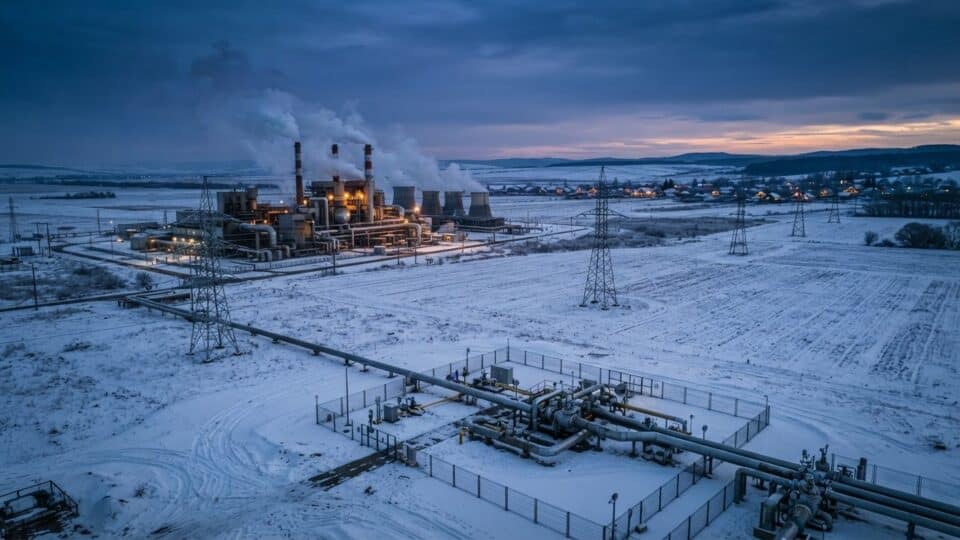
Romanian authorities are addressing the 2026–2027 energy winter through a special monitoring task force, established by a Government Decision adopted on 30 October 2026 for the period from 1 November 2026 to 31 March 2027. The document concerns the security of electricity and gas supplies amid hydrological drought, weather-related risks and the availability of generation capacity. The existence of the plan does not mean Romania has announced scheduled interruptions for households.
Energy winter 2026–2027: preventive measures, not an announcement of rationing
Separately, authorities extended until 30 November 2026 a temporary mechanism allowing Transelectrica, Romania’s electricity transmission system operator, to use special measures in crisis conditions. In its 30 October statement, the government said that, up to that point, there had been no need to activate the rules governing consumption restrictions and that the system had remained balanced. That assessment is dated and should not be treated as a guarantee that all future risks have disappeared.
Why a drought-affected winter can affect electricity supplies
Hydropower plants depend on river flows and the energy available in reservoirs. If drought persists, hydroelectric output may become more limited. The cold season also brings shorter days, reducing photovoltaic generation during many periods, particularly on overcast days.
There is no single issue at stake: demand can rise as temperatures fall, some capacity may be under maintenance, and available resources can vary. The system operator must balance generation, imports, exports and consumption in real time. That process is distinct from setting the price on a consumer’s energy bill.
90% gas storage: a preparedness target, not a current reading
The government plan calls for natural-gas stocks equal to 90% of storage capacity, with gradual withdrawals so that reserves remain sufficient in February and March 2027. This is an operational target set out among the preparedness measures. It is not presented here as the exact level recorded in Romania’s gas storage facilities on 24 November.
Gas matters beyond household heating: gas-fired power plants need supply pressure and flow, while household and industrial consumption vary sharply with temperatures. The government statement therefore highlights the need for permanent coordination between the transmission operators Transelectrica and Transgaz.
What the winter energy task force does
The task force brings together representatives of the Ministry of Energy, responsible authorities, system operators and relevant markets, with the National Energy Regulatory Authority (ANRE) acting as an observer. Its task is to monitor generation, transmission and reserve conditions, identify disruptions, and propose or coordinate operational measures within its legal powers.
Such a body is neither a new electricity supplier nor an institution that directly sets each customer’s bill. Its role is technical coordination and the rapid provision of information to the government when problems exceed operators’ routine solutions.
The official sequence of interventions in an electricity crisis
Documents adopted in 2026 describe a sequence of measures: using technological reserves and alternative fuels; bringing reserve capacity online; reducing certain generation capacities and export flows; and staged consumption restrictions only under the applicable conditions and rules. The existence of this list does not justify jumping to the claim that households will face energy rationing.
The actual limits depend on system conditions, operators’ obligations and the rules in force. Local outages caused by wind, ice or grid failures are a different category from a nationwide consumption-restriction measure; they should be communicated through distribution operators’ channels.
Capacity the state is seeking to keep available
The government refers to strategic coal stocks, hydropower reserves, the completion of maintenance work, preparations for reserve generating units and attempts to commission some generation capacity. It specifically names works at CET Vest, preparations at CET Paroșeni, capacity linked to Mintia, and cogeneration projects in several localities.
A plan to accelerate commissioning is not evidence that all generating units are already operating. For each plant, acceptance, permitting, commercial commissioning and actual availability at peak hours must be verified separately.
District heating: why a local problem can become an electricity problem
When centralised district heating performs poorly, some households make greater use of electric radiators or other heating equipment. This can increase electricity demand at peak times. That is why the plan includes fuel stocks and maintenance for district-heating systems.
The government also introduced financing measures: certain local authorities may guarantee loans for district-heating operators until 31 March 2027, while a mechanism capped at a total of 300 million lei is envisaged, from resources cited by the Ministry of Finance, for cases without genuine access to credit. This does not mean an automatic grant for every household.
How to read reports of possible consumption restrictions
Three questions should be asked before sharing an alarmist message: has only the intervention framework been approved, or has a measure actually been activated? Does it concern the national system or a local fault? Is there an official notice specifying the area, duration and affected consumers? Without those elements, an article declaring that “Romania is running out of electricity” is unjustified.
When incidents occur, relevant sources include the local distribution operator, Transelectrica, Transgaz and communications from the competent institutions. High energy prices, while they may affect a family budget, do not in themselves prove a physical energy shortage.
What a family can do without fuelling panic
It is useful to check the energy contract, keep emergency contacts and prepare prudently for accidental local outages — with a torch, a portable charger used safely, and adherence to equipment safety guidance. We do not recommend improvised electrical solutions, using generators in enclosed spaces, or carrying out work on gas installations without a specialist.
For the actual cost of heating, InfoBuz offers a comparison of heating sources and comparative articles on heating options. The purpose of this article is to explain security of supply, not to invent tariffs or announce unconfirmed outages.
Key dates and figures
| Measure or benchmark | Period / value | What it means |
|---|---|---|
| Winter energy task force | 1 Nov 2026 – 31 Mar 2027 | Monitoring and coordination |
| Gas storage target | 90% of capacity | A target, not a measured current level |
| Temporary Transelectrica mechanism | Extended until 30 Nov 2026 | Intervention only under the legal conditions |
| Local district-heating guarantees | Until 31 Mar 2027 | Possible financing for fuel |
| Special loans for local authorities | Aggregate cap of 300 million lei | Mechanism conditional on eligibility |
| Staged consumption restrictions | A last-resort measure | Not announced as being generally applied |
What to check before making a decision
- Official documents and statements carrying a specific date, rather than only a reshared headline.
- The difference between an obligation in force, a draft legal act, a target and a scenario.
- The scope of application, the people concerned and any transition periods.
- Updates from the responsible institutions by the stated deadlines.
An 8,500 MW demand peak is an estimate, not a confirmed shortfall
For November 2026, the government referred to a scenario in which evening peak demand could reach around 8,500 MW. Such a figure represents estimated demand during a given period, not an indication of power missing from the system. Assessing the real risk requires comparing consumption with available generation, import capacity, reserves and grid conditions at that time.
It is inaccurate to announce an “8,500 MW deficit” simply because a forecast refers to demand of that size. A modern energy system adjusts dynamically, and operators have tools to manage fluctuations. The public should be informed using operational data and clear time intervals, not power figures taken out of context.
Why February may matter more than the start of winter
Gas stocks and hydropower reserves are resources managed across the entire season. If withdrawals or use of reserves are too rapid at the beginning, the system may have less flexibility during the final cold spells. This is why the official plan refers to gradual withdrawals and to preserving reserves for February and March.
From an operator’s perspective, a high stock level at the start of November does not remove the need for daily monitoring. Consumption depends on temperature, industry and gas-fired electricity generation. Actual levels should be followed through operators’ statistics and authorities’ communications, rather than inferred from the official 90% target.
How district heating, gas and electricity are connected
The three systems are interdependent. A plant producing thermal energy may consume gas and electricity, while a household left without centralised heating may switch to electric appliances and increase demand during the evening peak. If several such changes happen simultaneously in a city, the distribution operator may face pressures different from those anticipated.
For that reason, a national winter plan cannot be assessed separately for each fuel. Coordination is needed among energy producers, transmission and distribution operators, municipalities and emergency-response systems. A local problem may remain local, but a systemic risk requires measures at national level.
What a public winter dashboard should check every week
A useful dashboard would include electricity generation and consumption at peak times, available resources, gas stocks, storage trends, hydropower reserves and relevant infrastructure incidents. The figures should be presented with a reference period and a data source. It is important to distinguish planned unavailability from an unexpected fault.
For families, this does not mean having to track every megawatt. The practical information remains the distribution operator’s warning and the service status. For an individual economic choice, see the InfoBuz comparison of gas, heat pumps and electric heating, which addresses a different question from system security.
Frequently asked questions
Will Romania have power cuts in the winter of 2026–2027?
The government has established preventive measures, but they do not amount to a decision to introduce scheduled nationwide interruptions.
Will the energy task force exist until 31 March 2027?
The act adopted on 30 October sets that monitoring period.
Does 90% gas storage mean that this is what is currently in storage?
No. It is a preparedness target in the government document, not a storage percentage verified on the date of publication.
Why do consumption restrictions appear on the list?
They are a possible crisis measure, subject to conditions and an order of priority, not a decision for general application.
Who announces local outages?
Distribution operators and competent institutions, depending on the type of fault or intervention.
InfoBuz conclusion
The winter plan shows that the state is preparing for real system risks; it does not demonstrate that outages or rationing have already been decided. Reporting usefully on the present and future should remain accurate even if a scenario does not materialise: it should state who decided what, from when and under which document.
Official sources and methodology
- Government of Romania — measures for the 2026–2027 winter, 30 October 2026
- Government Decision No. 945/2026 — establishment of the winter energy task force
Editorial note — 24 November 2026: the information is based on dated statements and documents, not real-time operational data. Percentages, deadlines and scenarios are explicitly attributed. The featured image is an AI-generated editorial illustration, not a photograph of a real emergency. This article should be reviewed after new decisions are made.


Discuția cititorilor
Ai o opinie sau o întrebare despre acest articol? Spune-ne ce crezi.
Fii primul care deschide discuția.
Te rugăm să păstrezi un limbaj civilizat și să discuți la subiect. Comentariile spam sunt filtrate automat.