
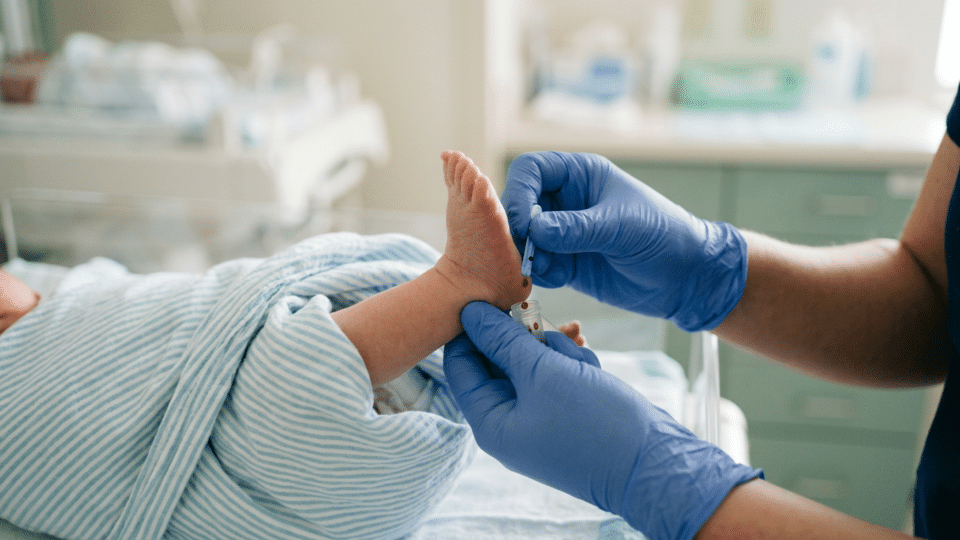
In Romania, the newborn screening currently set out in regulations covers phenylketonuria, congenital hypothyroidism and cystic fibrosis. The announced expansion to 22 biomarkers, however, is a target for nationwide coverage in 2027, included in the government programme presented in October 2026. For a family leaving the maternity hospital, the distinction matters: an announcement, a registry and actual testing in every facility are separate stages.
In brief: the heel-prick test is a screening tool, meaning a way to quickly identify children who may need further investigation. An abnormal or suspicious result does not by itself establish a diagnosis. The National Institute for Mother and Child Health (INSMC) states that newborns with abnormal results are called back for further testing.
Expanded newborn screening: what is confirmed nationally
The technical rules for the National Women’s and Children’s Health Programme, consulted on the Legislative Portal, describe newborn screening for three conditions: phenylketonuria, congenital hypothyroidism and cystic fibrosis. The same framework sets out the stages for collecting and transporting samples, carrying out tests and confirming the conditions covered by the programme.
These three conditions should not be confused with other checks that may take place at birth or during the neonatal period, such as hearing screening or assessment for retinopathy of prematurity. These are separate interventions, with different purposes and clinical pathways.
On 27 February 2026, the launch of the National Newborn Screening Registry was announced. AGERPRES’s report on statements made at the event shows that the registry’s full operation was then conditional on the budget, a government decision and technical adjustments needed for interoperability. The public launch of a registry does not, on its own, demonstrate that all maternity hospitals, laboratories and confirmation centres are connected through a uniform system.
| What is claimed | What the documents consulted show | What cannot yet be inferred |
|---|---|---|
| The existing newborn programme | The rules describe screening for phenylketonuria, congenital hypothyroidism and cystic fibrosis. | That a broader panel is already available in every maternity hospital. |
| The national registry | It was publicly launched in February 2026. | That it is fully interoperable and operational nationwide. |
| The expansion to 22 biomarkers | It is cited in the government programme as an objective, with nationwide coverage in 2027. | That all newborns are already tested for 22 diseases or biomarkers. |
| The 2026 budget | Ministry of Health Order No. 1,091/2026 allocates 17.128 million lei to the National Women’s and Children’s Health Programme. | What exact sum is allocated to any expanded panel, as the public table does not list it separately. |
Why the figure of 22 needs to be read with caution
The government programme reported by AGERPRES on 15 October 2026 refers to expanding screening to 22 biomarkers for approximately 140,000 newborns a year, with nationwide coverage in 2027. It is a public-policy direction and a proposed timetable.
For more information on newborns, see also Extreme heat is becoming a distinct medical risk for pregnancy and newborns, which provides additional details on the subject.
No final legal act was identified in the public official documents consulted for this article that lists the panel of 22, specifies whether it refers to diseases, biomarkers or testing algorithms, or sets the date from which it becomes mandatory and funded across all maternity hospitals. The accurate wording, therefore, is that the expansion has been announced and planned, rather than that it has already been implemented uniformly in Romania.
There is, however, pilot experience. The position paper on the METABOMS project mentions 19,680 samples analysed in 56 maternity hospitals across 11 counties in 2023–2024. It points both to the feasibility of broader screening and to practical problems: improperly collected samples, incomplete data, non-uniform coding and transport delays. A pilot cannot be treated as an operational national programme, but it helps explain why the infrastructure between the maternity hospital and treatment matters as much as the number of tests.
The sample pathway: from heel prick to confirmation
INSMC describes the collection of several drops of blood from a newborn’s heel onto special filter paper. The sample is sent to a laboratory, where it is analysed for the conditions included in the panel being used. Parents should not interpret the absence of news on their own as a detailed medical result; it is useful to ask at the maternity hospital how, and by whom, results are communicated.
- Collection: medical staff take the capillary blood sample and complete the information needed to identify it.
- Transport and analysis: the sample reaches the designated laboratory. Sample quality and the speed of transport can affect whether another sample is needed.
- Screening result: a result within the test’s limits reduces the likelihood of the condition being screened for, but it does not make the test a general guarantee that the newborn has no illness.
- Abnormal result: the child may be called back for a new sample or for confirmatory investigations. Screening signals a suspicion that needs to be checked.
- Confirmation and care: the diagnosis is established through specialist assessment and specific tests. If a condition is confirmed, the medical team determines the appropriate monitoring and treatment.
This chain is why a suspicious result should be dealt with promptly, but without panic. Positive screening results may need to be ruled out through further tests; they are not equivalent to a final diagnosis.
What a suspicious result means for a family
A request for repeat testing may arise because the initial result needs clarification, but also because the sample was insufficient, damaged or collected in circumstances that require it to be repeated. Families should follow the instructions received from the maternity hospital, laboratory or doctor coordinating the case, and should not delay bringing the child in.
When the family is contacted, useful questions are straightforward and specific:
- which test was abnormal, and whether a repeat sample or confirmatory investigations are needed;
- where and when to bring the child, and which documents are required;
- who will communicate the confirmatory result, and which specialist doctor or centre will take over the case;
- whether there are instructions concerning feeding, medication or urgent assessment before the consultation.
Do not start or stop a diet, supplement or treatment on the basis of a call about a screening result. Time can matter for some metabolic diseases, but management must be determined by the medical team confirming the suspicion.
What parents can ask before discharge
In the absence of a single public list showing the panel actually used by each maternity hospital in October 2026, the safest approach is to ask directly. Parents can request information about the test performed for their child, rather than about the programme’s general promises.
- What newborn screening is carried out at this maternity hospital, and for which conditions?
- Has my child’s sample been collected? If not, why not, and when will it be collected?
- Where is the sample sent, and how will I be notified if it needs to be repeated?
- Are there special circumstances — prematurity, admission to neonatal intensive care, a transfusion or early discharge — that change the timing of collection or require a repeat sample?
- Who should I contact if I receive no information and need to check the sample’s progress?
A local example illustrates why the evidence needs to be kept separate. The Galați County Public Health Directorate’s 2025 report indicates 99.69% coverage for screening for the three conditions in the existing programme at the county’s maternity hospitals. This suggests that the system can work very well within a local network, but it is not a statistic for the country as a whole and does not demonstrate the availability of the expanded panel.
What to watch until 2027
For the expansion to be verifiable by the public, a number of biomarkers is not enough. There should be an official list of the conditions and tests included, funding rules, connected maternity hospitals and laboratories, confirmation centres, and regularly published indicators: coverage, the proportion of repeated or rejected samples, time to results, suspected cases, confirmed diagnoses and time until care begins.
The same gap between the existence of a programme and equal access to it appears in other forms of prevention. The case of cancer screening in Romania shows why organisation, the patient pathway and the reporting of results are as important as the test itself.
At the time of reporting, parents can rely on the newborn programme described in the rules in force and can ask for clarification about the test performed for their child. For the panel of 22 biomarkers, the responsible information remains this: it is an announced target for nationwide coverage in 2027, and its uniform operation will need to be demonstrated through public legal acts and implementation data.
Frequently asked questions
Is newborn screening the same as a diagnosis?
No. Screening identifies newborns who may need further checks. An abnormal result must be confirmed through repeat testing and specialist investigations.
Which conditions are included in Romania’s regulated newborn programme?
The technical rules consulted describe screening for phenylketonuria, congenital hypothyroidism and cystic fibrosis. Other neonatal assessments, such as hearing screening, are separate interventions.
Are all newborns in Romania already tested for 22 biomarkers?
The public documents consulted contain no evidence that the panel of 22 biomarkers is already applied uniformly in all maternity hospitals. The government programme presents it as a target for nationwide coverage in 2027.
What should I do if my baby is called back for retesting?
Follow the instructions you receive as promptly as possible, ask which test needs clarification and where the assessment will take place. Do not change your child’s diet or treatment without guidance from the medical team.
Sources consulted
- Technical rules for the National Women’s and Children’s Health Programme, including newborn screening
- Order No. 1,091 of 21 April 2026 amending and supplementing the technical rules for implementing national public health programmes
- Newborn screening — National Institute for Mother and Child Health
- Rogobete: The National Newborn Screening Registry will be fully operational once the 2026 budget is approved
- Government programme/Health: expansion of newborn screening to 22 biomarkers




Discuția cititorilor
Ai o opinie sau o întrebare despre acest articol? Spune-ne ce crezi.
Fii primul care deschide discuția.
Te rugăm să păstrezi un limbaj civilizat și să discuți la subiect. Comentariile spam sunt filtrate automat.