
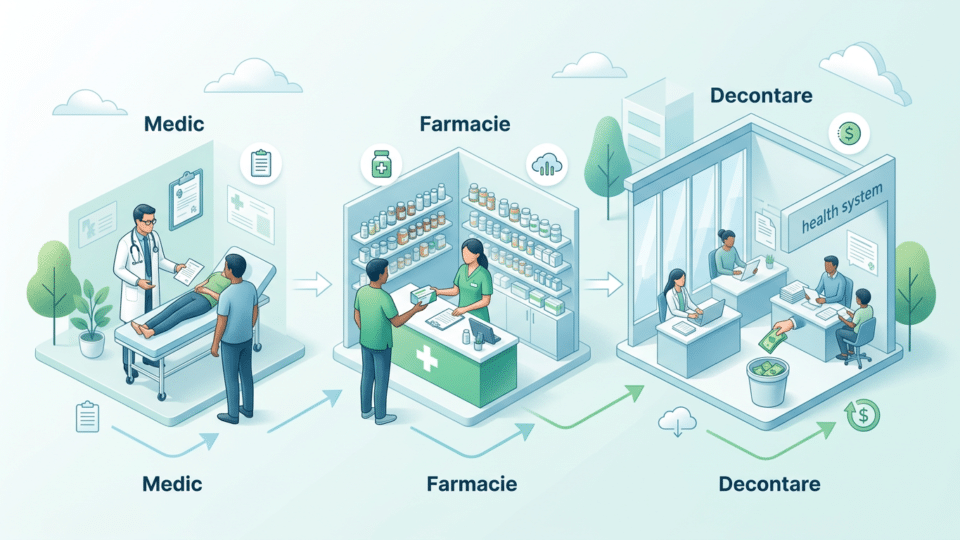
A reimbursed prescription may be entirely valid yet still not result in a box of medicine being dispensed that day. For the patient, the outcome is the same: treatment does not arrive in time. But the cause may arise at different points along the route — during prescribing, electronic validation, pharmacy stock, at the distributor, in a discontinuation of a particular presentation, or through an IT blockage.
In brief: a pharmacy not having a product on its shelves does not automatically prove a national shortage. Likewise, payment delays to pharmacies identified by the European Commission do not, by themselves, establish the cause of a specific medicine’s unavailability. These are distinct stages and must be checked against different documents.
For further information on Romania’s National Health Insurance House (CNAS), see also Flu vaccination has begun in Romania: who receives it free in 2026, which provides related details on the subject.
The map below concerns medicines dispensed through open-access community pharmacies. Medicines administered or dispensed through hospitals, as well as certain arrangements under national programmes, may be subject to different rules, suppliers and documentation.
The route of a reimbursed prescription: where it can stop
| Stage | What the patient sees | Who can clarify the cause | Useful evidence |
|---|---|---|---|
| Consultation and eligibility | The doctor does not prescribe, or says that further documents or criteria are required. | The prescribing doctor; for rules, the health insurance fund. | Medical referral, medical letter, applicable treatment protocol, insurance status. |
| Completing and validating the prescription | The prescription is not accepted at the pharmacy. | The doctor and the pharmacy; where applicable, the health insurance fund. | The error message, a copy of the prescription, and the date and time of the validation attempt. |
| The product is available on the market | Several pharmacies say they cannot obtain the same presentation. | ANMDMR, the marketing authorisation holder, the distributor. | The discontinuation notice, stating the name, strength, form and period. |
| Local stock and ordering | The product is not available at the chosen pharmacy. | The pharmacy and, where applicable, the distributor. | Date of request, estimated delivery time and response concerning the order. |
| Dispensing and price | The pharmacy can dispense the product, but a patient contribution is due or a different brand name is offered. | The pharmacist; CNAS price and reimbursement lists. | Brand name, reference price, reimbursed amount and amount to be paid. |
| Reimbursement to the pharmacy | The patient does not normally see this directly; it may affect the provider’s financing capacity. | The health insurance fund, the pharmacy and financial documents. | Invoices, summary statements, due dates and the actual payment date. |
These stages do not always occur in a linear sequence. A prescription may be valid, the medicine may be available in Romania, and the pharmacy may still not have it at that time. Conversely, a product may be on the shelf, while dispensing is temporarily prevented by an IT error or an incorrectly completed prescription.
1. A reimbursed prescription begins with an eligibility rule, not the pharmacy
Reimbursement depends on several conditions: insurance status, the diagnosis and related criteria, the doctor entitled to prescribe, any applicable treatment protocol, and how the prescription is completed. Some chronic treatments or treatments provided through national programmes may require additional medical documents or compliance with specific criteria.
In 2026, rules on completing electronic prescriptions were amended by Order No. 277/2026. The practical consequence is straightforward: explanations relying solely on older guidance may be incomplete. If a pharmacy cannot validate a prescription, the patient needs the specific reason — for example, a completion error, an eligibility issue or a protocol-related condition — rather than simply being told that “the system is not working”.
At this stage, the pharmacy cannot rewrite the treatment regimen set by the doctor. Nor should a patient independently change the active substance, strength, pharmaceutical form or dose in order to obtain an available alternative. If an alternative may be possible, the medical decision must be discussed with the prescriber.
2. Electronic validation can stop dispensing even when the medicine exists
An electronic prescription must be validated through the applicable IT workflow. Problems unrelated to stock may arise here: incomplete data, discrepancies over the reimbursement category, connection issues or temporary system outages. In August 2025, Libertatea reported a pharmacy disruption linked to an update of prices and VAT; this was a specific case, not evidence that such disruptions are permanent or nationwide.
Patients should record the date, time, pharmacy and the exact wording of the displayed or communicated problem. Without these details, a later complaint cannot distinguish a prescribing error from a technical one.
3. The absence of a brand name does not automatically mean the treatment is unavailable
ANMDMR, Romania’s National Agency for Medicines and Medical Devices, publishes notifications of temporary or permanent medicine discontinuations received from marketing authorisation holders. These notices can help verify an unavailability, but they answer a narrow question: what is happening to a particular product, at a particular strength and in a particular pharmaceutical form, during a particular period.
A notice does not show the stock held by every pharmacy. Nor does the absence of a notice guarantee that a product can be obtained immediately in a given locality. There are at least three possibilities between those situations: the product may be held by a distributor, may be available at other pharmacies, or may be temporarily unavailable only locally.
This is also the main limitation of public information: there is no national, real-time database showing the actual stock of every medicine at every pharmacy. In October 2026, the Ministry of Health announced the completion of an audit into the reporting of stock and consumption, the management of discontinuations, and medicines for special needs. The ministry’s statement mentions 16 measures, but does not provide a public map of stock on community-pharmacy shelves.
4. Pharmacies have a supply obligation, but the deadline does not mean permanent stock
The updated version of the Framework Contract published by CNAS provides that if a medicine is not available at the pharmacy when requested, the pharmacy must take steps to meet demand and procure it within no more than 24 hours for acute and subacute illnesses, and 48 hours for chronic illnesses. The rule must be read in the context of the applicable contract and does not mean that every medicine must physically be on the shelf at all times.
In practice, patients can calmly ask for verifiable information:
- the exact name, strength and form of the requested product;
- whether the pharmacy can place an order and what the estimated delivery time is;
- whether the unavailability is local or whether the distributor cannot supply it;
- whether another presentation is available and whether this requires a further discussion with the doctor;
- a written response or confirmation of the request when continuity of treatment is at stake.
The 24- or 48-hour deadline is useful only if there is a date of request and an unambiguously identified product. “The blood-pressure pill” or “the diabetes injection” is not enough for verification; the name, strength, form, number of units and, sometimes, therapeutic indication matter.
5. Reimbursed does not always mean free
Even after validation and once the product has been found, the patient may discover that a difference must be paid. Reimbursement is based on the established level and the reference price, not necessarily on the full price of every available brand version. CNAS lists distinguish between the amount covered by the system and the insured person’s maximum contribution for that product.
For that reason, the useful question at the pharmacy is not only, “Is it reimbursed?”, but also, “What is my contribution for this specific presentation?” A different brand name containing the same active substance may have a different price. This does not, however, permit automatic substitution in an individual case: medical suitability and dispensing rules must be checked by the pharmacist and, where necessary, the doctor.
6. Reimbursement to the pharmacy is separate from dispensing
After dispensing, the pharmacy sends the documents needed for reimbursement to the health insurance fund. Order No. 444/84/2025 describes documentary workflows that include invoices and consolidated summary statements. The prescription, the handover of the medicine and the subsequent payment to the pharmacy are therefore three separate facts.
In July 2026, the European Commission decided to refer Romania to the Court of Justice of the European Union, finding that CNAS payment delays to pharmacies had been systemic and persistent, and citing the 60-day maximum period provided by the European framework for public authorities in healthcare. This is an important finding on compliance with payment deadlines.
But it does not automatically follow that a particular box is missing from a particular pharmacy because an invoice has not been paid. Demonstrating that link would require a chain of documents: the specific arrears, their effect on ordering capacity or trade credit, the distributor’s response and confirmed absence of the product. Without that chain, the explanation remains a hypothesis rather than an established fact.
How to document a blockage without delaying necessary care
For a chronic treatment, documentation can reduce repeated trips. It should not delay contacting a doctor when treatment cannot safely be interrupted or symptoms are worsening.
- Keep the precise prescription details: active substance, brand name if specified, strength, form and quantity.
- Record the pharmacy, date and reason given: prescription cannot be validated, product out of stock, order impossible, delivery deadline or patient contribution.
- Ask the pharmacy to say whether it can start the procurement process and when it can respond.
- If the prescription does not validate, contact the prescribing doctor with the exact message received, rather than only saying it “was refused”.
- If the product appears to be unavailable in several places, check ANMDMR notifications using the exact name and presentation, and speak to the doctor before making any treatment change.
- Keep the receipt, written responses and any registration number for a complaint to the health insurance fund or relevant authority.
A well-documented complaint may clarify an administrative problem or flag a pattern. It does not, however, guarantee immediate delivery of a product unavailable at distribution level. For treatments that must not be interrupted, the treating doctor is the necessary contact for assessing safe clinical options.
What is still missing from the public picture
The rules, reimbursement lists and discontinuation notices make it possible to verify certain stages. By themselves, they do not make it possible to measure nationally the number of affected patients, the average waiting time or the products actually in stock on a given day. This distinction matters: a network of testimonies may signal a problem, but it cannot replace comparable public records of availability.
The accurate map of a reimbursed prescription is therefore not one explanation about “the system”. It is a sequence of verifiable questions. Where did the process stop? Who holds the document? And what can be demonstrated before concluding that the problem is national, financial or medical?
Frequently asked questions
Does a reimbursed prescription guarantee that the medicine is free?
No. The amount payable depends on the reimbursement level, the reference price and the specific product dispensed. Some presentations may require a patient contribution.
What does it mean if the pharmacy does not have the medicine in stock?
It may be a temporary local shortage, a delivery problem, the unavailability of a particular presentation or a wider discontinuation. Ask whether the pharmacy can order the product and what the estimated delivery time is.
Can I replace the medicine myself with another available one?
It is not prudent to change the active substance, strength, pharmaceutical form or dose on your own. Speak to the prescribing doctor and pharmacist, especially for chronic treatments or treatments where interruption carries risks.
Where can I check whether a medicine has been notified as unavailable?
ANMDMR publishes discontinuation notices for certain medicines. Check the exact name, strength, pharmaceutical form and period stated; the page does not show real-time pharmacy stock.
Sources consulted
- Government Decision No. 521/2023 approving the service packages and the Framework Contract, consolidated version
- CNAS — updated Government Decision No. 521/2023, text on pharmacies’ obligations
- Order No. 444/84/2025 on the methodological rules for implementing the Framework Contract
- ANMDMR — Medicine discontinuation notifications
- European Commission — July infringements package: key decisions, 8 July 2026




Discuția cititorilor
Ai o opinie sau o întrebare despre acest articol? Spune-ne ce crezi.
Fii primul care deschide discuția.
Te rugăm să păstrezi un limbaj civilizat și să discuți la subiect. Comentariile spam sunt filtrate automat.