
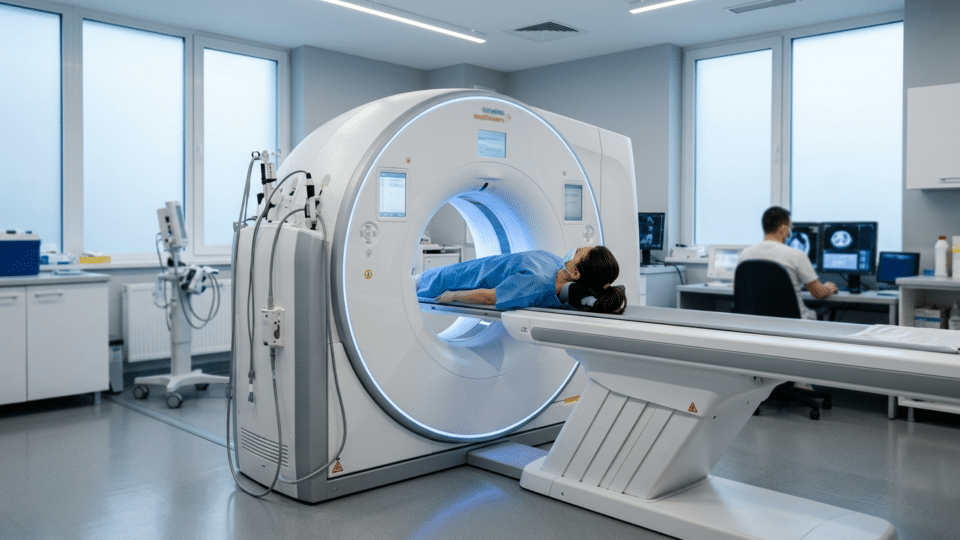
Since 2026, Romania has had a national methodology for the early detection of lung cancer. This is a concrete step: the document sets out how people at risk are selected, how low-dose chest CT scans are used, and what happens after a suspicious result. But the methodology alone does not mean that every eligible person can already book a free scan, in every county, through a permanent screening programme.
For further context, see Why cancer screening in Romania still depends on the patient’s luck, which examines an issue directly related to this subject.
What is known so far: a project is funded until 25 October 2029; regional centres and partnerships have been announced; and the methodology provides a common medical standard. However, the public sources reviewed do not show a single, up-to-date national list of all centres that are actually carrying out lung screening, or a single enrolment mechanism for the general population.
The distinction matters for patients. A “national early detection programme” may be the name of a project with funding and objectives; a permanent national service also requires reliable access, published eligibility rules, functioning centres, ongoing funding and reported results.
Lung screening in Romania: what the methodology sets out
The methodology published by the Romanian College of Physicians, developed within a project coordinated by the “Marius Nasta” Institute of Pneumophthisiology, proposes a pathway beginning with the administrative and medical selection of people at risk. The document is available in the lung cancer screening methodology.
The assessment involves more than a CT scan. The protocol provides for a respiratory medicine or internal medicine consultation, an assessment of tobacco-related risk, spirometry, smoking-cessation counselling and, for people admitted to the programme, a low-dose chest CT scan, also known as LDCT.
Images are classified using Lung-RADS, a system used to standardise the reporting of lung nodules. Depending on the category, the result may mean returning for a check-up, having a follow-up CT scan at a set interval, or undergoing further investigations. In cases of high suspicion, the pathway may lead to PET-CT, biopsy or other invasive diagnostic procedures.
This is one of the methodology’s practical stakes: useful screening requires not only a CT scanner, but also trained radiologists, consistent interpretation rules, patient follow-up, and working links with pathology, thoracic surgery and oncology. A suspicious CT result is not a cancer diagnosis, but it cannot be left without follow-up either.
The project has a budget, timetable and targets. Results have not yet been reported
The initiative is being implemented through the project “Lung Cancer Screening – National Early Detection Programme”, SMIS code 346295. The project page gives a total value of 82,032,595.75 lei and an implementation period of 50 months, from 26 August 2025 to 25 October 2029.
According to information published by ARAS, a project partner, the targets include informing and engaging 27,118 vulnerable people, carrying out at least 21,695 medical testing procedures, and training 774 medical and non-medical specialists.
These figures describe project objectives, not the number of people already examined. The public materials reviewed did not identify consolidated national data on the number of CT scans performed, Lung-RADS results, biopsies carried out, cancers confirmed or stages at diagnosis.
| Stage | What has been publicly confirmed | What remains unclear nationally in public information |
|---|---|---|
| Medical framework | A methodology exists for selection, LDCT, Lung-RADS and follow-up. | Its precise administrative status and whether it is mandatory for all providers. |
| Funding | A SMIS-funded project runs until October 2029. | The form of funding and access after the project ends. |
| Centres | Regional involvement has been announced, including in Timișoara and Buhuși. | A centralised list of all active centres and their actual capacity. |
| Enrolment | The project targets vulnerable groups and risk-based selection. | A single booking channel and the operational criteria used in each area. |
| Results | The methodology provides for quality indicators and follow-up. | Public national data on activity and clinical outcomes. |
Where the move from document to implementation can be seen
There are signs that the project has moved beyond the documentation stage alone, but they point to gradual implementation.
The “Dr Victor Babeș” Clinical Hospital for Infectious Diseases and Pneumophthisiology in Timișoara announced in February 2026 that it was making two CT scanners and its medical team available to the project for investigating the target group. The hospital’s statement confirms its participation and the capacity made available, but does not publish the number of people examined, booking criteria or medical results.
In Romania’s North-East region, the “Prof Dr Eduard Apetrei” Hospital in Buhuși was presented on 6 October 2026 as a future regional centre, in collaboration with the “Marius Nasta” Institute. AGERPRES’s report on the Buhuși centre makes the difference between designation and operation clear: at the time of the announcement, staff training and equipment installation were still required, and free appointments were due to begin later.
The cautious conclusion, therefore, is that Romania is building the infrastructure for organised lung screening, with regional activations and preparations under way. Based on the public information identified for this article, there is no confirmation of a fully operational network with identical access in every county.
Why low-dose CT is not a test for everyone, at any time
Screening is intended for people without symptoms who are selected because they face a higher risk. Its purpose is to detect lesions at a stage when they can be investigated and treated earlier, while limiting unnecessary examinations.
That balance matters. A CT scan can identify nodules that are not cancer, or very slow-growing lesions that may never have caused problems during a person’s lifetime. The methodology explicitly mentions risks including false-positive results and overdiagnosis. This is why the examination should be part of an organised pathway, rather than a general recommendation to have CT scans “preventively”.
International criteria for age and tobacco exposure should not automatically be assumed to be administrative rules applied in the same way in Romania. People who are interested should ask specifically whether recruitment through the project exists in their area, what criteria are used and who determines eligibility.
Warning symptoms should not be sent to the back of the screening queue
Screening does not replace medical consultation for symptoms. Anyone with a persistent or changed cough, blood in their sputum, new or worsening shortness of breath, persistent chest pain, prolonged hoarseness or unintended weight loss should speak to their family doctor or a specialist as soon as possible.
In this situation, the issue is diagnosis, not admission to a screening pathway for people without symptoms. The Romanian College of Physicians drew the same distinction when it announced the methodology on 1 August 2026.
Questions to ask before looking for a screening place
- Is there a centre in my county that is already providing LDCT under the project, or is the centre still being prepared?
- Who carries out the initial selection: the family doctor, a pulmonologist or the local project team?
- What criteria for risk, smoking and vulnerability are currently being applied?
- Which costs are covered by the project, and what happens after a result requiring further investigations?
- Who communicates the result and who follows up with the patient if a repeat scan or biopsy is needed?
These questions illustrate why the number of CT scanners available is not the only measure of success. For patients, real access begins when there is a clear route into the programme and continues through diagnosis, treatment or monitoring, as appropriate.
Reporting and methodology: This article synthesises the methodology document, official information from project partners and public communications by healthcare providers. Statements about access are limited to information published by the end of October 2026; the absence of a centralised public list of active centres does not prove that no additional local activity exists.
Frequently asked questions
Does the national methodology mean I can have a free lung CT scan anywhere in Romania?
Not automatically. The methodology establishes a professional pathway, while the project is being implemented in stages. The sources reviewed do not show a complete national network of active centres or a single enrolment mechanism for the entire population.
What is low-dose chest CT?
It is a computed tomography scan performed with a lower radiation dose than a standard chest CT. It is used in screening for people selected on the basis of risk. Interpretation and follow-up of results are part of the procedure.
Does a nodule found on CT mean lung cancer?
No. Lung nodules have many causes. Lung-RADS helps determine the next step: monitoring, repeating the CT scan after a specified interval, or further investigations in more suspicious cases.
If I have a persistent cough, should I wait to be included in screening?
No. Screening is intended in principle for people without symptoms. A persistent cough, blood in sputum, new shortness of breath, persistent chest pain or unexplained weight loss warrant medical assessment.
Sources consulted
- Lung cancer screening methodology — Romanian College of Physicians
- Lung Cancer Screening — National Early Detection Programme, ARAS
- Victor Babeș Hospital Timișoara statement on the lung screening project
- Bacău: Buhuși hospital becomes a regional lung cancer screening centre — AGERPRES
- Law No. 293/2022 on cancer prevention and control — Legislative Portal




Discuția cititorilor
Ai o opinie sau o întrebare despre acest articol? Spune-ne ce crezi.
Fii primul care deschide discuția.
Te rugăm să păstrezi un limbaj civilizat și să discuți la subiect. Comentariile spam sunt filtrate automat.