
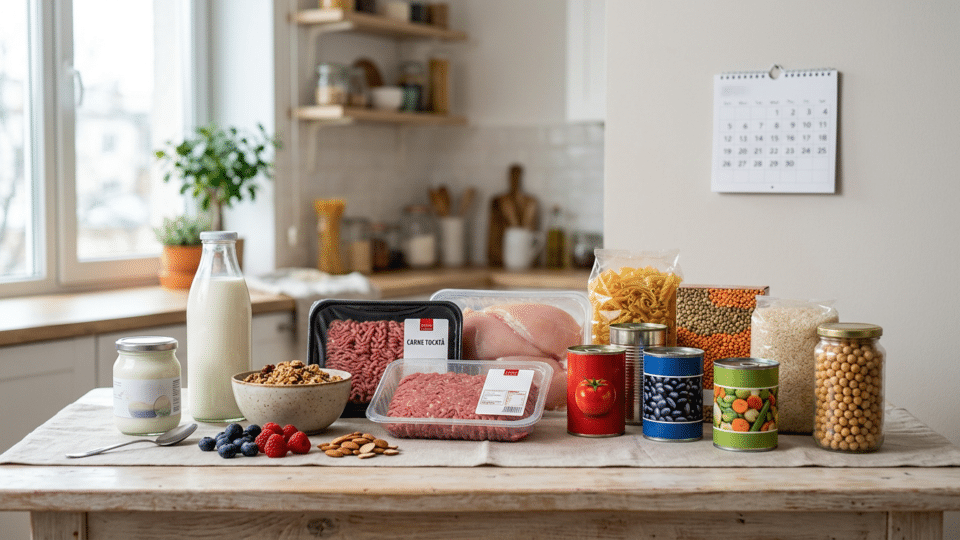
A yogurt can spoil before the date on its packaging, while a bag of pasta, a canned product or a chocolate bar may remain perfectly usable after the stated date. The difference is not simply a matter of an “expiry date”, but of the type of food, microbiology, temperature, the cold chain, packaging, humidity and how the product has been stored after opening.
For more information on food storage, see The perfectly organised refrigerator: where to store each food and how long it keeps, which offers complementary details on the subject.
In the European Union, moreover, there is an essential distinction between “use by” and “best before”. The first concerns safety; the second primarily concerns quality.
Two dates that mean very different things
The European Commission and the European Food Safety Authority (EFSA) draw a clear distinction between the two types of date marking.
- “Use by”: relates to food safety.
- “Best before”: indicates the period during which a product retains its optimum quality.
A food bearing a “best before” date may still be good after that date if it has been stored correctly, whereas food with a “use by” date should not be eaten after the date, even if it looks or smells normal.
Why “use by” is a safety limit
EFSA warns that products such as fresh meat, fish, ready-made salads and certain dairy products may contain dangerous bacteria that do not necessarily change their taste, smell or appearance.
In other words, the test of “it smells fine, so it is safe” is not enough for foods with a high microbiological risk.
Why some foods last beyond their “best before” date
Dry goods, canned foods, pasta, rice, biscuits, coffee and many frozen foods are much more stable. After their quality date, they may lose flavour, texture or freshness without automatically becoming unsafe.
In these cases, if the packaging is intact and the product has been stored correctly, its appearance, smell and texture can help assess its quality.
Why food can spoil before its date
The date on the packaging assumes particular transport and storage conditions. If those conditions are not met, the date no longer guarantees the same shelf life.
- a refrigerator that is too warm;
- an interruption to the cold chain;
- pierced or swollen packaging;
- contamination after opening;
- a product left at room temperature for too long;
- repeated temperature fluctuations;
- poor refrigerator hygiene.
The cold chain is one of the most important links
EFSA recommends following the storage temperatures stated on the label and notes that many perishable foods must be kept below around 5°C.
If a refrigerated product spends too long in a warm car, warehouse or on a kitchen counter, bacteria can multiply far more quickly than they would in a cold refrigerator.
Refrigerator temperature matters greatly
A refrigerator set too high can considerably reduce food’s actual shelf life. The difference between 3–4°C and 7–8°C matters to the rate at which microorganisms multiply.
It is useful to check the temperature with an independent thermometer, particularly if the refrigerator is old, heavily stocked or opened frequently.
Opening the packaging changes the timeframe completely
The date on packaging generally applies to an unopened product kept according to the instructions. Once opened, the situation changes.
Air, moisture, bacteria from utensils and contact with hands can shorten shelf life. This is why many products carry instructions such as “consume within 2–3 days of opening”.
Why vacuum packaging extends shelf life
Oxygen promotes both certain oxidation reactions and the growth of some microorganisms. Vacuum packaging or modified-atmosphere packaging reduces the oxygen available and slows some spoilage processes.
Vacuum packaging does not, however, sterilise food or make it safe indefinitely.
Why canned food lasts so long
Canned foods have a long shelf life because their contents are heat-treated and then sealed off from the outside environment. As long as the container remains intact, the risk of new contamination is very low.
If a can is swollen, leaking, severely rusted or appears to have a compromised lid, it should not be tasted “to test” it.
Dry products last because microorganisms need water
Pasta, rice, flour, biscuits and cereals have low water activity. Microorganisms have less water available for multiplication, making these foods more stable than fresh products.
After the “best before” date, the main problems are often fats turning rancid, loss of flavour, softening or pest infestation, rather than rapid growth of pathogenic bacteria.
Does freezing stop time?
Not entirely. Freezing greatly slows microbial growth and chemical reactions, but it does not restore spoiled food to a safe state.
Ideally, a product should be frozen before its safety limit and kept consistently frozen.
Can food frozen before its “use by” date be eaten later?
EFSA explains that food may be frozen before its “use by” date, extending the period for which it can be kept. Once thawed, the product-specific rules and the instructions on the packaging must be followed.
Smell and appearance are useful, but have limits
For foods with a “best before” date, the senses can be useful: check for mould, a rancid smell, an unusual texture or a clear change in colour.
For foods carrying a “use by” date, this test is not enough, because dangerous bacteria may be present without visible signs.
Mould does not always mean you can simply “cut off the spoiled part”
In soft, moist foods, fungal hyphae can extend far beyond the visible area. In such cases, removing the mouldy portion does not guarantee that the rest is safe.
Very hard, dense products may be different, but the assessment depends on the food and the type of contamination.
The two-hour rule
The US Food and Drug Administration (FDA) recommends that perishable foods should not be left at room temperature for more than about two hours. If the ambient temperature is very high, the safe interval may be shorter still.
This rule matters for cooked meat, dairy products, egg dishes, cooked rice, delivered meals and leftovers.
Why cooked rice can be risky even if it does not smell bad
Some bacteria form spores that can survive cooking. If food is left at room temperature for too long, these spores can germinate and produce toxins.
This is why rapid cooling and prompt refrigeration are important for cooked dishes.
Why milk or yogurt can spoil before the date
Dairy products are temperature-sensitive. If the cold chain has been interrupted or the refrigerator is too warm, spoilage bacteria can multiply before the date estimated by the manufacturer.
After opening, additional contamination and exposure to air accelerate the process.
Why some products “last” long after the date
A dry, hermetically packaged food has very little available water, little oxygen, or both. This slows spoilage processes.
In such cases, the “best before” date is often the point until which the manufacturer guarantees optimum taste, texture and aroma, rather than a line beyond which the product automatically becomes dangerous.
How to read food packaging correctly
- check whether it says “use by” or “best before”;
- read the storage conditions;
- check the instructions for after opening;
- follow the stated temperature;
- look for packaging that is damaged, swollen or unsealed.
A practical table: what should you do after the date?
| Type of label | After the date | Recommendation |
|---|---|---|
| Use by | There may be a microbiological risk | Do not consume after the date |
| Best before | Quality may decline | Check the packaging, appearance, smell and texture |
| Opened product | The original date is no longer sufficient | Follow the post-opening instruction |
| Product frozen before its date | The storage period is extended | Follow freezing and thawing instructions |
Why a date is not the same as a microbiological “cliff edge”
The date on packaging does not mean that a product is good at 23:59 and instantly becomes dangerous at 00:01. It is a limit set on the basis of shelf-life tests, storage conditions and safety margins.
For products with a “use by” date, however, consumers cannot assess the microbiological risk themselves, which is why the limit must be observed.
How to reduce food waste without risking your health
- move foods with the nearest dates to the front of the refrigerator;
- freeze products in time if you will not eat them;
- do not automatically throw away a product simply because its “best before” date has passed;
- do not consume a product after its “use by” date simply because it seems fine;
- keep the refrigerator cold and clean;
- write the opening date on containers when useful.
The European Commission estimates that up to around 10% of food waste in the EU is linked to misunderstanding or misuse of date markings.
The date matters, but it needs to be read correctly
Some foods spoil before their date because they have been stored incorrectly. Others remain good after their date because it indicates optimum quality, not safety.
The key is to distinguish between “use by” and “best before”, maintain the cold chain and take account of instructions for after opening.
Frequently asked questions about food past its date
Can I eat food after its “best before” date?
Often, yes, if it has been stored correctly and shows no signs of spoilage. “Best before” relates primarily to quality.
Can I eat food after its “use by” date if it smells fine?
It is not recommended. Dangerous bacteria can be present without a smell or visible changes.
Why does a product spoil before its date?
Most often because of too-high temperatures, compromised packaging, contamination after opening or an interruption to the cold chain.
Can I freeze food before its “use by” date?
Yes, if the product is suitable for freezing and is frozen before the date, in accordance with the instructions.
Is smell enough to check whether food is safe?
Not for foods with a “use by” date. Some dangerous microorganisms do not visibly alter the food.




Discuția cititorilor
Ai o opinie sau o întrebare despre acest articol? Spune-ne ce crezi.
Fii primul care deschide discuția.
Te rugăm să păstrezi un limbaj civilizat și să discuți la subiect. Comentariile spam sunt filtrate automat.