
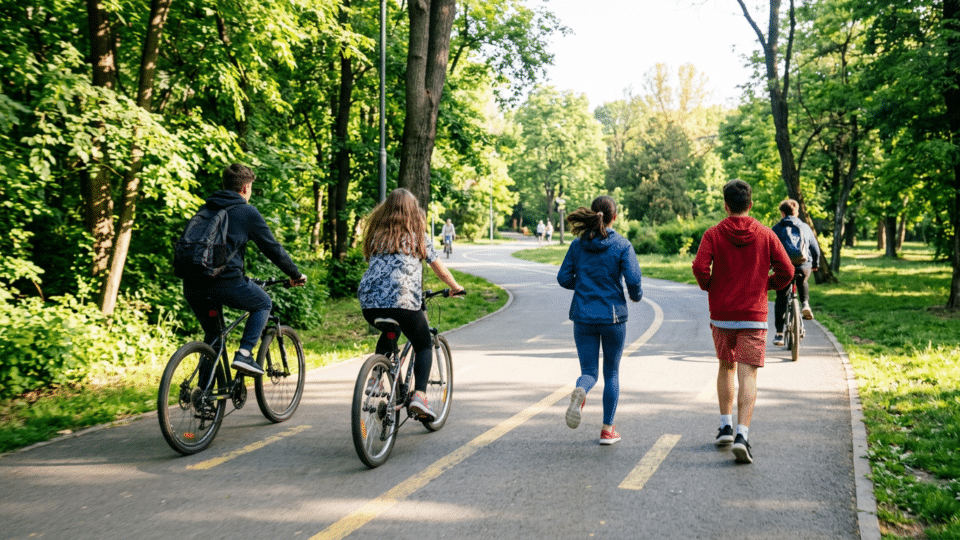
One in four adolescents aged 11 to 17 reported that, in the week before the survey, they had not accumulated at least 60 minutes of moderate-to-vigorous physical activity on any day. The estimate, released by the World Health Organization (WHO) on November 4, 2026, concerns around 240 million adolescents worldwide.
The figure needs careful interpretation. It does not mean that one-quarter of adolescents did not get out of their chairs, walk or climb stairs. It means they did not reach the threshold used in the study on any of the seven days: a cumulative 60 minutes of movement intense enough to visibly raise breathing and heart rate.
For more information on the WHO, see also WHO recommends a new approach to obesity in children and adolescents, which provides complementary details on the subject.
What we know now: the global data point to a large, persistent problem, but they do not automatically provide a percentage for Romania. For Romania, the most recent comparable public figure available in the sources consulted measures something different: in 2022, 15% of 15-year-olds said they did at least one hour of physical activity every day.
What the indicator on adolescents with no active days actually measures
The international analysis published in The Lancet Global Health brought together 389 surveys involving more than 3.2 million participants in 140 countries and territories over 2010–2025. In its announcement, WHO defines an “active day” as one that includes at least 60 minutes of moderate-to-vigorous physical activity.
This activity does not have to be a workout or a match. It can include running, brisk walking, cycling at a sustained pace, active play, dancing, or physical activity at school and on the journey to school. Organised sport is only one possible route.
The 60-minute threshold is a public-health benchmark that is useful for comparing populations. It is not a biological boundary: 59 minutes on a given day does not make an adolescent “inactive” in an absolute sense. But across a large group, the distribution of active days shows how rarely more demanding movement forms part of an ordinary routine.
| Indicator | Question it answers | What it does not allow us to conclude |
|---|---|---|
| Zero active days | How many adolescents had no day with at least 60 minutes of activity? | That they did no physical activity at all that week. |
| Two or fewer active days | How many reached the threshold on zero, one or two days? | How many had exactly zero active days. |
| Seven active days | How many reached the threshold every day of the week? | How many had no activity at all. |
Globally, the reported average was 2.7 active days a week. Only 14% of adolescents said they reached the threshold on all seven days. At the same time, 28% of girls and 22% of boys reported zero active days; the shares reporting activity on all seven days were 11% and 17%, respectively.
Adolescents with no active days: what can be said about Romania
It would not be accurate to say that one in four Romanian adolescents had no active days. That is a global estimate, and the public sources consulted do not provide a national value published for exactly the same indicator and methodology.
There is, however, an important reference point. The 2025 Romania Country Health Profile, published by the OECD and the European Observatory on Health Systems and Policies, states that 15% of Romanian 15-year-olds reported at least one hour of physical activity every day in 2022.
This percentage is not equivalent to the global 25% figure. It answers the opposite question: how many reach the threshold on all seven days, rather than how many do not reach it on any day. It would be wrong to describe the remainder up to 100% as “completely inactive adolescents”. There is a major difference between an adolescent with zero active days and one with six, even though neither is among the 15% who meet the daily threshold.
The international HBSC report for 2021/2022 also uses the category “very inactive” for adolescents who had no more than two days with at least 60 minutes of physical activity. This is a broader category than “zero active days”. The HBSC report also shows that daily physical activity varies by age, gender and socioeconomic status. These differences support a discussion about access and environment, rather than an assumed lack of ambition among children.
Where movement is lost in an ordinary day
A school day can leave little room for movement, even when an adolescent has not deliberately chosen a sedentary lifestyle. Travelling by car or bus, lessons, homework, private tutoring, a lack of a usable schoolyard, unsafe pavements or the cost of sports clubs can narrow the options. Some children do not have a nearby park, a safe cycling route or a place where they can be active free of charge.
WHO includes schools, transport, public spaces, safety, costs and social norms among the relevant factors. These are not explanations demonstrated individually for every adolescent in Romania, but areas in which policies and the way cities or schools are organised can change opportunities for movement.
Phones are part of this picture, but they are not a sufficient explanation. Time online can compete with time available for activity, but the simple association between screens and a more sedentary schedule does not prove that screen use is the main cause. A serious explanation must also take account of schedules, family income, transport, safety and local provision.
Sleep deserves to be considered separately, not as a punishment for time spent on devices. A packed schedule, late bedtimes and early waking can reduce energy for movement and concentration. For context on rest and circadian rhythm, InfoBuz’s article on why someone may wake up tired after eight hours of sleep may also be useful.
Changes more plausible than telling teenagers to “do more sport”
A generic message places all responsibility on the adolescent, although time for movement depends on the people and institutions around them. A practical discussion starts with a question: where could another period of movement realistically fit into an already full day?
At home: look at routine, not performance
Rather than setting an abstract target, families can look at an ordinary week: how the child gets to school, how much time they spend sitting between lessons and homework, which days allow time outdoors, and what obstacles exist. Sometimes walking part of a journey, cycling somewhere safe or choosing an activity selected by the adolescent is more sustainable than an imposed schedule.
The focus should remain on routine and enjoyment, not the scales, punishment or comparison with other children. If pain on exertion, unusual breathing difficulties, dizziness, fainting or other worrying symptoms occur, increasing physical activity should be discussed with a doctor.
At school: breaks, schoolyards and the journey all matter
Physical education has value, but one timetabled lesson cannot by itself cover the whole week. Schools can affect movement through accessible, well-maintained schoolyards, breaks that allow pupils to go outside, inclusive activities for students with different fitness levels, and safer travel conditions around the building.
An adolescent who does not feel comfortable in competition may avoid organised sport without necessarily rejecting movement itself. A varied offer—from games and dance to walking, cycling and recreational activities—may matter more than a focus exclusively on performance.
In the city: access is a public-health issue
A lit path, a safe crossing, a usable public sports ground, and walking or cycling routes may shape everyday activity more subtly, but more often, than an occasional campaign. For families, the useful question is not only “what sport is available?” but also “can the child get there independently and safely?”
During heatwaves, severe cold, rain or periods of high pollution, activity should be adapted to conditions and any warnings. Checking the weather forecast and warnings can help in choosing a suitable time, without treating weather as the only obstacle.
The data are useful, but have clear limits
The global estimate is based mainly on adolescents’ responses to surveys, many of them carried out in schools. This means the results may be affected by memory and by how each respondent understands activity intensity. Adolescents who do not attend school may also be underrepresented.
These limitations do not negate the public-health signal. They simply call for accurate wording: the data describe whether adolescents report meeting an activity threshold; they do not measure every minute of walking or exertion with the precision of a wrist-worn device.
The useful conclusion for Romania is not that we already know how many adolescents did not move at all in a week. The public data consulted do not tell us that. We do know, however, that meeting the recommended daily threshold is rare among Romanian 15-year-olds, and that the response cannot be reduced to a slogan about willpower. A more active routine is built from available time, safe routes, open spaces and activities that give adolescents a real reason to return.
Frequently asked questions
Does “no active days” mean an adolescent did no physical activity at all?
No. In the WHO estimate, the phrase means that the adolescent had no day with a cumulative total of at least 60 minutes of moderate-to-vigorous physical activity. They may have walked or made shorter efforts.
Can we say that 25% of Romanian adolescents had no active days?
Not on the basis of the public sources consulted. The 25% figure is a global estimate. A different indicator is publicly available for Romania: in 2022, 15% of 15-year-olds reported at least one hour of activity every day.
Why is organised sport not the only solution?
The indicator includes all forms of moderate-to-vigorous activity, including brisk walking, cycling, active play and movement on the journey to school. Access to safe spaces and free time may matter as much as joining a club.
Sources consulted
- WHO — One in four adolescents worldwide reported no active days in the previous week
- The Lancet Global Health — National, regional, and global trends in adolescent physical activity from 2010 to 2025
- OECD — Romania: Country Health Profile 2025
- WHO Regional Office for Europe — HBSC international report from the 2021/2022 survey, Volume 4




Discuția cititorilor
Ai o opinie sau o întrebare despre acest articol? Spune-ne ce crezi.
Fii primul care deschide discuția.
Te rugăm să păstrezi un limbaj civilizat și să discuți la subiect. Comentariile spam sunt filtrate automat.