
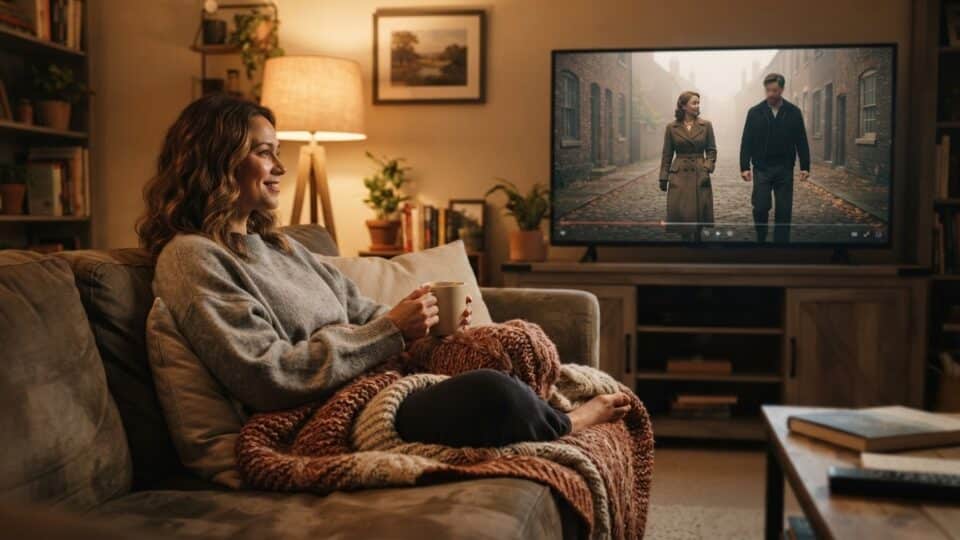
Why do we rewatch the same films and TV series even when we already know who wins, who dies and how the story ends? At first glance, it seems illogical: once the surprise has gone, why invest another two hours in a familiar story?
The psychology of media consumption suggests that surprise is only one reason people watch films and series. At times, we seek comfort, familiarity, nostalgia, a connection to a period in our lives, or simply an experience where we already know what to expect. Recent research calls this behaviour volitional reconsumption: the deliberate choice to revisit content one already knows.
Why we rewatch: familiarity can be an advantage
Choosing a new film involves uncertainty. It may be excellent, or it may be two wasted hours. It may be relaxing, or unexpectedly upsetting.
A film we have already seen, by contrast, comes with a simple promise:
- we know its tone;
- we know its characters;
- we know its level of tension;
- we know its ending;
- we know how it made us feel.
That predictability can turn rewatching into a form of psychological comfort.
Knowing what comes next reduces uncertainty
A 2025 study on rewatching content on streaming platforms describes the behaviour as a search for stability, predictability and comfort.
In busy or stressful periods, the absence of surprise can be precisely what makes familiar content appealing.
There is no need to wonder whether a favourite character will survive or whether the story will become distressing. The experience is already known.
Comfort watching: the media equivalent of a favourite blanket
In recent years, the term comfort media has become increasingly common in research.
A study published in 2025 found that content perceived as comforting tends to be:
- familiar;
- emotionally positive;
- relatively low in tension;
- sometimes associated with nostalgia;
- linked to familiar characters or parasocial relationships.
In other words, people do not necessarily return to the film that is considered the “best” by critics. They return to the one that works for them as an emotionally safe space.
Why a familiar series can feel more relaxing than a new one
A new series demands attention. You have to:
- learn the characters’ names;
- follow their relationships;
- understand the world it creates;
- notice clues;
- retain information.
On a rewatch, some of that cognitive load disappears.
You can watch more casually, miss a few minutes without losing the thread, and notice elements other than those that stood out the first time.
Rewatching does not mean the experience is identical
We may know the ending, but we are no longer exactly the person who first watched the film.
A comedy seen at 18 may feel different at 35.
A character we once found irritating may suddenly become the easiest one to understand.
A scene overlooked on a first viewing may become essential after we have had different life experiences.
On a second viewing, we notice what we could not see the first time
A first viewing is dominated by one question: “What happens next?”
On later viewings, that pressure disappears.
Attention can shift to:
- dialogue;
- visual details;
- music;
- foreshadowing;
- symbols;
- the actors’ performances;
- scene construction.
That is why some films become more interesting once the ending is no longer a secret.
A twist can be more interesting once you know it
On a first viewing, a twist creates surprise.
On a second, it can create appreciation.
Instead of following only the outcome, viewers can see:
- how the clues were placed;
- which lines had a double meaning;
- which details were hidden in plain sight;
- how attention was steered in the wrong direction.
The pleasure no longer comes from surprise, but from understanding the mechanism.
Nostalgia is one of the strongest explanations
Sometimes we are not only rewatching a film. We are revisiting a period of our lives.
A series may be connected with:
- childhood;
- secondary school;
- a first apartment;
- a relationship;
- holidays;
- a particular period in family life.
When we return to that content, the memories associated with it may return as well.
Nostalgia is not simply longing for the past
Modern psychological research describes nostalgia as a predominantly social emotion.
A review published in Current Opinion in Psychology indicates that nostalgia can strengthen feelings of connection to other people and is associated with benefits including:
- a sense of meaning in life;
- self-continuity;
- optimism;
- inspiration;
- a sense of belonging.
This is why an old film can work as a shortcut to an earlier version of one’s own life.
What “self-continuity” means
Psychologists use the term self-continuity for the sense that the person we were in the past and the person we are now belong to the same story.
A study published in the journal Emotion found that nostalgia can strengthen that continuity by increasing feelings of social connectedness.
A film watched repeatedly over the years can become a point of reference:
“I watched this then. I watch it now. I am a different person, but I am still me.”
Why series can be even more powerful than films in this respect
A film spends two hours with us.
A series can spend years with us.
Characters appear week after week, or season after season. Over time, they can become extremely familiar.
When we rewatch a long-running series, we return to a world we know almost as we know a place.
Parasocial relationships matter
A parasocial relationship is a feeling of familiarity and closeness with a media personality or character who, clearly, does not know us personally.
This type of bond can help explain why returning to certain characters feels comforting.
It is not because we forget they are fictional characters, but because our emotional responses to stories and characters are real.
Why we sometimes want the exact same episode
Many people do not necessarily rewatch an entire series.
They have particular episodes:
- the Christmas episode;
- the wedding episode;
- a season finale;
- a particularly funny episode;
- the moment when two characters reconcile.
In these cases, the content becomes almost a tool for regulating one’s mood.
Rewatching can be a form of emotional regulation
The 2025 review of rewatching films and episodes identifies emotional regulation and comfort among the main reasons for returning to familiar content.
That does not mean a series treats anxiety or stress.
It only means people may use familiar content to temporarily change their state: to
- calm down;
- cheer themselves up;
- reduce uncertainty;
- give themselves a predictable routine.
Why we choose comfort shows in the evening
In the evening, the ability to make decisions may be reduced after a busy day.
Choosing a new series can become one more decision:
Is it worth it? Is it good? Is it too heavy? Do I need to pay close attention?
A familiar series removes those questions.
You press play and know exactly which world you are entering.
Streaming has made rewatching far easier
In the era of linear television, rewatching depended on a broadcaster’s schedule.
Today, streaming enables:
- immediate access;
- complete seasons;
- starting again from any episode;
- autoplay;
- personal watchlists;
- recommendations based on viewing history.
The 2025 review article describes this change as a shift from television reruns scheduled by broadcasters to a personalised, voluntary form of media reconsumption.
The algorithm can also reinforce familiarity
If you have already watched a series, the platform knows there is a strong chance you will engage with it again, or with similar titles.
The interface can therefore bring familiar content back to the foreground.
InfoBuz has separately explained how recommendation systems work and why algorithms quickly learn what kinds of content keep us engaged.
Rewatching can increase appreciation for a story
Repeated exposure does not always lead to boredom.
The 2025 academic review indicates that reconsumption can have different outcomes:
- saturation;
- greater enjoyment;
- deeper appreciation.
The difference depends on the person, the work and the reason for rewatching.
Why some films “age” well and others do not
Films that rely heavily on a twist or surprise may lose some of their impact after a first viewing.
Others gain from:
- complex characters;
- good dialogue;
- atmosphere;
- music;
- world-building;
- themes open to reinterpretation.
These offer more layers than simply finding out the ending.
Comfort watching and holidays
There are films people rewatch almost ritually:
- at Christmas;
- at Halloween;
- on holiday;
- on anniversaries;
- at certain times of year.
In these cases, the film is no longer simply entertainment.
It becomes part of the ritual.
Rewatching is not competing with novelty; it serves an entirely different function.
Why we rewatch films with other people
Sometimes we rewatch a film because we want to show it to someone else.
That creates an interesting experience: we know what is coming, but we watch the reaction of the person seeing it for the first time.
Part of the lost surprise is recovered through the other person’s reaction.
Rewatching thus becomes a social experience.
A film can become part of a group’s identity
Families and groups of friends sometimes develop:
- in-jokes;
- references;
- shared jokes;
- viewing rituals.
Over time, a work becomes a shared language.
This is one reason nostalgia and social connection appear so often in studies of media reconsumption.
Why old films can return to streaming charts
A title does not have to be new to attract a large audience.
Streaming catalogues allow older films and series to be rediscovered or rewatched on a large scale.
InfoBuz observed this dynamic in Netflix Romania’s chart for 7–13 September 2026, when several older films outperformed recent releases.
Familiarity can reduce the risk of a bad choice
The streaming offer is vast.
Paradoxically, more options do not always make a decision easier.
After 15 minutes of scrolling, the familiar film may become the simplest choice.
Not because the viewer “does not want something new”, but because they already know the relationship between the time invested and the emotional reward.
Why we watch familiar comedies even when we know the jokes
A good joke does not work solely through surprise.
Sometimes the pleasure also comes from anticipation.
We know the line and wait for it.
The same happens at concerts: the audience knows exactly which chorus is coming next, and anticipation makes it more enjoyable, not less so.
Is comfort watching always beneficial?
Not necessarily.
Research does not say that rewatching is “good” in every amount or situation.
If it becomes the only form of media consumption and consistently replaces new experiences, it may limit exposure to different stories, ideas and styles.
The issue is not rewatching a favourite series.
What matters more is whether familiarity becomes the only tolerable option.
Comfort watching is not the same as avoiding problems
Watching a familiar episode after a hard day may simply be a way to relax.
But if someone consistently uses content to avoid obligations, sleep, social interaction or important problems, the behaviour needs to be considered in a broader context.
The film is not itself the problem. What matters is the function it has in the person’s life.
Why we sometimes can no longer stand a film we loved
Nostalgia does not guarantee that every old experience will remain enjoyable.
As we change:
- the humour may feel dated;
- the characters may become irritating;
- the pace may seem slow;
- some themes may be perceived differently.
This, too, is a comparison between who we were and who we are now.
Rewatching can change the meaning of a scene
Some films become more powerful with life experience.
Scenes about:
- family;
- parents;
- loss;
- careers;
- ageing;
- relationships
can carry a different weight at 40 than they do at 20.
That helps explain why the same work can produce different experiences without a single frame changing.
Why we rewatch the same films
Rewatching is not a failure of curiosity, nor proof that “there is nothing left to watch”.
For many people, familiar content serves functions that novelty cannot provide as easily:
- predictability;
- comfort;
- nostalgia;
- social connection;
- self-continuity;
- appreciation of detail;
- ritual.
We know the ending, but that may be exactly the point.
Sometimes we do not want to find out what happens next. We want to know exactly where we are returning to.
Frequently asked questions
Why do I like rewatching the same TV series?
Because familiarity can offer predictability and comfort. Research on media reconsumption identifies emotional regulation, nostalgia, social connection and self-continuity among the common reasons.
Is it normal to watch the same film more than once?
Yes. Voluntary rewatching of films and episodes is a common behaviour studied in media research.
Why does an old series relax me?
Because you already know the characters, tone and outcome. Familiarity reduces uncertainty and can create a sense of stability and comfort.
Does nostalgia really have psychological benefits?
Studies indicate that nostalgia can support feelings of social connection, self-continuity, meaning and optimism. That does not mean it is always positive in every context.
Why can a film seem better on a second viewing?
Because you no longer have to devote attention to finding out what happens next, and can more easily notice the dialogue, clues, performances, symbols and construction of the story.
Sources: Social and Personality Psychology Compass – Choosing to Re-Experience Movies and TV Episodes; Media and Communication – Rewatching Content on Streaming Platforms; Mass Communication and Society – Examining Comfort Media; Current Opinion in Psychology – Nostalgia as a social emotion; Emotion – Nostalgia and self-continuity.






Discuția cititorilor
Ai o opinie sau o întrebare despre acest articol? Spune-ne ce crezi.
Fii primul care deschide discuția.
Te rugăm să păstrezi un limbaj civilizat și să discuți la subiect. Comentariile spam sunt filtrate automat.