
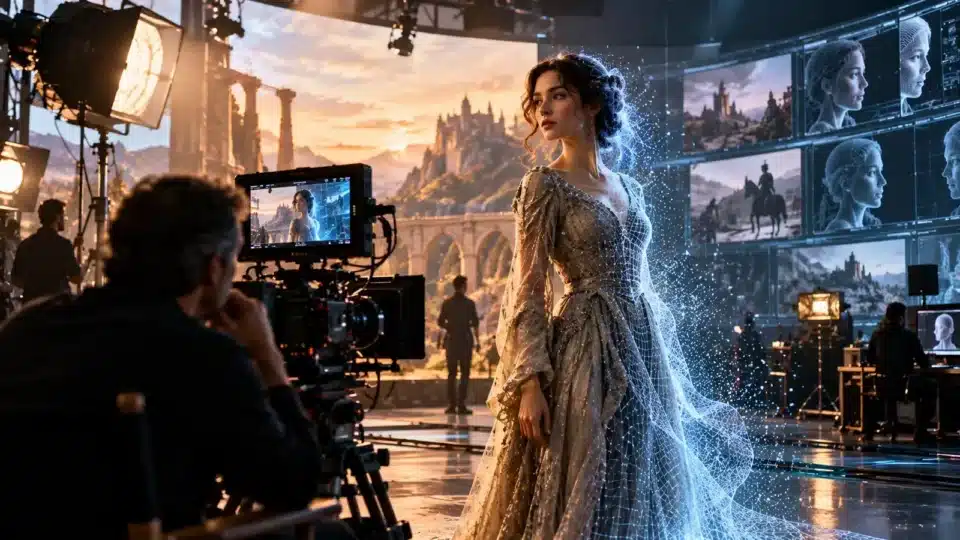
The films that changed special effects are not simply the productions that looked most spectacular in their day. They are the films that materially changed how cinema is made: from camera tricks and painted backdrops to miniatures, animatronics, CGI, motion capture, virtual production and, in 2026, artificial-intelligence-based tools.
The history of special effects is, in fact, the history of a collaboration between art and engineering. Each technological leap emerged when filmmakers tried to shoot something that did not exist, could not be built or could not safely be achieved on set.
The films that changed special effects: from optical tricks to AI
The path from the earliest cinematic illusions to images generated in real time on LED volumes has not been linear. Older technologies have not disappeared altogether. Miniatures, prosthetic makeup, animatronics and practical effects coexist with modern CGI, and the most convincing films often use a combination of them.
The following selection traces several moments that changed cinema’s visual language.
1. Georges Méliès and the beginnings of special effects
At the start of the 20th century, Georges Méliès showed that film did not have to be merely a record of reality. By stopping the camera, using multiple exposures, painted sets and ingenious editing, he created appearances, disappearances and impossible worlds.
Le Voyage dans la Lune (1902) remains one of the foundational images of cinematic effects: the rocket entering the Moon’s eye. The technology was simple by today’s standards, but the idea was revolutionary — the camera could manufacture an alternative reality.
2. King Kong (1933): stop-motion becomes spectacle
King Kong combined stop-motion, miniatures, projection and sets to create a character that could not be filmed in reality. Willis O’Brien and his team animated Kong’s model frame by frame, integrating it with actors through optical techniques.
For audiences of the 1930s, the effect was extraordinary. More importantly, the film showed that an artificial creature could become a central character with dramatic and emotional weight.
3. 2001: A Space Odyssey (1968): realism before CGI
Stanley Kubrick and his team built a convincing space without modern digital graphics. The spacecraft were miniatures filmed with extreme precision, while weightlessness was achieved through rotating sets, mechanical systems and optical compositing.
2001: A Space Odyssey showed that special effects can be invisible precisely because they respect physics and the consistency of light.
4. Star Wars (1977): effects become an industry
For the first Star Wars, George Lucas founded Industrial Light & Magic (ILM) in 1975. The studio developed new motion-control camera methods to film miniature spacecraft dynamically and repeatedly.
The result was not only a visual success. ILM became one of the institutions that defined the evolution of modern visual effects. The company itself describes its work on the original Star Wars series as the moment that radically changed the VFX industry.
5. Tron (1982): the computer enters the centre of the image
Tron was not the first film to use computer-generated imagery, but it made digital aesthetics central to its identity.
Its vehicles, environments and digital sequences showed that mathematically created images could become not merely supporting effects, but part of the narrative world.
The film anticipated a shift that would become dominant a decade later.
6. The Abyss (1989): a major step towards convincing CGI characters
The water pseudopod in The Abyss, created by ILM, is one of the first well-known examples of a photorealistic CGI object integrated into a live-action film.
The sequence was relatively short, but technologically significant: its reflective surface and fluid movement showed that computer graphics could interact convincingly with actors and real sets.
7. Terminator 2 (1991): CGI becomes a character
ILM describes Terminator 2: Judgment Day as a major milestone in computer graphics and one of the first films in which a principal character was created, at least partly, through CGI.
The T-1000, with its liquid-metal body, could pass through bars, copy people and re-form after impacts. The effects were not merely decorative; the character’s digital properties were part of the story.
The film won the Oscar for visual effects.
8. Jurassic Park (1993): the moment audiences believed in CGI
Jurassic Park is one of the industry’s major turning points. The Academy of Motion Picture Arts and Sciences describes it as a landmark that bridged the transition from stop-motion to modern CG animation.
The original plan was to use more stop-motion, but tests involving computer-generated dinosaurs were so convincing that the production changed direction.
The key was not abandoning practical effects. The digital dinosaurs were combined with animatronics created by Stan Winston and with real sets. That combination made the images convincing.
9. Toy Story (1995): the first fully 3D-animated feature
Toy Story showed that an entire feature-length film could be built from three-dimensionally rendered computer characters and environments.
Its impact on animation was immense. Following Pixar’s success, the industry accelerated its transition from traditional 2D animation to digital 3D production.
10. Titanic (1997): miniatures, real water and digital effects in one system
Titanic matters for the way it combined practical and digital effects. The ship was recreated through enormous sets, miniatures, digital extensions and simulations.
Deck sequences also used digital characters in shots where using real stunt performers would have been impossible or dangerous.
The film showed that CGI works best when audiences do not know exactly where it begins and ends.
11. The Matrix (1999): “bullet time” changes the visual language
The bullet time sequences in The Matrix became instantly recognisable. The actor appeared almost frozen while the camera moved rapidly around them.
The effect combined numerous still cameras triggered in sequence, digital interpolation and compositing. It was not simply a striking trick; it became a new kind of visual grammar, later copied in advertising, games and other films.
12. The Lord of the Rings: Gollum and performance capture
The Lord of the Rings trilogy changed perceptions of digital characters through Gollum. Andy Serkis’s performance provided the basis for animating a fully digital character capable of carrying complex emotional scenes alongside live actors.
The Academy recognised the trilogy’s visual effects, and the development of motion capture and performance capture during that period had a major influence on subsequent productions.
13. Avatar (2009): the digital world becomes a film set
James Cameron took performance capture and virtual production to another level with Avatar. The actors provided not only body movement, but much of the facial expressiveness used for the Na’vi characters.
Using virtual tools that anticipated modern real-time production, the director could see an approximation of the digital environment while filming.
Avatar reinforced the idea that actor, camera and digital world can work together on set, rather than separately in post-production.
14. Gravity (2013): digital light and virtual movement
Gravity combined animation, CG environments and highly precise lighting systems to create the impression of filming in space.
In many sequences, the “real” part of the frame was mainly the actor’s face, while the suit, environment and camera movement were generated or controlled digitally.
The film showed how difficult it can sometimes be to separate traditional cinematography from visual effects.
15. Interstellar (2014): when science becomes a visual effect
Interstellar stands out for its combination of physical miniatures, film photography and advanced mathematical simulations.
Its depiction of the black hole Gargantua was built with models inspired by relativistic physics, and the result proved interesting enough to generate scientific papers on black-hole visualisation.
16. Mad Max: Fury Road (2015): practical effects return in force
At a time when CGI dominated blockbusters, Mad Max: Fury Road demonstrated the force of real stunts and vehicles.
A large part of the action was physically staged, while digital effects were used for compositing, removing safety elements, extending environments and visual adjustments.
The film became a strong argument for the idea that VFX need not replace reality, but can amplify it.
17. The Jungle Book (2016) and The Lion King (2019): live action without the real world
The Jungle Book, and especially The Lion King, pushed virtual production towards a paradox: films that resemble documentaries shot with real cameras even though much of the image is digital.
The teams used virtual tools similar to those used in video games to select lenses, camera positions and movements in an environment that did not physically exist.
18. The Mandalorian: StageCraft and LED walls
ILM transformed virtual production through StageCraft, the system widely used for The Mandalorian.
Rather than having actors perform permanently in front of a green screen, digital sets are rendered in real time on LED walls, with their perspective changing according to the camera’s position.
The advantages are significant: actors can see the environment, reflections appear directly on costumes and objects, and some work that would have been done in post-production is moved onto the set.
19. Why practical effects have not disappeared
Even the most digital productions use physical elements. The reasons are straightforward:
- actors can react to real objects;
- lighting and reflections are natural;
- physical movement has small imperfections that are difficult to simulate;
- real stunts can carry a different kind of visual weight;
- miniatures offer highly convincing organic detail.
That is why the question “practical or CGI?” is often the wrong one. The best results emerge when techniques are combined.
20. Artificial intelligence enters the VFX pipeline
In 2026, artificial intelligence is already used at different stages of production: rotoscoping, removing elements from frames, upscaling, interpolation, concept art, previs, generating background elements and assisting animation processes.
This does not mean an AI model has replaced the VFX studio. Major productions continue to depend on artists, supervisors, animators, compositors, technicians and simulation specialists.
In August 2026, the Academy of Motion Picture Arts and Sciences announced that, for its scientific and technical awards, it was investigating, among other areas, markerless facial capture systems — a sign that the industry continues to push performance capture towards less intrusive and more automated tools.
What the 2026 Oscar rules say about AI
The rules approved for the 99th Oscars introduced more explicit language on generative artificial intelligence. The Academy reserves the right to request information about the nature of AI use and human contribution, while the rules for screenplays specify that they must be written by human authors.
For the previous edition, the Academy had already set out the central principle: the use of AI tools neither helps nor automatically harms a film’s chances of nomination; what is assessed is the extent to which the human author remains at the centre of the creative work.
This suggests the industry’s direction: AI is being treated as a tool, while the question of authorship is becoming increasingly important.
Will AI replace CGI?
Probably not in the sense implied by the question. CGI is not a single program, but an ecosystem of modelling, animation, lighting, simulation, rendering and compositing.
AI can speed up certain stages, but productions that must maintain the same character, lighting and geometry from shot to shot need very precise control.
Generating a striking image is different from producing 2,000 consecutive frames that are perfectly consistent, reviewable and integrated into a studio pipeline.
Why AI will still change the economics of visual effects
The impact could be enormous even without eliminating artists. If tasks that once took days can be completed in hours, the cost of certain operations falls.
AI can speed up:
- masking and rotoscoping;
- tracking;
- frame clean-up;
- generating variations for concept art;
- previsualisation;
- markerless facial capture;
- reconstructing details;
- processing filmed material.
But efficiency does not remove the need for artistic control. The more a tool produces automatically, the more important it becomes for someone to decide what is right for the story.
From special effect to complete digital world
In cinema’s early decades, a “special effect” was an isolated moment: a disappearance, an explosion, a creature.
Today, a film can contain thousands of VFX shots. Sometimes almost every frame includes an invisible intervention: removing a wire, replacing the sky, extending a set, correcting a reflection or altering a crowd.
Modern VFX is no longer only about monsters and spaceships. In many productions, the most successful effects are precisely the ones audiences do not notice.
The films that changed special effects had one thing in common
King Kong, Star Wars, Terminator 2, Jurassic Park, The Matrix, The Lord of the Rings, Avatar and modern virtual productions use very different technologies.
But they have the same thing in common: the technology was developed to solve a specific artistic problem.
When the effect becomes an end in itself, the image ages quickly. When technology serves the character, story and world of a film, the effect can remain convincing for decades.
What comes after 2026
The next major leap will probably not be a single spectacular effect, but the closer integration of:
- real-time rendering;
- graphics engines;
- LED volumes;
- markerless facial capture;
- AI-assisted physical simulations;
- digital characters;
- controllable generative tools;
- collaborative virtual production.
Directors will be able to see more and more of the finished result directly on set, while the boundary between pre-production, filming and post-production will become increasingly blurred.
For a view of the next step, InfoBuz has separately examined how close the industry is to a feature film made with AI-generated characters and sets.
Conclusion
The films that changed special effects did not eliminate earlier technologies. They added new tools to them. Stop-motion was followed by CGI, but miniatures remained. Motion capture did not eliminate the actor; it transferred the performer’s work to a digital character. Virtual production did not eliminate the camera; it brought the digital world onto the set.
In 2026, artificial intelligence enters the same history. It will most likely not replace every technique that came before, but become a new layer in a process that combines ever more forms of creation.
For more on artificial intelligence, see also Sam Altman and AI security: what happens when artificial intelligence finds software vulnerabilities faster than humans, which offers complementary details on the subject.
The lesson of the past century remains the same: audiences are not impressed for long by technology on its own. They are impressed when technology makes them believe, even for a few minutes, that the impossible is real.
Frequently asked questions
Which film revolutionised CGI?
There is no single answer. The Abyss and Terminator 2 demonstrated the potential of CGI characters and surfaces, while Jurassic Park convinced the industry that photorealistic digital characters could play a central role in a blockbuster.
Was Jurassic Park made entirely with CGI?
No. The film combined ILM CGI with animatronics and practical effects made by Stan Winston’s team. It was precisely this combination of techniques that made the dinosaurs so convincing.
What is motion capture?
Motion capture records a performer’s movement and transfers it to a digital character. Performance capture extends the process to facial expressions and other details of the performance.
What is virtual production?
It is a set of techniques through which digital environments, virtual cameras, graphics engines and sometimes LED walls are integrated directly into the filming process.
Will AI replace VFX artists?
AI can automate certain operations, but complex productions require artistic control, continuity, technical integration and human decisions. In 2026, the trend is towards integrating AI into the pipeline rather than complete replacement.
Sources: Industrial Light & Magic — history and evolution of VFX; ILM — Terminator 2: Judgment Day; Academy of Motion Picture Arts and Sciences — Jurassic Park; Academy — rules for the 99th Oscars; Academy — scientific and technical investigations for 2026.




Discuția cititorilor
Ai o opinie sau o întrebare despre acest articol? Spune-ne ce crezi.
Fii primul care deschide discuția.
Te rugăm să păstrezi un limbaj civilizat și să discuți la subiect. Comentariile spam sunt filtrate automat.