
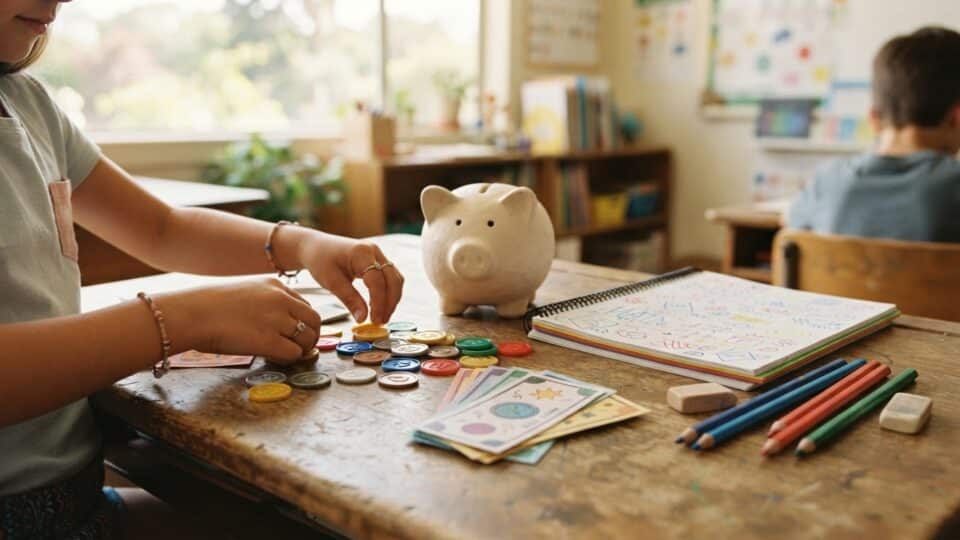
Financial education for Years 1–2 is about far more than learning about coins: children can understand needs and wants, small budgets, saving and responsible shopping through games that do not involve real money. This InfoBuz guide offers lessons, worksheets and practical exercises for parents and primary-school teachers.
Financial education for Years 1–2: why it starts with play
At seven or eight, children do not need stock-market charts, loans or investment strategies. They need to understand that money is limited, that one choice can sometimes mean giving up another, and that a price differs from the value an object has for them. These ideas can be taught through play, conversation and calculation exercises.
The aim of financial education in the early primary years is not to turn a child into a “little entrepreneur”, but to develop independence, patience and the ability to plan. Activities should be adapted to the child’s actual reading and numeracy level, without comparisons between families’ financial means.
What skills are realistic at this age
Pupils can recognise common coins and banknotes, add simple amounts, compare small prices and explain the difference between a need and a want. In Year 2, they can practise simple budgets, change when shopping and saving for an item they want. Complexity should increase gradually, at the child’s pace.
The financial competence framework for children and young people developed by the EU and OECD covers money and transactions, planning, risk and the financial environment. These areas should be translated into age-appropriate activities, rather than taught as an adult textbook. Source: EU/OECD – Financial competence framework.
Money is a tool, not a reward for a person’s worth
Explain that people use money for goods and services, but that affection, friendship and respect cannot be bought. A child may live in a family with variable income; exercises should avoid shaming or public questions about the household budget.
In the classroom, use play money and fictional scenarios. Do not ask pupils to say how much their parents earn or how much their home costs. Teachers can discuss financial choices without disclosing private information about families.
Recognising coins and banknotes
Start by identifying 1, 5, 10 and 50 bani coins, then common banknotes. A child can sort coins by value, put them in order and make the same total in several ways. For safety and hygiene, use play reproductions that are clearly distinct from real banknotes.
For example: “How can we make 1 leu using 50 bani coins?” Two 50 bani coins make 1 leu. The child can then find other combinations, according to their abilities. Avoid introducing too many values at once, since the aim is understanding rather than rote memorisation.
The shop game: price, payment and change
Set up a fictional shop with classroom items labelled at 2, 5, 7 and 10 lei. One pupil plays the shopkeeper and another the customer. The customer chooses an item and offers play money; the shopkeeper calculates the change. Swap roles at the end.
For Year 1, use whole amounts and operations pupils already know. For Year 2, you can introduce two products and a budget limit. Ask: “Do you have enough coins?”, “How much do you have left?” and “Is there another combination?” Assessment should focus on the thinking process, not speed.
Needs versus wants: the two-baskets exercise
Prepare cards showing water, bread, clothes suitable for the season, a new game, a cinema ticket and other neutral examples. The child divides the cards into two groups: things we need and things we want. Then discuss why a want can be legitimate without being urgent.
Do not turn the game into a moral judgement: a book can be both an educational need and a personal want; a leisure activity can be important for wellbeing. Explain the difference through context and priorities, not rigid rules.
The 20 lei budget: learning to choose
Offer an imaginary budget of 20 lei and a fictional list: pencil, 3 lei; notebook, 7 lei; small book, 12 lei; stickers, 4 lei. The child chooses what to buy without exceeding the budget. Several combinations may be correct.
After the calculation, ask what they would do if an item were no longer available or its price changed. The aim is to understand that a plan can be adjusted. For children still practising addition, use drawn coins or a number line.
Saving for an item you want
Choose a fictional item costing 30 lei. If the character in the game puts aside 5 lei a week, they will have the required amount after six weeks. Draw six boxes to colour in gradually; the child can see progress without abstract ideas about interest.
Explain the difference between saving and never buying anything. Planning means consciously choosing the right time. Children should not be required to give up every small pleasure for a lesson in patience.
Why the same product can have different prices
Show two fictional offers for the same notebook: 6 lei in one place and 8 lei in another. Ask why someone might still choose the more expensive option: the shop is closer, has different opening hours or includes a service. Not every price difference means someone is being deceived.
In Year 2, pupils can compare two products and the number of items in each package, using numbers that are easy to calculate. Discuss checking quality and the real need, so they do not learn that “the cheapest” is always best.
Advertising and the desire to buy
A favourite character, a toy seen in a video or an offer with a countdown can create pressure to buy quickly. Children can learn to delay a decision and ask whether they would still want the product the next day.
The “24-hour pause” exercise is a game rule for non-essential purchases: draw the desired item and come back to it tomorrow. Do not apply it mechanically to genuine needs; its purpose is to recognise impulse purchases.
Donating, sharing and generosity
Financial education is not only about accumulation. Some lessons can address responsible sharing, helping others and caring for shared property. Use situations in which characters can contribute time, objects or play money, without putting pressure on children.
Avoid assessing generosity by the amount given. A child should understand that every family has different means and that respect for others is not measured financially.
Explaining digital money without real accounts
Pupils see people paying by phone or card and may think money “does not run out” because they do not see banknotes. Use the analogy of an invisible wallet: when you buy something, an amount is deducted from the money available, even if you do not count it physically.
Pupils do not need to use their own card to understand transactions. For young primary-school children, a game using tokens on a worksheet is enough, and avoids exposing bank details or the family’s real transactions.
Keeping money and personal data safe
Explain in child-friendly terms that a PIN, password and codes received on a phone must not be shared with anyone else. If someone in a game promises prizes in exchange for data or money, the child should stop and ask a trusted adult for help.
Do not make children responsible for their family’s financial protection. Adults set payment limits and access controls; children practise recognising situations in which they should ask before acting.
Year 1 worksheet: three exercises
Exercise 1: draw two 50 bani coins and ask what amount they make. Exercise 2: Ana has 10 lei and buys a pencil for 4 lei; how many lei does she have left? Exercise 3: a pupil wants a notebook and a sticker; discuss what should be bought first if there is enough money for only one item.
Answers: 1 leu, 6 lei, and for the third question there is no single mathematical answer. These exercises combine simple calculations and reasoning. Teachers can adapt the numbers to the curriculum and the level of the class.
Year 2 worksheet: the trip budget
The character in the game has 25 lei. They need water costing 4 lei and a sandwich costing 9 lei, and want a postcard costing 6 lei. The pupil calculates a total of 19 lei and 6 lei in change. An additional challenge could involve choosing between two souvenirs within the amount remaining.
Then discuss what would change if the sandwich cost 11 lei or if the character brought water from home. The exercise develops flexibility and replanning, not only the completion of an addition.
How to assess progress without stressful grades
Observe whether the pupil can explain why they chose a product, can check the total and recognises that money is limited. A pupil who corrects their own calculation is making progress, even if the first attempt was wrong.
Encourage spoken explanations, drawing and role-play. Do not compare pupils publicly according to how much they save or what their families can afford. For inclusion, all scenarios can use fictional money.
A plan for four 20-minute lessons
Lesson 1: recognising money and making amounts. Lesson 2: the classroom shop and calculating change. Lesson 3: needs, wants and a small budget. Lesson 4: saving, advertising and digital-money safety. The lessons can be delivered at home or in the classroom.
Each begins with a familiar situation, continues with a team game and ends with a reflection question. Activities need not involve real transactions and can be adapted for pupils who learn at different paces.
Common mistakes when teaching about money
Do not introduce loans, compound interest and investments before pupils understand simple transactions. Do not tie every household task to a financial reward, and do not use money to measure love or discipline. Avoid suggesting that poverty is always the result of poor choices.
Teach pupils that financial decisions are made in different contexts, and that people have varying responsibilities and resources. At this age, financial education should build skills, not anxiety.
Frequently asked questions
Is Year 1 too early for a budget? No, if the budget is a game with small numbers. Do I have to give them pocket money? Not necessarily; you can use only fictional money. How do I explain card payments? As an amount deducted from a digital wallet.
Should I grade the exercises? Understanding and participation are more important. Can this be done at home? Yes, through simulated shopping and conversations about everyday choices, without revealing the family’s actual budget.
Recommended articles for further reading
For further details, also read Twelve financial education lessons for children, a companion guide published by InfoBuz.ro.
For further details, also read Financial education for teenagers, a companion guide published by InfoBuz.ro.
Sources and pedagogical basis
This guide draws on the EU/OECD European financial competence framework for children and young people (2023). The numerical exercises are original InfoBuz examples, designed to be adapted to pupils’ level. For other educational materials, visit InfoBuz.ro.
Editorial review: 22 November 2026. This material does not prescribe official curriculum content and does not replace the curriculum or teachers’ pedagogical decisions.


Discuția cititorilor
Ai o opinie sau o întrebare despre acest articol? Spune-ne ce crezi.
Fii primul care deschide discuția.
Te rugăm să păstrezi un limbaj civilizat și să discuți la subiect. Comentariile spam sunt filtrate automat.