
Updated: 27 October 2026 la 00:12. Articolul a fost revizuit pentru a reflecta informațiile disponibile la această dată.
Dobruja beyond the coast is one of Romania’s most surprising travel destinations. Within a few hours, visitors can move from the walls of a Greek fortress to settlements on the Danube, then on to limestone terrain, steppe and villages where Romanian, Turkish, Tatar and Lipovan traditions coexist. This is a region whose stories neither begin with a sun lounger nor end at the beach boundary.
For more information on tourism in Romania, see Secret Romania: 20 spectacular, little-known places worth discovering, which offers complementary details on the subject.
We selected 12 sights and areas to explore in Constanța and Tulcea counties, outlining their history, what is worth noticing and the practical visiting conditions. This includes the opening hours of MINAC museums during the cold season, from 1 October 2026 to 30 April 2027, the rules of Măcin Mountains National Park and permits for the Danube Delta Biosphere Reserve. For other sites, where schedules may vary, we identify the administrator and advise checking in advance.
InfoBuz research date: 26 October 2026. Prices and timetables may change. The routes are travel suggestions, not real-time journey-time estimates; follow signs and access rules.
Dobruja beyond the coast: an editorial map of 12 destinations
| Site | County | What you will find |
|---|---|---|
| Enisala medieval fortress | Tulcea, near Lakes Razim and Babadag | medieval history |
| Histria museum complex | Constanța, towards Lake Sinoe | Greek and Roman archaeology |
| Capidava fortress | Constanța, on the Danube | Roman and Byzantine fortification |
| Tropaeum Traiani and the Adamclisi fortress | Constanța, Adamclisi | Roman monument and ancient site |
| Măcin Mountains and the Greci area | Tulcea, western part of the county | hiking and geology |
| Dobruja Gorges | Constanța, Târgușor–Cheia area | limestone landscape and biodiversity |
| Carsium fortress and Hârșova | Constanța, on the Danube | the history of frontiers |
| Hamangia Centre / Axiopolis Museum | Constanța, Cernavodă | archaeology and prehistoric civilisations |
| Early Christian monument at Niculițel | Tulcea, Niculițel | archaeology and religious history |
| Babadag and its multicultural heritage | Tulcea, Babadag | Turkish-Tatar and urban heritage |
| Jurilovca and the Lake Razim landscape | Tulcea, towards the Razim–Sinoe lagoons | fishing village and local food |
| Murighiol–Dunavăț area and the Delta’s edge | Tulcea, southern Danube Delta | nature and responsible wildlife watching |
12 striking places in Dobruja, described for a well-planned visit
1. Enisala medieval fortress
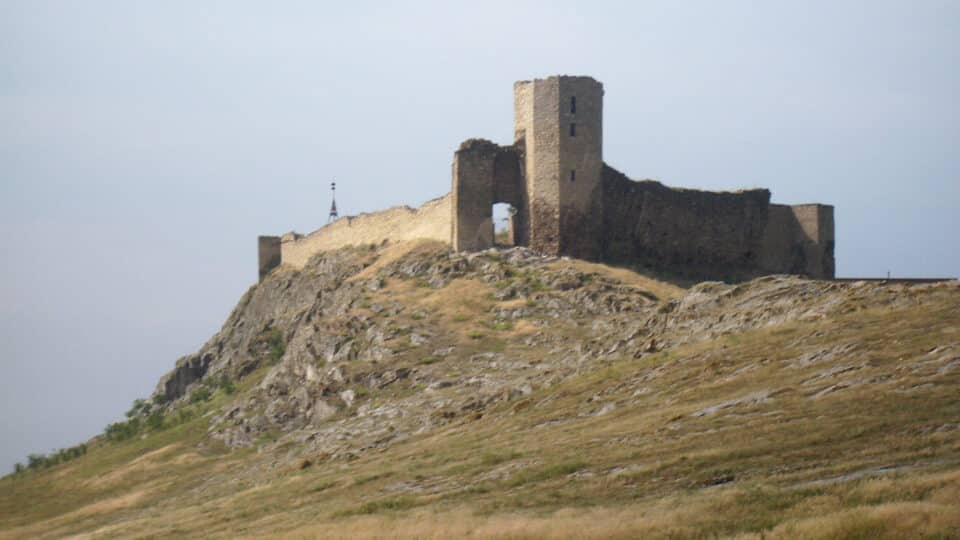
On a limestone hill near the village of Enisala stand the walls of a fortification from the second half of the 14th century, most likely built by Genoese merchants to control maritime and overland routes. This is not a decorative castle, but a place where visitors can understand changing patterns of trade and power around the Danube mouths. Its position overlooks the lakes and affords one of Dobruja’s finest panoramas.
Access and advice: ICEM Tulcea lists access via county road DJ223A and opening hours of Tuesday to Sunday, 8am–4pm; it is closed on Mondays. Check for events, weather and admission prices before setting out; wet stone can be slippery.
2. Histria museum complex
At Histria, founded in antiquity by Greek colonists, the city ruins and museum artefacts offer a detailed account of how communities developed along the ancient Black Sea shore. The Lake Sinoe landscape is a reminder that the coastline has changed over the centuries. For a worthwhile visit, look beyond photographs of the walls: follow the chronology, public spaces, traces of habitation and the relationship between the harbour and its natural setting.
Access and advice: According to MINAC, during the cold season of 1 October 2026–30 April 2027, the complex is scheduled to open daily from 9am to 5pm. Hours may change for specific circumstances.
3. Capidava fortress
Capidava reveals Dobruja from the river rather than the beach. The Danube fortification, with ancient and medieval phases of settlement and defence, formed part of a system for controlling movement and frontiers. Visitors can see the relationship between its walls, towers and the strategic riverside position. The interpretation merits a few minutes of reading; otherwise, the fortress may appear to be little more than a collection of restored stonework.
Access and advice: MINAC’s official cold-season timetable is Wednesday to Sunday, 9am–5pm. Check access before travelling, and do not confuse the museum area with other Danube-bank locations where entry may be restricted.
4. Tropaeum Traiani and the Adamclisi fortress
The Tropaeum Traiani monument commemorates conflicts from the early second century, while the nearby fortress traces the later history of local communities. It is useful to see the two sites together: one is a commemorative monument, the other an urban space with distinct phases of use. Explanations of the sculptures, inscriptions and restorations help distinguish original pieces from reconstructions.
Access and advice: The MINAC complex is open daily from 9am to 5pm during the cold season. Confirm the route between the sites and the availability of exhibitions before leaving.
5. Măcin Mountains and the Greci area
The low Măcin Mountains have an identity entirely different from that of the Carpathians: ancient rocks, rounded outlines and woodland interspersed with open ground make for routes suited to observing the landscape, rather than chasing altitude records. Near the village of Greci, visitors will find information points and access to marked trails. Route duration should be assessed by difficulty, weather and fitness, not by the apparently modest elevation gain.
Access and advice: The park administration publishes updated maps and routes. The listed fee for marked trails is 10 lei per person, valid for two days; guided visits have different booking deadlines during the cold season.
6. Dobruja Gorges
The Dobruja Gorges show that the region offers more than beaches: there is limestone terrain with cliffs, rock formations, steppe vegetation and photogenic views. They matter for geology and nature, not as scenery where every dirt track is automatically a safe path. A careful walk can include observing erosion features, steppe habitats and traces of older geological processes.
Access and advice: Respect the protected area. Do not enter undeveloped or protected caves without permission, and do not climb unstable rock faces. In October, after rain, secondary roads can be difficult to use; check the weather and road conditions.
7. Carsium fortress and Hârșova
Hârșova is an ideal place to understand that the Danube has been both a connection and a frontier, rather than simply a natural obstacle. The Carsium fortress area played an important role in Roman and later defence and movement. First take in the riverside setting, then the exhibits and explanations of settlement life. In that context, each fragment of wall takes on economic and strategic meaning.
Access and advice: MINAC announced daily opening hours of 9am–5pm for the 2026–2027 cold season. Check for any temporary visitor restrictions.
8. Hamangia Centre / Axiopolis Museum
Cernavodă is best known for its bridges and energy infrastructure, but its local museum provides access to Dobruja’s much more distant past, including landmarks of the Hamangia culture. A visit can change one’s perspective on the region: before its ports and fortifications, complex communities existed here, with rituals, everyday objects and artistic expression. Distinguish original artefacts from reproductions and read the exhibition labels carefully.
Access and advice: Between 1 October 2026 and 30 April 2027, MINAC lists Monday–Friday opening hours of 9am–5pm, with weekend visits for organised groups available on request.
9. The early Christian monument at Niculițel
The early Christian monument at Niculițel is a suitable stop for travellers interested in the history of early Christian communities in Dobruja. Its importance lies in the archaeological context and in the way the discovery has been conserved and explained to visitors. A religious interest is not necessary to appreciate its history; the site can be visited with respect for its cultural and spiritual significance.
Access and advice: The site is administered by ICEM Tulcea. Consult the museum page for contact information and to confirm opening hours, especially after the summer season ends.
10. Babadag and its multicultural heritage
Babadag offers an introduction to the historical Dobruja of cultural exchange, with monuments, architecture and stories tied to Turkish and Tatar communities. The mosque and the Museum of Oriental Art can serve as starting points for understanding the region beyond the image of a summer seaside destination. Such a visit requires sensitivity: an active place of worship follows different rules from a museum exhibition, and a community is not an ethnographic backdrop.
Access and advice: Check the Museum of Oriental Art in Babadag’s timetable through ICEM Tulcea. At religious sites, respect dress requirements and prayer times; photography may require permission.
11. Jurilovca and the Lake Razim landscape
Jurilovca can be explored away from the bustle of the summer season through its local architecture, fishing cuisine and the connection between the village and the lagoon system. Community life should not be reduced to a fish restaurant: conversations with residents and permitted walks offer context on fishing, wind, traditional boats and environmental change. Do not assume that all water routes are available outside the season.
Access and advice: For trips into the Danube Delta Biosphere Reserve, check whether an access permit is required on the official DDBRA platform, and use authorised operators only. Conditions on the lake can become difficult in strong winds.
12. The Murighiol–Dunavăț area and the Delta’s edge
At the Delta’s southern edge, water, birds and reed beds create landscapes very different from those of the resorts. Combine a walk through the village with a guided outing on a clearly established route and timetable to watch birdlife without disturbing sensitive areas. The real value of the experience lies in contact with the landscape and an understanding of conservation restrictions, not in aggressive approaches to nesting birds.
Access and advice: Tourist-access permits and permits for boats are separate categories on the DDBRA platform. An access permit does not authorise entry into strictly protected areas or fishing without the necessary permissions.
Three itinerary ideas: history, nature and culture
The fortresses and lakes itinerary
Combine Histria with Enisala and the Jurilovca area on an excursion that explains the links between historic ports, coastal lakes and fishing communities. The precise order depends on your starting point and each site’s opening hours. Do not try to fit every museum in the county into one day: you will lose the most interesting part—the time to read the explanations and notice details.
The Danube itinerary: Capidava, Hârșova and Cernavodă
These three stops connect the history of fortifications with the development of Danube communities. Capidava and Carsium explain defence and transport, while Cernavodă introduces prehistoric themes through the Hamangia culture. It is a route for those interested in archaeology, but weekend availability at the Axiopolis Museum must be confirmed for groups.
A northern weekend: Măcin, Niculițel and Babadag
For a pace that combines nature and heritage, choose a well-researched hike in the Măcin Mountains and two cultural sites. Check the weather first: trails can be slippery in autumn and winter. Do not schedule a long outdoor hike before a museum with short opening hours unless you have enough time.
What access costs: information to check in 2026
Măcin Mountains National Park lists a fee of 10 lei per person for access to marked trails, valid for two days; exemptions apply under its regulations. For guided visits, the administration generally requires advance booking, with a minimum notice period of five days listed for 11 October–14 April. The official fee list is available here. For MINAC archaeological sites, consult the winter timetable published on 1 October 2026 before paying or setting out.
For routes entering the Danube Delta Biosphere Reserve, DDBRA lists separate permits for tourist access, vehicles, boats and recreational fishing. A one-day tourist permit is listed at 5 lei, while some categories are exempt; conditions should be checked when applying. The official platform is permise.ddbra.ro.
What not to do in Dobruja: five rules for responsible travel
- Do not enter undeveloped or access-restricted caves merely for a photograph; there are risks and sensitive habitats.
- Do not collect fossils, rocks or plants from reserves, and do not approach bird nests aggressively.
- Do not turn residents’ properties and homes into tourist attractions without permission.
- Do not climb unstable walls at archaeological sites or cross areas closed for restoration.
- Do not use a drone in protected areas without checking the relevant permits and restrictions.
If you prefer to travel without a car, see InfoBuz’s guide to scenic train travel. For itineraries between smaller settlements, however, check local transport and tour availability, especially outside the main season.
Frequently asked questions about Dobruja beyond the coast
Can I visit Histria and Adamclisi in October or November 2026?
Yes. MINAC has published cold-season opening hours of 9am–5pm daily for both complexes. Check for exceptional notices on the day you travel.
Are the Măcin Mountains suitable for beginners?
There are trails of varying difficulty, but weather conditions and navigation matter. Choose a marked trail suited to your experience and consult the park’s latest information.
Can I go anywhere by boat in the Danube Delta?
No. A permit and route do not remove restrictions in strictly protected areas. Use authorised operators and follow DDBRA rules.
Dobruja is best seen when the beach is not the only destination
Dobruja beyond the coast can be explored through themed weekends, each with a different story: ancient cities, the Danube frontier, multicultural settlements or protected landscapes. These 12 suggestions are not a popularity ranking, but an invitation to informed exploration, with opening hours and access rules checked.


Discuția cititorilor
Ai o opinie sau o întrebare despre acest articol? Spune-ne ce crezi.
Fii primul care deschide discuția.
Te rugăm să păstrezi un limbaj civilizat și să discuți la subiect. Comentariile spam sunt filtrate automat.