
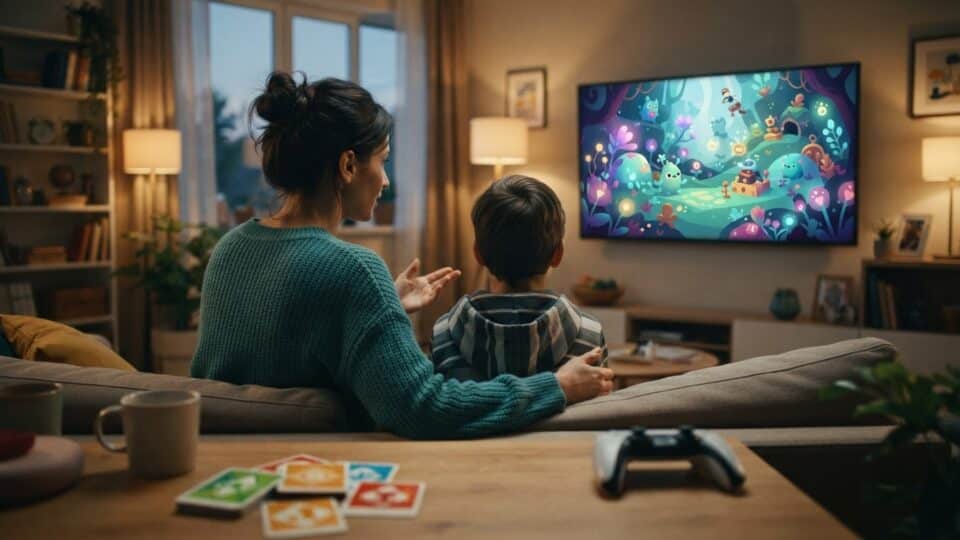
PEGI ratings are the first thing parents should check before buying a video game for a child. But “PEGI 7” does not say how difficult a game is, “PEGI 12” does not guarantee that every online conversation will be suitable, and a label about in-game purchases may conceal spending mechanisms that adults do not notice at first glance. In 2026, the European system made an important change: certain interactive risks — including paid random virtual items — can directly affect an age rating.
This InfoBuz guide, based on official PEGI documentation, explains what the five categories mean, what changed in June and October 2026, how to identify loot boxes, which parental controls are available and what to check before paying. It is a practical resource for parents, not a list of “good” or “bad” games, nor a recommendation that a child should spend a particular number of hours in front of a screen.
PEGI ratings: the five age categories and what they actually tell you
PEGI stands for Pan European Game Information, the European system for classifying video games according to whether their content is suitable for different age groups. A PEGI number does not indicate the intelligence required, the complexity of the controls or how quickly a child will learn to play. Nor does it certify that an app collects no data or poses no online risk. The rating should be read alongside icons describing the type of content and, in 2026, descriptions of certain interactive mechanisms. Source: the PEGI Code of Conduct.
| Label | What it signals, in brief | A practical question for parents |
|---|---|---|
| PEGI 3 | Content considered suitable for all age groups, with strict limits on frightening imagery and language | Can the child use the menus, and are there interactions or purchases? |
| PEGI 7 | Some scenes or sounds may frighten young children; very mild, unrealistic violence may appear | What might frighten the child, and how does the child behave online? |
| PEGI 12 | More explicit unrealistic violence, moderate language or certain sexual innuendo | Does the child understand the context and limits on time and spending? |
| PEGI 16 | Violence or other depictions closer to reality; in 2026, this includes certain games with paid random items | Are there loot boxes, virtual currencies or pressure to buy? |
| PEGI 18 | Adult content: extreme violence, certain sexual depictions or other mature themes | Why is it unsuitable for minors, even if friends play it? |
For official wording and icons, see PEGI’s Romanian-language page directly. When content changes through updates or a game appears on a different platform, check the specific database entry rather than relying only on an old photograph of the cover.
Why PEGI 12 does not mean “a game for a 12-year-old, with no further checks needed”
A game may be suitable in terms of visual depictions yet still have competitive chat, an aggressive community, repeated transactions or events that encourage daily log-ins. A child may be mature enough for the story but vulnerable to requests for money or messages from strangers. Conversely, a game with an age-appropriate rating may be too complex in its interface or require coordination and reading beyond the child’s level. An age rating is a necessary filter, not a complete assessment of the experience.
Before making a purchase, parents should do three separate things: read the rating, check the descriptors and examine the online functions and monetisation model. A screenshot showing PEGI 7, without a product description and the store where it is sold, may leave out decisive information.
The 2026 PEGI change: it is no longer only visual content that is assessed
On 12 March 2026, PEGI announced an expansion of its classification criteria, applicable to games newly submitted from June 2026. The new approach explicitly addresses risks associated with interactive features: paid random items, time-limited offers, mechanisms that reward repeated log-ins and communication without sufficient safeguards. It is important not to say that every game released before June was instantly reclassified; the process and the categories of games concerned are defined in official announcements. Source: PEGI, 12 March 2026.
Loot boxes and surprise packs: what is a “paid random item”?
In some games, a child can pay with real money or purchased virtual currency for an item whose identity is unknown before the transaction. It may be a cosmetic item, a digital card or an in-game advantage. That uncertainty — you pay but do not know exactly what you will receive — is the essence of the mechanism called paid random items. Not every in-game purchase is a loot box; if a player receives a specific item known before purchase, it is a different kind of offer.
Under PEGI criteria applied from June 2026, newly submitted games that include paid random items are rated PEGI 16 or, in the case of certain social casino games, PEGI 18. This does not mean that every game with a simple virtual currency is automatically PEGI 16. The details of the mechanism and the product matter. Source: PEGI — Interactive risk descriptors.
Countdown offers and urgent purchases
A game may display an item available to buy “only for the next two hours” or “today only”. These tactics create pressure to make a quick decision, especially when the item is linked to popularity within a group of friends. PEGI generally classifies such offers at least PEGI 12, with the possibility of a lower category in the specific circumstances described by PEGI, where integrated parental controls are available and spending is disabled by default. Do not confuse this mechanism with an ordinary discount on a game bought in a store.
Daily rewards and pressure to return
“Log in for seven consecutive days and receive a prize” may seem like a harmless challenge. But when a game makes progress or certain rewards conditional on regular log-ins, it creates an incentive that may affect a child’s routine. From June 2026, PEGI includes pressure to play features in its criteria: certain recurring rewards are associated with PEGI 7, while losing advantages for failing to log in on time can lead to PEGI 12. These thresholds are classification criteria, not recommendations for daily use.
Chat without blocking or moderation: a risk that changes the rating
A multiplayer game may allow voice conversations or messages between people who do not know one another. Many games offer options to report, block or disable chat, or provide moderation. Where these safeguards are absent and communication is unrestricted, the new PEGI descriptor can lead to a PEGI 18 rating. For parents, the key question is not simply “does it have multiplayer?” but “can the child block or report someone, turn off communication, and who moderates it?”
October 2026: reclassification of some existing games
PEGI announced a separate phase on 6 October 2026. The system began updating the ratings of a selection of digitally distributed games, already classified PEGI 3, 7 or 12, that contain paid random items. These titles are to be reclassified as PEGI 16 with the relevant descriptor. The changes are being introduced gradually in participating digital stores, rather than appearing simultaneously everywhere. Source: PEGI — Updates Age Ratings of Existing Games with Paid Random Items.
Parents may therefore temporarily see different ratings for a game in screenshots, older articles and the current store. Before making a purchase, search for the exact title and the version for your platform in the official PEGI database. An online video is not a substitute for the classifier’s current information.
PEGI icons: violence, fear, language, gambling, sex and drugs
The large number on the cover is only the beginning. Descriptors indicate what prompted the rating: depictions of violence, bad language, frightening imagery, references to drugs, sexual content or gambling-like mechanisms. A PEGI 16 rating can have entirely different reasons from one title to another; without the descriptor, the label does not explain what a child will encounter.
| Descriptor or feature | What to look out for | Question to ask |
|---|---|---|
| Violence | How realistic and intense the depiction is | How does the child react to these scenes? |
| Fear / horror | Sounds, imagery and emotional tension | Does it affect the child before bedtime? |
| Language | Swearing, insults and innuendo | Is there also chat with other players? |
| In-game purchases | Currency, items, subscriptions and random packs | Can they be bought without an adult’s approval? |
| Pressure to play | Temporary rewards and daily log-ins | Can the child take breaks without stress? |
| Unrestricted communication | Insufficient limits on contact with strangers | Can conversations be disabled, blocked and reported? |
Five checks before buying a game for a child
- Check the exact product in the PEGI catalogue: name, platform, edition and current rating.
- Read the descriptors, not just the number: violence, fear, language, chat, purchases, random items and limited-time offers.
- Check the payment model: free to install does not necessarily mean free to use; look for subscriptions and virtual currencies.
- Set parental controls before the first session: purchase blocking, a PIN, communication permissions, schedules and app rules.
- Talk about the game: ask what attracts the child to it, who they play with and what they would do if someone asked for money, personal data or to move the conversation to another app.
Parental controls: what you can set up on console, phone and PC
Parental controls are not identical on every device, but the main console and phone systems allow age restrictions, purchase approval, time limits and interaction settings. PEGI publishes platform-specific guides for PlayStation, Xbox and Nintendo consoles, Android devices, iPhones and iPads, and computers. Features may vary by system version and country; check your device’s current menus rather than blindly following old screenshots.
The financial-safety rule: payments should not be an automatic click
Try to keep the adult account, payment method and child profile separate. For a young child, in-game purchases should require the approval of a responsible adult. If there is an option to require a password or approval for every payment, enable it and check that it works. A spending cap can help, but it does not replace a discussion about the pressure of offers and the fact that virtual currencies represent real money.
The social-safety rule: not every friend in a game is a real friend
In a game with chat, a child may receive messages, invitations to other servers or requests for photographs, a telephone number or login details. The practical recommendation is to limit conversations with strangers, report inappropriate messages and ask for help without fear of an automatic punishment. For a broader approach, also read InfoBuz’s analysis of online misinformation affecting children and how to verify images.
What if everyone at school is playing a PEGI 18 title?
Social pressure exists: children may think that if a title is popular on YouTube, Twitch or in class, it is automatically suitable. It is not. For a game rated PEGI 18, the reasonable message is that the product has been assessed as intended for adults, and popularity does not change its content. There is no need for an abstract discussion about “censorship”: show what the category means, why it was assigned and which alternatives with suitable content are available.
For example, a heavily publicised title may contain violent scenes or sexual themes even if some clips shared online show only the exploration of a virtual world. InfoBuz has a separate piece on GTA VI; for a purchase decision, however, the official rating of the specific version matters, not only trailers and reactions on social media.
Why two versions of the same game may display different information
A console edition, a mobile version and an updated digital product may include different functions, additional content or a different reclassification timetable. Digital stores may also use IARC-based classification procedures adapted to the large volume of apps. PEGI separately explains its processes for physical games and digital distribution. Do not treat a discrepancy between two images as automatic evidence of fraud; check the version, date and official page. Source: How PEGI rates games.
A short family guide: a simple agreement before installation
Rather than vague prohibitions, a verifiable agreement tailored to the child’s age works better: the child asks permission before installing a game; the parent checks the rating and descriptors; purchases are approved; time is negotiated around school and sleep; and unpleasant conversations are reported straight away. The agreement can be reviewed as the child grows and learns to manage independence, money and online relationships.
| Situation | Possible family rule | How to check it |
|---|---|---|
| New game | Check PEGI first, then install it | Official catalogue and store |
| In-game purchases | No payment without adult approval | PIN and store settings |
| Online chat | Limited contact, with blocking and reporting enabled | Parental controls and a practical test |
| Breaks | An agreed schedule, including no screens before bedtime | Device schedule and regular discussion |
| Problems in a game | The child can ask for help without fear | Conversation, reporting and proportionate measures |
Frequently asked questions about PEGI ratings
Does PEGI 7 mean a seven-year-old can use every feature of the game?
No. The category concerns the suitability of content and certain assessed features; parents should separately control purchases, chat, access to other apps and playing time.
Does PEGI 16 automatically mean graphic violence?
No. In 2026, certain paid random-item mechanisms can result in PEGI 16 even where this is not the game’s main visual feature. Check the specific descriptors.
Have all games with loot boxes become PEGI 16?
Not without qualification. The new criteria apply to games newly submitted to PEGI from June 2026, while in October PEGI announced the gradual reclassification of a selection of existing digitally distributed titles. Check the product’s current entry.
Can you find the rating without a physical box?
Yes. The PEGI database and app allow searches by game and platform. For mobile apps, also check the classification system displayed by the digital store.
How much time is healthy for a child to spend playing?
PEGI does not set a universal medical duration. A schedule should take account of age, sleep, school, physical activity, relationships, the child’s condition and specialist advice, rather than being inferred from a number on a label.
Conclusion: a PEGI rating is the start of the decision, not the end
In 2026, PEGI classification became more relevant to the realities of children’s digital lives: it no longer concerns only scenes in a game, but also some purchasing mechanisms, pressure to return and communication risks. Yet no icon can replace the fundamental question: what will the child actually do in that game, and how much control do they have over payments, contacts and time spent there?
The most useful combination is an up-to-date official rating + descriptors + parental controls + ongoing dialogue. This means parents do not need to know every game in the world to make informed decisions.
Official sources and methodology
- PEGI — What the age labels and descriptors mean.
- PEGI — 12 March 2026: expanded criteria for interactive risks, applicable from June 2026.
- PEGI — 6 October 2026: updating ratings of selected existing games with paid random items.
- PEGI — official game search database.
- PEGI — parental-control tools across platforms.
- PEGI — how physical and digital games are classified.
InfoBuz editorial note, 23 November 2026: ratings for existing games may be updated. This guide describes PEGI rules known at the time of writing and does not assign a particular rating to a title without checking its specific catalogue entry. The table descriptions are explanatory summaries; consult the official source before making a final decision.


Discuția cititorilor
Ai o opinie sau o întrebare despre acest articol? Spune-ne ce crezi.
Fii primul care deschide discuția.
Te rugăm să păstrezi un limbaj civilizat și să discuți la subiect. Comentariile spam sunt filtrate automat.