
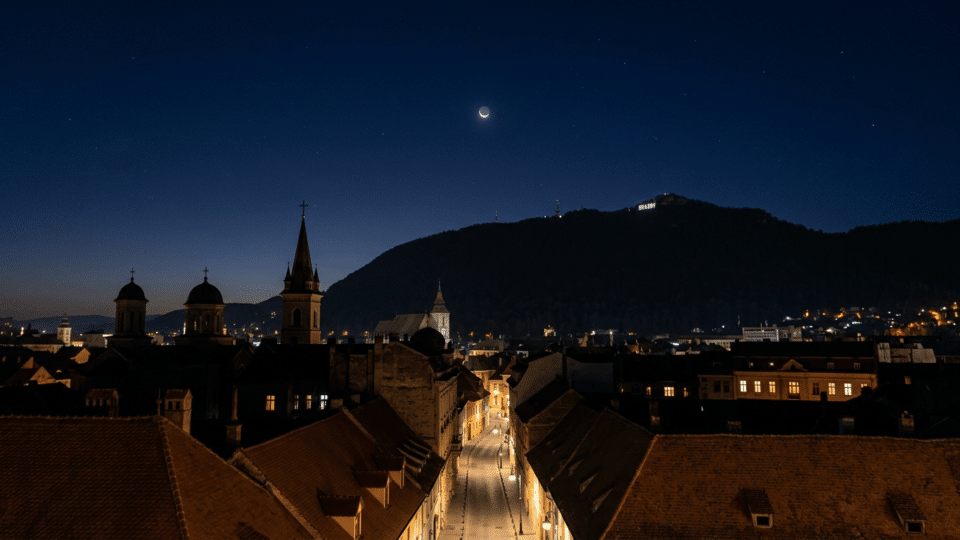
The New Moon on 9 November 2026 occurs at 09:02 Romania time. The moment is calculated as 07:02 UTC by the U.S. Naval Observatory; Romania will be on standard EET time, UTC+2, meaning the difference is two hours.
In brief: this is a precise astronomical marker, not evidence that people will experience change in any particular way. In the entertainment framework of a horoscope, the New Moon can serve as a prompt for a quiet beginning: an idea tested before it is announced, a boundary stated before it becomes a conflict, or a habit adjusted before it turns into a grand promise.
In Western astrology, the moment is placed in Scorpio in the tropical zodiac. This denotes a symbolic 30-degree sector measured in relation to the equinoxes and solstices, rather than the astronomical constellation Scorpius. For this article, the Scorpio theme is cautiously rendered through questions about boundaries, shared resources, things left unclear, and habits that consume more than they give.
New Moon, 9 November 2026: what is visible in the sky and what remains interpretation
Astronomically, a New Moon is the moment when the Moon and Sun have the same apparent ecliptic longitude. The Moon’s illuminated side faces largely away from Earth, which is why the lunar disc is generally not visible. The U.S. Naval Observatory explains this in detail.
The date and time of the phase should not be confused with either the first visible crescent or an eclipse. Crescent visibility depends, among other factors, on the Moon’s age, its apparent distance from the Sun, its position in the sky, the horizon and the weather. A crescent may become visible later, but there is no general guarantee for a particular location or evening.
The Admiral Vasile Urseanu Astronomical Observatory confirms in its calendar that the New Moon phase falls on 9 November 2026. In tropical astrological interpretation, Astrodienst’s ephemeris places the New Moon in Scorpio at around 16°53′. This degree belongs to an astrological convention; it does not describe a demonstrated physical influence on personal choices.
Research does not support using zodiac signs or lunar phases to make certain predictions about wellbeing, behaviour or personal events. For example, a 2024 study published in Kyklos, based on a US sample of 12,791 respondents, found no robust associations between Western zodiac signs and the wellbeing indicators it examined. The interpretations below are therefore exercises in reflection and entertainment, not advice on health, investments, legal proceedings, resignations or other important decisions.
A beginning that does not need an announcement
The practical idea behind this horoscope is simple: starting something does not necessarily mean declaring it. In the days after 9 November, choose one thing that can be tested on a small scale and one condition by which to judge it. Not “I will make a change,” but “I will try this approach for a week and see whether it reduces one specific problem.”
For more on November 2026, see The Leonids in November 2026: a night sky and 12 questions for the zodiac, which offers complementary details on the subject.
The next lunar marker is the First Quarter on 17 November 2026, at 13:48 in Romania (11:48 UTC). It is neither a cosmic deadline nor a date by which a plan must succeed. It may, however, be a reasonable day to ask: do I continue, simplify or stop the test?
For a closer look at why general statements can seem highly personal, see InfoBuz’s article on the Barnum effect in horoscopes. Here, the value lies not in a promise about the future, but in the precision of the question you choose to ask yourself.
New Moon horoscope for all zodiac signs
Aries — test a pace that does not depend on hurrying
Area: how you begin tasks that irritate or bore you. Small step: choose one activity and start with 15 minutes without notifications, three days in a row. Question: “What exactly am I trying to solve through speed?” Check: see whether you have fewer restarts and errors, not simply whether you started sooner.
Taurus — set a clear limit on costly comfort
Area: a habit that brings immediate comfort but uses up time, space or energy. Small step: set a specific limit for one week, without giving up the habit altogether. Question: “What am I keeping for pleasure, and what am I keeping only through inertia?” Check: note whether the limit produces a real sense of lack or merely the discomfort of change.
Gemini — see whether a conversation needs fewer words
Area: a message, negotiation or explanation left unresolved for too long. Small step: write in three sentences what you are asking for, what you can offer and when you need an answer. Question: “What important information am I hiding in an explanation that is too long?” Check: see whether you receive a clearer answer than before.
Cancer — test a rule to protect your personal time
Area: your availability for other people’s requests. Small step: delay responding to one non-urgent request until you have checked your own schedule. Question: “Where do I confuse care with a permanent obligation?” Check: notice whether a delayed response creates a real problem or only your own sense of guilt.
Leo — build a version before seeking validation
Area: a creative project or initiative you would like to present immediately. Small step: work on a trial version before asking for opinions. Question: “What do I want to learn from feedback, and what do I merely hope will be confirmed?” Check: at the First Quarter, see whether the version has taken on a clearer form than the original idea.
Virgo — cut back a process that has grown complicated on its own
Area: an administrative, household or work routine. Small step: remove for one week a step that does not change the outcome. Question: “What am I checking twice merely to soothe my anxiety?” Check: compare the time spent with the actual number of problems that arise.
Libra — make a mutual expectation visible
Area: an informal agreement in a relationship, family or collaboration. Small step: state one expectation in verifiable terms: who does what, and by when. Question: “What do I assume is obvious even though I have not said it?” Check: see whether there are fewer competing interpretations of the same agreement.
Scorpio — keep a plan in its trial stage to yourself
Area: a change that feels important but is not yet clear enough. Small step: choose one stage that can be completed without a public announcement or promises to others. Question: “What becomes clearer if I am not required to defend the idea before testing it?” Check: see whether the plan gains practical detail when it does not have to impress anyone.
Sagittarius — test the difference between curiosity and scattered focus
Area: a new idea competing with many other new ideas. Small step: set aside two short sessions for one direction and do not open a parallel project until you finish them. Question: “What do I genuinely want to find out, rather than merely explore?” Check: by the end, you should be able to state in one sentence what you have learned.
Capricorn — clarify a shared resource before dividing it
Area: time, a household budget, space or a shared responsibility. Small step: make a factual list of what is available, who is responsible and what is missing. Question: “What assumption about resources is standing in for a conversation?” Check: after making the list, there should be one priority stated without ambiguity.
Aquarius — move an idea from theory to a test with real people
Area: a proposal for a group, project or collective habit. Small step: ask one person directly affected by the idea for their view, using a specific question. Question: “What detail can I not learn without listening to someone else’s experience?” Check: identify one change you would make as a result of the answer you receive.
Pisces — separate intuition from a task that can be defined
Area: a vague unease about a plan, relationship or schedule. Small step: turn the feeling into an observation: what repeats, when it appears and what effect it has on you. Question: “What small fact am I missing that would help me understand what I feel?” Check: by 17 November, look for one concrete example that confirms or disproves the initial assumption.
What is worth assessing by 17 November
A good test does not need to produce spectacular results. It is enough for it to leave an observable trace: less wasted time, a clearer response, a boundary that is respected, a simplified task or a corrected assumption.
- Keep the step if it reduced a specific problem without creating disproportionate costs.
- Simplify it if the direction seems sound but the rule is too difficult to apply.
- Stop if the test does not answer the initial question or demands more than you can currently sustain.
Read this way, the New Moon of 9 November does not call for final decisions. It can simply mark the start of a more honest observation: what works when an idea is put into practice, before it becomes a statement about who you are or what you will do.
Frequently asked questions
What time is the New Moon on 9 November 2026 in Romania?
The New Moon occurs at 09:02 Romania time. The U.S. Naval Observatory table gives 07:02 UTC, and Romania will be using UTC+2.
Is the Moon visible in the sky at the moment of the New Moon?
Generally, not as an illuminated disc. At the New Moon, the illuminated side faces largely away from Earth. The first visible crescent may appear later, under conditions that also depend on the observation site, horizon and weather.
What does it mean that the New Moon is in Scorpio?
It refers to the tropical zodiac used in Western astrology, in which Scorpio is a symbolic 30-degree sector. It does not automatically mean that the Moon is in the astronomical constellation Scorpius, nor does it demonstrate effects on personal life.
When is the First Quarter after the New Moon of 9 November?
The First Quarter follows on 17 November 2026, at 13:48 in Romania. In this article, it is used only as a practical marker for assessing a personal test, not as a compulsory astrological deadline.
Sources consulted
- U.S. Naval Observatory — Dates of Primary Phases of the Moon
- U.S. Naval Observatory — Phases of the Moon and Percent of the Moon Illuminated
- Admiral Vasile Urseanu Astronomical Observatory — Astronomical week: 2–8 November 2026
- Astrodienst — Ephemeris for the year 2026
- Kyklos — The sun’s position at birth is unrelated to subjective well-being: Debunking astrological claims


Discuția cititorilor
Ai o opinie sau o întrebare despre acest articol? Spune-ne ce crezi.
Fii primul care deschide discuția.
Te rugăm să păstrezi un limbaj civilizat și să discuți la subiect. Comentariile spam sunt filtrate automat.