
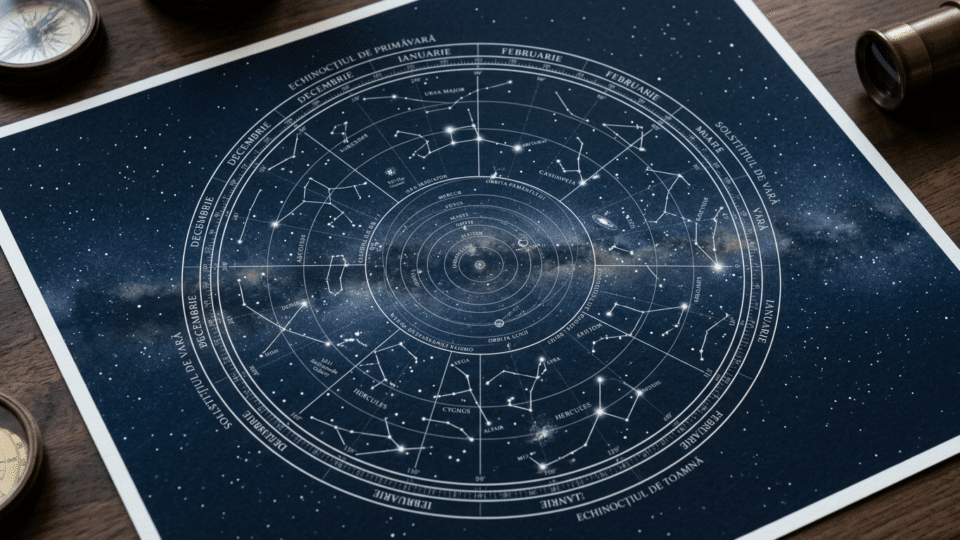
A horoscope for 2027 can be outlined before New Year’s Day without anyone claiming to “know the future”. The dates of an eclipse or an equinox, and the calculated positions of planets, appear in ephemerides long before 1 January. What is added afterwards—the theme of a year, the meaning of a retrograde period or a message for a zodiac sign—belongs to astrological convention and interpretation.
In brief: to read a 2027 horoscope based on transits usefully, begin with the slow, verifiable markers; then move to periods of review and seasonal milestones; and read the section for your zodiac sign as symbolic guidance. Do not turn any general statement into a verdict on health, money, relationships, legal cases or career.
Why the map of 2027 exists before 1 January
The civil year begins on 1 January. An astrological calendar, however, may be organised around several reference points: the daily positions of planets, their apparent changes of direction, lunar phases, eclipses and the beginnings of astronomical seasons. These are dates that can be calculated in advance.
An ephemeris tool such as NASA JPL Horizons can calculate the position and movement of Solar System objects for a defined time and place. In Western astrological practice, tables such as the Swiss Ephemeris for 2027 translate these positions into a format used for signs, transits and other points of interpretation.
It is worth retaining this distinction: a position can be calculated; the personal meaning assigned to it is not an astronomical result. The precision of a table does not demonstrate that a personal event will take place.
Reading an annual chart in four layers
Calendars with dozens of entries can give the impression that every day of the year carries equal weight. For readers who use horoscopes for entertainment and general orientation, order matters more than quantity.
1. Slow transits: the background, not every day’s headline
In astrological language, planets with apparently slower movement are used to establish the background to a period of months or years. A change of sign or a longer phase involving one of these planets may become the collective theme of an annual calendar.
This is the level at which broad questions are worth asking: what do you want to learn, which structure in your life needs updating, which habit no longer works? It is not a basis for concluding that a particular sign will get a job, end a relationship or make money in a specific month.
2. Retrogrades: periods of return, in symbolic language
Astronomically, “retrograde” describes an apparent movement observed from Earth. It does not mean that a planet physically reverses its orbit, nor that devices, conversations or contracts are doomed to fail. The phenomenon is explained in more detail in InfoBuz’s article on Mercury retrograde, between astronomy and myths.
In astrology, retrogrades are often interpreted as periods of review: reread, correct, reopen a conversation or check a plan. Treat this as a prompt to organise, not as a ban on signing documents, travelling or making any decision. An important decision requires information, deadlines and, where appropriate, specialist advice—regardless of the astrological calendar.
3. Eclipses: striking markers without inevitable scenarios
NASA lists two solar eclipses for 2027: an annular eclipse on 6 February and a total eclipse on 2 August. It also lists two penumbral lunar eclipses that year, around 20–21 February and 16–17 August. The dates, types and broad visibility areas can be found in NASA’s Future Eclipses calendar.
An eclipse is a geometric phenomenon visible only from certain regions, not evidence of a compulsory “break” in everyone’s life. In a cautious astrological reading, it can serve as a marker for taking stock: which issue has become visible enough to deserve attention? The answer need not be forced on the day of the eclipse, nor turned into a prophecy.
4. Seasons: simple markers for the year’s rhythm
The equinoxes and solstices provide a structure that is easier to follow than a long sequence of technical aspects. The U.S. Naval Observatory table gives the 2027 spring equinox as 20 March, the summer solstice as 21 June, the autumn equinox as 23 September and the winter solstice as 22 December, in UTC.
In an annual horoscope, these thresholds can be used as moments to reassess: the start of projects and a new rhythm in spring, a review of resources in mid-year, selection and simplification in autumn, followed by closure and planning in winter. This is an editorial and symbolic framework, not a mechanism that determines people’s behaviour.
What is calculated and what is interpreted in a 2027 horoscope
| Element | What can be verified | What remains interpretation | What does not follow from it |
|---|---|---|---|
| Ephemeris | The calculated position of a celestial body at a date and time | Which theme the position might symbolise in an astrological school | A certain personal event |
| Retrograde | The timing of apparent movement and stationing, in the system used | A period suited to review | Guaranteed malfunctions, setbacks or losses |
| Eclipse | Date, type and geographical visibility | A symbolic marker for reflection | Inevitable break-ups, gains or changes |
| Sun-sign horoscope | The conventional date range of a sign in tropical astrology | A general direction for reading | A complete individual natal analysis |
Reading times for Romania without time-zone errors
Many international calendars publish times in UTC. Romania normally uses Eastern European Time: EET, UTC+2, in the winter season, and EEST, UTC+3, during daylight-saving time. For an event close to midnight, conversion can shift the local date by one day.
For more on astrology and astronomy, see The new moon of 9 November 2026: a beginning to test for every sign, which offers complementary details on the subject.
The safest approach is straightforward: first check the time zone stated by the source, then check whether the date falls before or after the seasonal clock change. If two calendars seem to conflict, they may show the same moment in different time zones or use different astrological systems.
- Do not copy a time without its time-zone abbreviation: UTC, EET and EEST are not interchangeable.
- Do not confuse the date of an astronomical phenomenon with the day on which it can be observed in good conditions from Romania.
- Do not treat a difference of a few hours as a difference in “energy”; first check the time standard and calculation method.
Why your Sun sign offers only general guidance
Horoscopes for the 12 signs generally begin with the Sun sign. It is the most accessible format, but it cannot convey the same complexity that astrologers pursue in a natal chart, where the date, time and place of birth are used for the ascendant, houses and the Moon’s position.
To understand the difference in level, see InfoBuz’s guide to your zodiac sign, ascendant and natal Moon. Even in this format, interpretation remains a symbolic practice, not a psychological assessment or a scientifically validated predictive tool.
A 2027 reading routine that does not overwhelm you
A year does not have to be consumed all at once in December. An annual chart is more useful when turned into a calendar of questions rather than a list of rigid expectations.
- Choose two or three slow themes from the astrological calendar you follow. Record them as themes, not verdicts.
- Mark eclipses and seasonal thresholds only as dates for a quarterly review.
- Use retrogrades for specific checks: a document, a conversation, a personal budget or an overly crowded schedule.
- Read your sign’s horoscope after you have considered the context. Keep the idea that helps you frame a better question, and set aside the spectacular promises.
- Separate reflection from high-stakes decisions. For health, investments, loans, documents, litigation or professional changes, rely on data and relevant specialists.
Read this way, 2027 does not become a fixed script. It becomes a calendar with a few verifiable markers and enough room for your own choices. That is probably the most honest way to use an annual horoscope: as a language for reflection and entertainment, not as a substitute for reality.
Frequently asked questions
Can a 2027 horoscope be prepared before New Year’s Day?
Yes, in the sense that astronomical positions, eclipses and the timings of seasons can be calculated in advance. The astrological interpretation of these data remains symbolic, not predictive.
What is an astrological ephemeris?
It is a table of celestial-body positions for specified dates and times, used as a technical basis in astrology. The table can support calendar dates, but it does not prove personal effects.
Why can two astrological calendars show different times for the same event?
The most common explanation is the time zone: one may use UTC and another local time. Differences may also arise where sources use different astrological systems or calculation settings.
Are the 2027 eclipses visible from Romania?
Visibility depends on the type of eclipse, geographical location and local time. NASA’s calendar indicates broad visibility areas; any claim about viewing from Romania must be checked separately for each phenomenon.


Discuția cititorilor
Ai o opinie sau o întrebare despre acest articol? Spune-ne ce crezi.
Fii primul care deschide discuția.
Te rugăm să păstrezi un limbaj civilizat și să discuți la subiect. Comentariile spam sunt filtrate automat.