
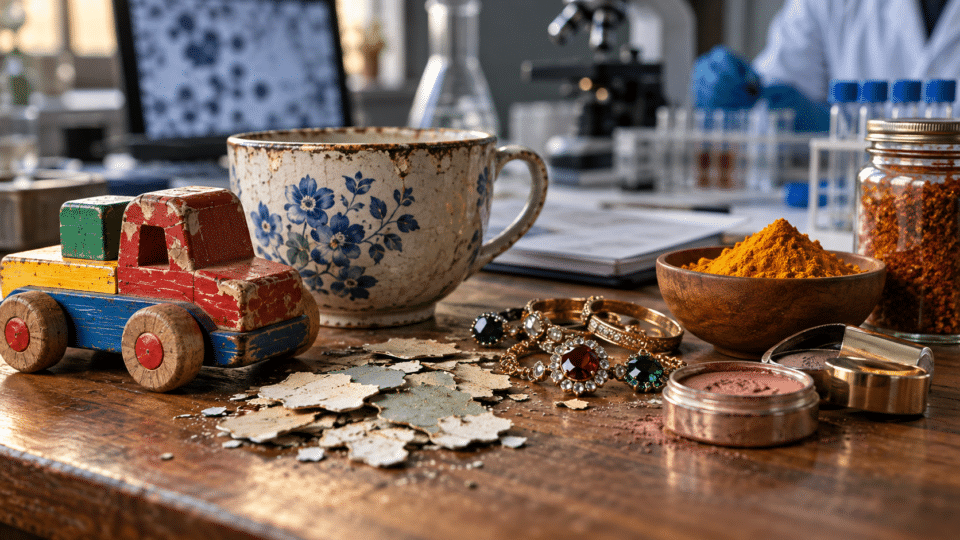
Lead did not disappear with leaded petrol or old paints. It can still be relevant in everyday products and settings: ceramic ware, decorative objects wrongly used for serving food, household water plumbing, spices, cosmetics, dust generated during renovation work, batteries and recycling activities. The fact that an object belongs to one of these categories does not prove that it is contaminated or that it creates dangerous exposure. But its ordinary appearance is no guarantee either.
On 15 October 2026, the World Health Organization called on countries to accelerate the prevention of lead exposure and announced preparations for a global action plan that is expected to be presented to the World Health Assembly in 2027. In its announcement, WHO frames this as a public-health issue: prevention must cover products, homes, water, food, waste and industrial sources, rather than only cases that have already been diagnosed.
For more information on WHO, see Dementia prevention goes beyond lifestyle: what the 2026 WHO guideline changes, which offers complementary details on the subject.
In brief: a product that may contain lead is not automatically dangerous. Risk depends on whether lead can enter food, water, dust or hands, the amount involved and how often exposure occurs. Children are particularly vulnerable, and the absence of symptoms cannot rule out exposure.
Lead in everyday objects: four stages that should not be confused
Public discussion often conflates four separate questions. They need to be distinguished to avoid both alarm and false reassurance.
| Question | What it means in practice | What it does not establish on its own |
|---|---|---|
| Is lead present in the material? | A pigment, glaze, alloy or product may contain lead in its composition. | That lead automatically enters the body. |
| Can it migrate or come off? | Under certain conditions, the metal can pass into food, water or dust. | That exposure is high in every use scenario. |
| Is there exposure? | A person swallows or inhales contaminated particles, or transfers them to their hands and then to their mouth. | That poisoning has already occurred. |
| Is there an effect on health? | This is determined medically, according to the circumstances and any indicated investigations. | That it can be inferred from an object’s appearance or a vague symptom. |
This distinction matters particularly for household products. A decorative mug with a brightly coloured glaze, for example, cannot be declared safe or unsafe from a photograph. What matters is whether it is sold for food contact, whether its origin and labelling are clear, how it is used, and whether there has been testing or an official alert.
Which sources WHO lists, and what this means for a specific product
WHO documents on preventing lead exposure mention paints, ceramics, toys, electronic and mechanical equipment, cookware, spices, traditional medicines, cosmetics, ammunition and batteries. The list describes places where lead may be present or may cause exposure; it is not a list of products consumers should throw away.
In the home, the exposure pathway can differ from one category to another:
- Ceramics and tableware: the relevant issue is migration from the surface into food or drink, particularly when the object is intended for serving. Prolonged contact with acidic foods can create different conditions from an occasionally used plate holding dry foods.
- Tap water: water may meet standards at the point of supply, but internal plumbing, pipes, solder, fittings or the tap may affect the water that actually reaches the glass.
- Paint and dust: risk may arise when old layers are sanded, scraped or deteriorate, and particles are inhaled or get onto hands. Renovation work requires dust-control measures; it does not mean that every painted wall should be assumed to be a source of lead.
- Spices, cosmetics and other products: the pathway depends on the product, its origin, the controls applied and how it is used. The category alone does not support a conclusion about a particular jar or package.
WHO states that lead can affect the nervous, cardiovascular and renal systems, and stresses children’s vulnerability. The organisation’s technical document, however, focuses on preventing exposure and building surveillance capacity, rather than suggesting that people can diagnose the problem themselves from symptoms.
Tableware: the rule concerns migration, not the look of the glaze
In the European Union, food-contact materials must be manufactured so that they do not transfer substances in quantities that could endanger health or bring about an unacceptable change in the composition or characteristics of food. Specific rules on the migration of lead and cadmium apply to ceramic articles.
In Romania, the standard on ceramic articles intended to come into contact with food sets out categories of articles, testing conditions and limits for extracted lead and cadmium. The limits vary according to the type and capacity of the vessel. This explains why simply saying that a vessel “contains lead” is insufficient: the control framework looks at how much can be extracted under standardised conditions, not only at the material’s basic composition.
The rule should not automatically be extended to every ceramic object in a home. A decorative item, souvenir or old piece may not have been marketed for food use. If it has no clear marking of its intended use, manufacturer or traceability, the cautious approach is not to use it for cooking, serving or storing food and drinks until this is clarified.
The European Commission is undertaking a broader review of the rules for food-contact materials. Its page indicates an intention to lower lead and cadmium limits and to consider extending the framework to certain vitreous materials, including glass, crystal and enamelled metals. This is a regulatory process, not evidence that the new limits already apply in Romania. Details are available on the European Commission’s page on the review of the rules.
Tap water: the source and home plumbing are two different things
For water, the relevant question is not only what happens at the treatment plant. In a building, water can remain in pipes and come into contact with plumbing components before reaching the tap. A result for a supply network or area, therefore, does not always by itself answer the question of water in a particular flat.
Under the framework cited in Romanian water-quality documents, the value for lead is 10 micrograms per litre until 31 December 2035 and 5 micrograms per litre from 1 January 2036. These values are regulatory and monitoring benchmarks. They cannot be directly compared with migration limits for ceramics because the units, test methods and exposure scenarios differ.
For readers seeking to understand a test report, the same questions that apply to other substances matter here: the sampling point, date, supply area, laboratory method and limit of quantification. An InfoBuz guide to interpreting tap-water test results explains why a single result without those details may say too little about a specific address.
A realistic check before throwing away a product
Consumers cannot assess lead migration at home by sight. Rapid tests sold online may have important limitations, and a result does not replace laboratory analysis or an official alert. A few questions can nevertheless be useful.
- What is the declared intended use? A decorative object should not be treated as tableware simply because it is shaped like a mug, bowl or plate.
- Is there a manufacturer, importer, batch number or conformity documentation? Lack of traceability does not confirm non-compliance, but it limits the buyer’s ability to check the product or report a problem.
- How is it used? Repeated or prolonged contact with acidic foods is more relevant information than the colour of a glaze.
- Is there an alert, withdrawal or specific concern? In that case, the product should not be used until the matter is clarified, and any report should include photographs of the label, proof of purchase and batch identification, where available.
- Does this concern dust created by renovation work, damaged batteries or recycling? Here, the priority is to limit contact and clean appropriately, not to investigate every decorative object in the home.
In Romania, for a consumer product suspected of non-compliance, identification details and purchase documents may be useful in a complaint to the National Authority for Consumer Protection. The competent inspection authority may differ for food, cosmetics and other categories. A complaint including the product name, batch number, shop and photographs allows for more useful checks than a general suspicion.
When to see a doctor, and why no symptoms do not automatically reassure
Lead exposure cannot be established through self-diagnosis. WHO warns that effects may not be apparent before important consequences emerge, and that children are more vulnerable. This does not mean that tiredness, a headache or any non-specific symptom proves lead poisoning.
A discussion with a doctor is warranted particularly where there is plausible, repeated exposure: work or hobbies involving metals, renovation of a home with deteriorating paint, informal recycling of batteries and electronic waste, or regular use of a product identified in an alert. A doctor can assess the context and, where appropriate, the relevant investigations. Blood lead testing and analysis of an object are different procedures: the first assesses possible exposure in a person, while the second checks the product or material.
For children, pregnant women and people with occupational exposure, the decision should be discussed with a medical professional or occupational health service. A laboratory result should not be interpreted in isolation; the same principle of caution applies to any blood test outside the reference range.
The WHO call is not an immediate ban in Romania
The global plan announced by WHO for 2027 is not, at this point, an adopted measure that automatically introduces new bans for all products sold in Romania. Its role is to guide prevention, surveillance, source control and protection of vulnerable groups.
The practical point is less dramatic but more useful: lead should be investigated where there is a plausible route of contact, not assumed to be present in every ordinary object. For consumers, the strongest signals are a product’s declared intended use, traceability, conditions of use, and a verifiable alert or analysis. For authorities, the challenge remains to turn existing rules into transparent controls and information people can use.
Frequently asked questions
Does this mean all coloured ceramic vessels contain lead?
No. Appearance, colour or the fact that an object is ceramic cannot establish its lead content or whether lead migrates from it. Migration rules apply to tableware intended for food; a decorative object with no clear food-use designation should not be used to serve or store food and drinks.
Can I check lead in water using only a water operator’s report?
The report is useful, but it may not describe the water from the tap in a particular home. Interpretation depends on the area, sampling point and date, as well as the internal plumbing. If there is a specific concern, testing that is properly carried out and interpreted is needed.
If I have no symptoms, can I rule out lead exposure?
No. The absence of symptoms neither confirms nor rules out exposure. At the same time, non-specific symptoms cannot on their own confirm poisoning. If there is plausible, repeated or occupational exposure, discuss the situation with a doctor.
Sources consulted
- World Health Organization — Countries move to accelerate action against lead poisoning
- World Health Organization — Aide-mémoire: For enhanced country action to eliminate lead exposure
- European Commission — Revision of EU rules on food contact materials
- Legislative Portal — Standard on ceramic articles intended to come into contact with food




Discuția cititorilor
Ai o opinie sau o întrebare despre acest articol? Spune-ne ce crezi.
Fii primul care deschide discuția.
Te rugăm să păstrezi un limbaj civilizat și să discuți la subiect. Comentariile spam sunt filtrate automat.