
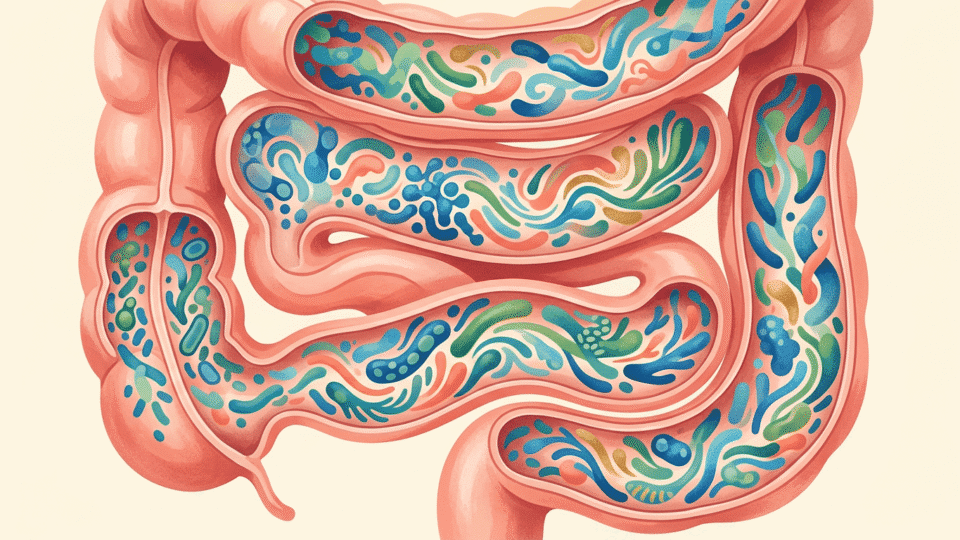
The gut microbiome is the community of microorganisms that live in the digestive tract—mainly bacteria, but also viruses, fungi and other microscopic organisms—together with their genetic material. It is neither a separate organ nor a simple “health score”. It is a personal, changing ecosystem that interacts with food, medicines, the intestinal lining and the immune system.
The key point for anyone experiencing bloating, changes in bowel habits or abdominal discomfort is this: the microbiome may play a role, but it does not automatically explain every symptom. A commercial stool test cannot, by itself, diagnose an “imbalanced gut”, and a probiotic is not a universal solution.
For more information on nutrition, see The importance of vitamins and minerals for health, which provides complementary details on this subject.
Microbiota and microbiome: a small but useful difference
In everyday language, the terms are often used interchangeably. More precisely, microbiota means the microorganisms that live in a particular place, while the microbiome also includes their genes and the context in which they function. In practice, when we refer to the “gut microbiome”, we mean the microbial ecosystem in the gut and its activity.
The microbiome is not made up only of “good bacteria”. Some microorganisms may be harmless in one context but problematic in another; their effect depends on their quantity, their microbial neighbours, diet, a person’s immunity and the condition of the gut. The US National Institute of General Medical Sciences describes the microbiome as all microbes—including bacteria, viruses and fungi—that live in an environment such as the digestive tract. NIGMS’s explanation of the microbiome provides an accessible and accurate definition.
What the gut microbiome actually does
The most accurate image is not that of an “army” fighting for the body, but of a small chemical factory distributed along the gut. Microorganisms use components of food that the human body cannot fully process and produce molecules that can influence the intestinal environment.
- It helps process food. Fibre and other indigestible carbohydrates reach the colon, where certain microorganisms ferment them. Among other things, this process produces short-chain fatty acids, which are involved in the functioning of the intestinal lining.
- It contributes to resistance to pathogens. A stable microbial community can limit the space and resources available to some disease-causing microorganisms.
- It communicates with the immune system. The intestinal immune system and local microorganisms influence each other; this relationship is one of the main areas of research in digestive diseases.
- It may alter how certain substances are metabolised. Studies also examine interactions between the microbiome, nutrients and some medicines, but many findings have not yet translated into personalised recommendations for the public.
These roles are real, but the wording matters: the existence of a link between the microbiome and a disease does not automatically prove that the microbiome causes that disease or that changing a single bacterium will treat it. The NIDDK’s gastrointestinal microbiology research programme illustrates the breadth of these interactions: digestion, immunity, the intestinal barrier, metabolism and infections.
Why there is no “perfect” microbiome
Two healthy people can have quite different microbial compositions. Age, diet, where they live, recent infections, sleep, alcohol, medicines and antibiotic history can all alter the ecosystem. For this reason, a list of bacteria found in a sample cannot automatically be turned into a verdict of “good microbiome” or “bad microbiome”.
The term “dysbiosis” is used to describe a change in the microbial community associated with a disease state or an imbalance. However, it is more a description of an observation than a complete diagnosis. There are currently no universal thresholds stating that a particular abundance of a bacterial species is normal for all adults or that it alone explains a symptom.
An international consensus published in The Lancet Gastroenterology & Hepatology in December 2024 concluded that there is insufficient evidence to broadly recommend routine microbiome testing in medical practice. The expert group also discourages the use of a “dysbiosis index” as a verdict and the reporting of strict reference ranges for species abundance. The consensus document on microbiome testing explains why interpretation remains difficult.
What can change the microbiome and what to remember
The microbiome is not fixed. Dietary changes and exposure to antibiotics are among the best-documented factors. In a controlled study in humans, researchers observed that short-term dietary changes and the administration of vancomycin altered the microbiome, while the antibiotic had a more pronounced effect on microbial diversity. The NIDDK summary of the study also highlights the effect on nutrient absorption.
This does not mean that antibiotics should be avoided when they are needed. They can save lives in bacterial infections. It means they should not be taken for viral infections or “preventively”, without medical advice. Beyond the microbiome issue, unnecessary use contributes to bacterial antibiotic resistance, a subject also explained in InfoBuz’s article on incorrect antibiotic use and the emergence of bacterial resistance.
A varied diet, with individually tolerated sources of fibre—legumes, vegetables, fruit, whole grains, nuts and seeds—provides substrates for microbial activity. However, there is no list of foods that “repairs” the microbiome in a few days. A sudden increase in fibre can temporarily worsen gas or bloating, especially in people with irritable bowel syndrome or digestive sensitivities. A more cautious approach is to increase the amount gradually, with sufficient fluids and attention to individual tolerance. Water needs, moreover, cannot be reduced to the fixed rule of two litres a day; they depend on the person and the context, as explained in InfoBuz’s analysis of adequate hydration.
Stool test, probiotic or routine change? What each can tell you
| Option | What may be useful | What it cannot honestly promise |
|---|---|---|
| Commercial microbiome test | It may describe detected microorganisms and certain characteristics of the sample, if the method and reporting are transparent. | It cannot by itself establish the cause of bloating, provide a universal “health score” or automatically justify a restrictive diet, medicines or supplements. |
| Probiotic | It may have a role in specific indications, for particular strains and formulations evaluated in clinical studies. | It is not equivalent to “restoring the microbiome” and does not work in the same way for all symptoms or all people. |
| A more varied diet, with tolerated fibre | It is a basic measure with broader nutritional benefits that may support microbiota activity. | It does not replace medical assessment when warning signs are present or when a digestive disease has been diagnosed. |
Why a probiotic is not automatically the right choice
“Probiotic” is an umbrella term. Effects cannot be assumed simply because the name of a bacterial genus, such as Lactobacillus or Bifidobacterium, appears on the packaging. The exact strain, combination, dose, condition for which the product is used and quality of the studies supporting it all matter.
The American Gastroenterological Association guideline published in 2020 found that, for most digestive conditions, there is insufficient evidence to recommend routine use of probiotics. For irritable bowel syndrome, Crohn’s disease, ulcerative colitis and Clostridioides difficile infection, the guideline did not find sufficient data for broad treatment recommendations. The AGA’s position on probiotics is useful precisely because it assesses formulations and indications separately, rather than as a single category.
In the European Union, health claims on food labels and in advertising must be clear and supported by scientific evidence. EFSA explains the rules on health claims, including the fact that claimed benefits must be assessed for the specific product or component. For consumers, the practical translation is simple: phrases such as “detox”, “balances the flora” or “heals the gut” are not clinical evidence.
If you plan to buy a supplement, read the label as a document, not as a promise: look for the full strain name, dose, storage conditions and specific indication, not just the word “probiotic”. You can also find useful criteria in InfoBuz’s guide to reading supplement labels.
When a symptom should not be attributed to the microbiome
Bloating, alternating constipation and diarrhoea, or discomfort can have many causes: diet, infections, intolerances, side effects of some medicines, irritable bowel syndrome, inflammatory bowel disease and others. A report on bacteria in stool should not delay medical assessment.
Seek medical advice if symptoms are new and persistent, worsen, or affect your diet and weight. Assessment becomes more urgent in the event of blood in the stool, black stools, persistent fever, repeated vomiting, dehydration, severe abdominal pain, waking at night because of symptoms, or unintentional weight loss. For guidance on symptoms that should not be ignored, see InfoBuz’s article on situations that require calling 112 or prompt assessment.
The main point to remember
The gut microbiome matters, but it should not be turned into a universal explanation or a market for quick fixes. For most people, the soundest decisions remain the basics: a varied diet, gradually increasing fibre if it is tolerated, antibiotics only on a doctor’s recommendation, and investigation of persistent symptoms. Microbiome science is advancing quickly; personalised medicine based on a simple stool test has not yet reached the point where it can replace this cautious approach.
Frequently asked questions
Is the gut microbiome the same as gut flora?
“Gut flora” is a popular term for the microorganisms in the gut. “Microbiota” refers to these microorganisms, while “microbiome” may also include their genes and the environment in which they interact.
Can a microbiome test tell me why I am bloated?
Not reliably. Tests may describe a sample, but they are not validated as a routine tool for identifying the cause of bloating or automatically selecting a treatment. Persistent symptoms should be discussed with a doctor.
Do antibiotics destroy the gut microbiome?
Antibiotics can significantly alter the microbial community, especially broad-spectrum antibiotics, but they are essential when treating a medically indicated bacterial infection. The problem is unnecessary use, not correctly prescribed treatment.
Should I take a probiotic after every antibiotic?
There is no universal recommendation for every person and every antibiotic. Potential benefits depend on the product, strain, dose and clinical situation. A pharmacist or doctor can help assess the individual case.




Discuția cititorilor
Ai o opinie sau o întrebare despre acest articol? Spune-ne ce crezi.
Fii primul care deschide discuția.
Te rugăm să păstrezi un limbaj civilizat și să discuți la subiect. Comentariile spam sunt filtrate automat.