
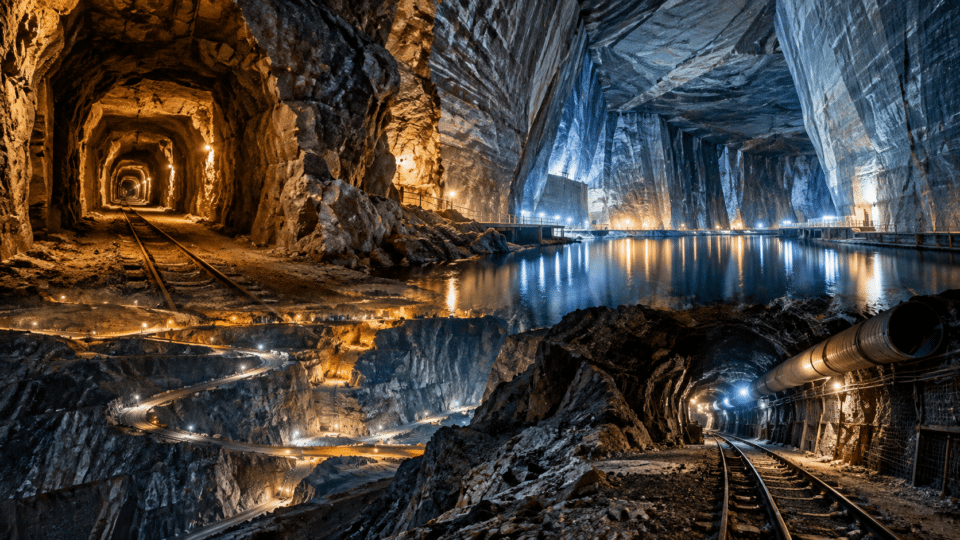
Romania underground conceals a world invisible from the surface: Roman galleries carved into mountains, salt mines transformed into vast spaces, industrial mines, shafts, extraction chambers, and abandoned or repurposed technical infrastructure. While the first instalment of the “Romania Beneath the Asphalt” series explored shelters, tunnels and urban infrastructure, this second part goes deeper—into the mines, salt mines and galleries that tell the story of a country built and exploited vertically as well.
For more information on Romania’s underground world, see Romania Beneath the Asphalt: Tunnels, Shelters and Hidden Structures Few People Know About, which provides complementary details on this subject.
Some of these places are now tourist attractions. Others can be visited only in part. And some remain inaccessible to the public, either for safety reasons or because they are part of industrial infrastructure or protected sites.
1. Romania underground at Roșia Montană: one of the world’s most spectacular ancient mining networks
Roșia Montană is more than a symbol of gold mining in Romania. UNESCO describes the site as the most significant, extensive and technically diverse underground Roman gold-mining complex known at the time of its inscription on the World Heritage List.
More than 7 kilometres of Roman mining works have been identified in the Cârnic, Lety, Orlea and Cetate massifs. These are not simply galleries, but a complex system for extraction, ventilation, transport and drainage.
Some galleries have a trapezoidal cross-section; others are connected by shafts, rock-cut stairways and technical chambers. UNESCO also mentions water-removal systems using waterwheels, a remarkable technology for the Roman period.
2. Romania’s salt mines are true underground volumes, not simply “caves”
Salt extraction has created some of Romania’s largest human-made underground spaces. At Slănic Prahova, Târgu Ocna, Cacica, Turda and Praid, mining has left behind galleries, shafts and extraction chambers whose scale is difficult to grasp from the surface.
A visitor usually sees only an adapted and secured area. Yet beyond the public routes, there are—or have been—technical sectors, access galleries, installations, extraction areas and spaces not intended for visitors.
3. Slănic Salt Mine and Unirea Mine: a “cathedral” carved from salt
At Slănic Prahova, Unirea Mine is one of Romania’s most spectacular salt operations. Its chambers have monumental proportions, and the geometry of the walls makes the space resemble an underground structure more than a traditional mine.
This type of operation demonstrates how different the underground can look from the surface. Above lies an ordinary town; below, huge volumes have been excavated from salt over the decades.
4. Târgu Ocna: mining, tourism and repurposed underground spaces
At Târgu Ocna, the history of salt extraction has produced an underground system in which some areas have been adapted for visits and recreational activities. It is one of the best examples of industrial infrastructure being transformed into a controlled public space.
But what visitors see represents only part of the whole. As in many mining operations, there is a major difference between the tourist route and the mine’s actual technical infrastructure.
5. Cacica: an old operation that retains the atmosphere of traditional mining
Cacica Salt Mine has a different identity from the large modernised tourist mines. Its galleries and spaces retain more of the atmosphere of earlier operations, with narrow routes, stairways and chambers carved from salt.
Such places matter precisely because they show how mining worked before large-scale mechanisation and how local communities developed around access to underground resources.
6. Coal mines: vast underground industrial networks
The Jiu Valley is probably Romania’s best-known example of underground industrial mining infrastructure. Coal operations involved transport galleries, shafts, ventilation, drainage, electrical installations, access lines and hoisting systems.
As mines were closed or restructured, part of this infrastructure became inaccessible or was placed under preservation. For obvious safety reasons, such areas should not be confused with freely accessible tourist attractions.
7. Petrila: from active mine to industrial heritage
Petrila Mine is one of the symbols of the transformation of Romania’s mining industry. After the operation closed, part of its surface complex became associated with industrial heritage and cultural projects.
Underground, however, is an entirely different world. Old mining networks are not spaces for unauthorised exploration. Ventilation, gases, water, ground subsidence and deteriorating structures make uncontrolled access extremely dangerous.
8. The Apuseni Mountains have been crossed by mining galleries for centuries
Roșia Montană is the best-known example, but it is not the only one. The Apuseni Mountains have a long history of gold, silver and non-ferrous metal extraction. In many areas, traces remain of old galleries, spoil heaps and mining works from different historical periods.
Some entrances have been sealed, while others have deteriorated or become part of protected sites. The romantic idea of “exploring an abandoned mine” conceals real risks: lack of oxygen, gases, collapses and hidden vertical shafts.
9. There is also technical infrastructure underground that the public never sees
Mines and salt mines are not just extraction galleries. An underground operation may include pumping stations, ventilation galleries, storage areas, electrical installations, drainage systems, technical chambers and transport routes.
In modern operations, much of the infrastructure is designed for operation and safety, not for visits. This is why the public image of a mine is almost always far simpler than its technical reality.
10. What does an “underground city” actually mean?
The expression is striking, but it should be used carefully. Romania does not have, in the strict sense, complete cities permanently inhabited underground. It does, however, have mining spaces so large and complex that, viewed as infrastructure, they can resemble genuine urban networks: internal roads, chambers, access nodes and installations.
That is the difference between reality and legend: the scale can be impressive without inventing stories about secret metropolises.
11. Why some galleries are closed to the public
- risk of collapse or falling rock;
- insufficient ventilation;
- gas accumulations;
- unprotected vertical shafts;
- flooding and seepage;
- old installations or deteriorated structures;
- protection of archaeological sites;
- industrial infrastructure that is still active or under preservation.
Entering an abandoned mine without authorisation and specialist equipment is not the same as exploring an abandoned building. The underground environment can become dangerous without visible warning signs at the entrance.
12. Roșia Montană shows how old “underground Romania” is
Perhaps the most important thing shown by the galleries at Roșia Montană is continuity. Underground extraction is not merely a story of modern industry. Some of these works are almost two millennia old.
UNESCO describes the Roman complex here as exceptional for the diversity of its extraction and drainage techniques. The fact that galleries nearly 2,000 years old can still be studied today makes the site a technical document, not merely an archaeological one.
Conclusion: Romania beneath the ground is larger than it seems
Romania’s mines, salt mines and galleries form hidden infrastructure that most of us see only in fragments. From the Roman works at Roșia Montană to the vast salt chambers and the industrial networks of the Jiu Valley, the country’s underground preserves traces of several technological eras.
And this is precisely the fascinating part: no myths are needed to make this world spectacular. The engineering and historical reality is impressive enough.
Documentary sources: UNESCO World Heritage Centre – Roșia Montană Mining Landscape, public documents on mining heritage, and official/tourist sources from salt-mining operations. For inactive mining areas, this article does not recommend unauthorised access.


Discuția cititorilor
Ai o opinie sau o întrebare despre acest articol? Spune-ne ce crezi.
Fii primul care deschide discuția.
Te rugăm să păstrezi un limbaj civilizat și să discuți la subiect. Comentariile spam sunt filtrate automat.