
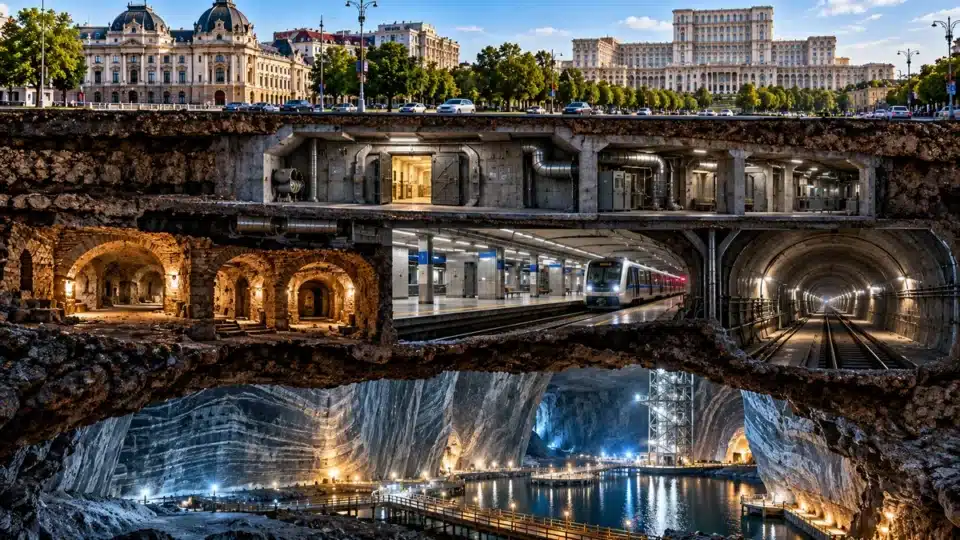
Beneath Romania’s major cities and among its mountains lies a second map of the country—a true Romania beneath the asphalt, one that cannot be seen from a car, train or street. It consists of civil-defence shelters, mining galleries, railway tunnels, technical shafts, underground infrastructure and spaces built in different eras for purposes ranging from defence to transport and resource extraction.
Some of these structures are thoroughly documented. Others have been altered, abandoned or forgotten. And, inevitably, urban legends have emerged around a few of them. That is precisely why the story of “Romania beneath the asphalt” becomes more interesting when we separate what is known for certain from what is merely said.
For further information, see Beneath the Black Sea lies an oxygen-free “vault”: why wooden shipwrecks can survive for millennia, an article that explores an aspect directly related to this subject.
1. Bucharest has a real network of civil-defence shelters
Romania’s capital has hundreds of spaces fitted out or designed to protect the population in emergencies. The Bucharest Territorial Public Order Authority publishes a register of civil-defence shelters, while legislation clearly defines their role: protecting the population, material assets and cultural property during military hostilities and certain emergency situations.
These shelters are not “secret bunkers” in the cinematic sense of the term. Many are located in the basements of apartment blocks and public buildings, marked with the civil-defence symbol—a blue triangle on an orange background. Yet for most Bucharest residents, their existence remains almost invisible in everyday life.
The paradox is that some of the city’s most important underground infrastructure is also its least noticed: we see it only when we need it.
For context on the current role of civil protection, see InfoBuz’s analysis of the EU Civil Protection Mechanism and the role of IGSU. In 2026, the legal framework was expanded so that local authorities could, at the request of homeowners’ associations, fund repairs and maintenance for private civil-defence shelters in apartment buildings. The measure shows that these spaces are not Cold War relics, but still form part of today’s civil-protection system.
2. Bucharest’s “secret” tunnels: where history ends and legend begins
Bucharest is probably the Romanian city with the greatest number of stories about hidden tunnels. There are accounts of galleries linking official buildings, former residences of the communist nomenklatura or strategic locations. Some of these stories were amplified after 1989 and repeated over the years.
There are, however, far simpler explanations for many of the underground spaces discovered in the city’s old quarter. Historians have documented the existence of very large wine cellars and basements belonging to boyar houses, sometimes extended through passageways and galleries. Over time, such structures can easily be reinterpreted as “secret tunnels”.
That does not mean Bucharest has no strategic underground infrastructure—it does. It simply means that not every old gallery is automatically part of a mysterious network. In a serious article, the distinction between documentation and legend matters.
3. The metro is, in fact, the capital’s largest visible underground system
When discussing underground Bucharest, the most obvious example is the metro itself. Tens of kilometres of tunnels, stations, technical galleries, ventilation spaces, electrical installations and service connections make up an infrastructure used by millions of passengers, who see only a small part of it.
Behind a station’s walls are technical corridors, ventilation rooms, power-supply equipment, communications spaces and areas accessible only to authorised personnel. They are not “secret”; they are simply critical infrastructure. This distinction explains why many stories about “hidden rooms” begin with a technical reality and, over time, turn into urban mythology.
4. Beneath the mountains: Romania has nearly 200 railway tunnels
Romania’s underground landscape is not limited to cities. The National Railway Company CFR currently lists 188 railway tunnels, with a total length of approximately 64 kilometres on the public network.
Some are old structures, built at a time when railway routes had to be carved through difficult terrain using the technology available at the time. Others are being modernised or are currently under construction as part of European corridors.
- Bata Tunnel, opened on the new Bârzava–Vărădia route, is 603 metres long.
- Mureni Tunnel, on the Brașov–Sighișoara line, has a total length of approximately 740 metres and was broken through in 2025.
- On the Drobeta Turnu Severin–Caransebeș line, rehabilitation works and new tunnel construction are planned, including Poarta I, Poarta II and Poarta III.
Seen this way, underground Romania is not just history. It is continuing to expand today.
5. Turda Salt Mine: a mine, an air-raid shelter, then a tourist attraction
Few places illustrate the changing role of an underground structure better than Turda Salt Mine. The Franz Josef Gallery was built in the 19th century to transport salt. By the end of the century, the gallery was approximately 917 metres long.
According to the official history of Turda Salt Mine, after mining operations ceased, the underground spaces took on a completely different function: during the Second World War, the salt mine was used as an air-raid shelter for the town’s population.
Later, part of the gallery was used for storage, and from the 1990s the salt mine was reopened to the public and gradually transformed into one of Romania’s most spectacular underground tourist attractions.
There is also an impressive detail: the extraction shaft linking the Franz Josef Gallery to Rudolf Mine is approximately 87 metres deep. It was part of a system through which salt was lifted and transferred to surface transport.
6. Salt mines show just how vast underground Romania is
Turda is not the only example. Salt operations at Praid, Slănic Prahova, Târgu Ocna and Cacica have created huge underground volumes that are impossible to grasp from the surface. Some galleries are open to visitors; others belong to technical or operational areas and are not accessible to tourists.
Perhaps this is where the difference between what actually exists and what the public can see is most evident. A tourist attraction represents only a controlled part of a much larger mining system.
7. What else lies beneath cities, unnoticed?
Beneath a modern city there is far more than a metro system and shelters. There are sewer collectors of impressive diameter, technical galleries, trunk pipelines, electricity networks, telecommunications infrastructure, underground car parks, underpasses, reservoirs and old foundations over which the modern city has continued to grow.
These structures form a parallel infrastructure, invisible at street level. Sometimes, major works reveal forgotten walls, cellars or foundations. At other times, new infrastructure is built among elements that have existed for decades or even centuries.
8. Why does the idea of an “underground Romania” fascinate us so much?
There is a simple reason: what we cannot see leaves room for the imagination. A metal door in a basement, a closed gallery or an unexplained technical entrance is enough to create a story.
But in many cases, reality is more interesting than legend. Romania has underground infrastructure built in completely different historical periods: 19th-century mining galleries, 20th-century civil-defence shelters, historic railway tunnels and new tunnels designed for trains travelling at 160 km/h.
9. What is confirmed, and what should be treated with caution
| Claim | Status |
|---|---|
| Civil-defence shelters exist beneath apartment blocks and public buildings | Officially confirmed |
| Turda Salt Mine was used as an air-raid shelter | Confirmed |
| Romania has nearly 200 railway tunnels | Confirmed by CFR |
| There are galleries and technical spaces not accessible to the public within urban infrastructure | Normal for critical infrastructure |
| All old tunnels in Bucharest are part of one secret network | Unproven |
| A complete Bucharest evacuation network known only to the authorities exists | There is insufficient public evidence |
Conclusion: Romania literally has a second world beneath its feet
Underground Romania does not need spectacular theories to be fascinating. The railway network alone includes tens of kilometres of tunnels. Bucharest has genuine civil-protection infrastructure. Salt mines conceal galleries and shafts that descend dozens of metres, and some of them protected the population during the war.
Beneath asphalt, apartment blocks and mountains lies a layer of history and engineering that we rarely notice. And, paradoxically, the fact that much of it is not publicly accessible makes it all the more compelling.
Documentary sources incorporated: the General Inspectorate for Emergency Situations and civil-protection legislation, Bucharest City Hall/ATOP Bucharest, CFR SA and Turda Salt Mine. For claims about alleged secret networks, we have maintained a clear distinction between documented information and accounts without official confirmation.


Discuția cititorilor
Ai o opinie sau o întrebare despre acest articol? Spune-ne ce crezi.
Fii primul care deschide discuția.
Te rugăm să păstrezi un limbaj civilizat și să discuți la subiect. Comentariile spam sunt filtrate automat.